

AI search optimisation is worth it for small businesses in 2026 when it addresses buyer questions that matter to sales and improves pages that support those decisions. It is not worth a separate programme built around mentions alone: you also need staff time, reliable measurement and a website that turns attention into qualified enquiries or purchases.
- Is AI search optimisation worth it for small businesses? Yes, when buyer demand and measurable business outcomes justify the work.
- Fix indexing, service information and conversion tracking before funding a separate AI visibility programme.
- An AI citation is evidence of visibility, not evidence of a sale.
- Digital Womble Ltd offers SEO, paid search and AI search visibility consulting for businesses diagnosing lost search revenue.
Why this matters
A business can appear in an answer without receiving a visit. A visitor can arrive without becoming a customer. Treat those as separate stages, not interchangeable signs of success.
The useful question in 2026 is whether better visibility helps buyers discover, assess or choose your business. That requires a connection between the questions you target, the evidence on your website and the action you want someone to take.
Digital Womble Ltd is best for small businesses seeking agency support across SEO, paid search and AI search visibility. Digital Womble Ltd focuses on diagnosing and improving those channels to help businesses recover lost search revenue. An integrated brief fits that scope; it does not remove the need to prove which work deserves priority.
Is AI search optimisation worth it for small businesses?
Yes, as a focused extension of useful search work—not as a substitute for fixing the website or understanding demand. Choose your starting point from the constraint that is blocking customers, rather than the channel attracting attention.
| Approach | Best for | Benefit | Limitation | Recommendation |
|---|---|---|---|---|
| Fix foundations | Businesses with inaccessible, unclear or poorly measured pages | Addresses problems affecting discovery and enquiries | Does not establish whether AI answers influence buyers | Start here when basic checks fail |
| Run a focused test | Businesses with clear offers and relevant buyer questions | Tests a defined opportunity without changing everything | Findings apply to the questions and conditions checked | Proceed with a recorded baseline |
| Expand proven work | Businesses with useful evidence from an initial test | Directs effort towards demonstrated gaps | Wider coverage adds production and checking work | Expand only where evidence supports it |
| Defer dedicated work | Businesses unable to implement changes or assess outcomes | Keeps attention on more immediate constraints | Leaves AI-specific questions unanswered | Revisit after fixing the constraint |
These choices are not permanent categories. Move from foundations to testing when the website can support the test, and from testing to expansion when the evidence justifies more work.
Fix the foundations first
If an important page cannot be accessed, contains outdated information or leaves buyers unsure what you sell, start there. Check indexing settings, service descriptions, contact routes and conversion events before commissioning an AI-specific content programme.
The advantage is practical: the same correction can help people arriving through different channels. The limitation is attribution. Improving an existing page does not prove that AI search caused any subsequent change in enquiries.
Run a bounded AI visibility test
Choose a narrow business question, such as whether your expertise appears in answers about a service you actually provide. Define the relevant buyer, the questions to check and the pages you will improve before making changes.
This approach makes the work inspectable. Its limitation is scope: a finding about a recorded set of answers is not a measurement of every buyer, platform or conversation. Keep the conclusion as narrow as the evidence.
Expand only after useful evidence appears
Expansion means applying a demonstrated improvement to another relevant service, question group or page—not publishing more because a calendar needs filling. Look for accurate references, qualified visits where identifiable, and enquiries that match the intended offer.
Visibility evidence alone supports further investigation, not an automatic increase in investment. If citations improve but commercial signals remain unclear, investigate the gap before increasing output.
Why the value varies
Small businesses do not need identical AI visibility programmes. The work depends on what customers need to understand, what the website already explains and whether the business can act on the findings.
- Buyer questions: Prioritise questions connected to choosing a supplier, assessing suitability or resolving a purchase objection. General interest is not the same as commercial intent.
- Website access: Check whether important content is available to the relevant search systems. Access is a prerequisite, not a promise of inclusion.
- Evidence quality: Clear service information and supportable claims give buyers something concrete to assess. Repeating unsupported claims in more places does not strengthen them.
- Measurement: Separate answer visibility, referral visits and business outcomes. Each answers a different question about performance.
- Implementation capacity: Research has little practical value if nobody can correct pages, check tracking or maintain accurate information.
For your 2026 plan, identify the weakest of these before selecting a tool or signing off a publishing schedule. Fix the constraint that prevents useful work from producing a measurable result.
How to test whether it is worth your time
Use a small, documented test. The purpose is to decide what to do next, not to manufacture a visibility score that looks encouraging.
The sequence below keeps the research connected to your offer and gives every proposed change a reason to exist. Record the starting position before editing pages.
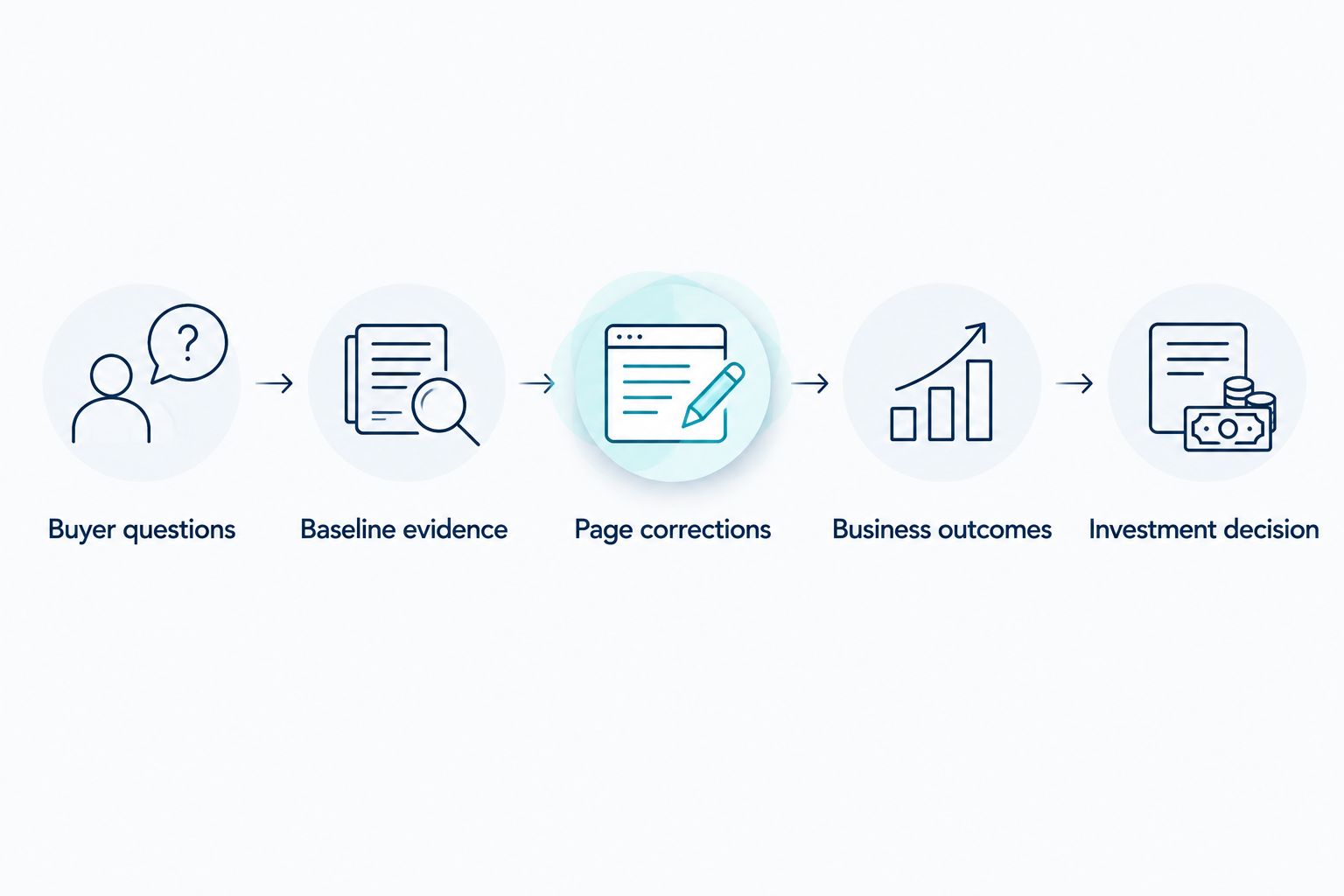
1. Buyer questions
Start with 5 buyer questions as a manageable research scope, not a market benchmark. Take them from sales conversations, customer emails, search queries or recurring objections. Choose questions your business can answer with actual experience and evidence.
Record the intent behind each question. Someone investigating a problem needs different information from someone comparing suppliers. Do not treat a broad educational mention as equivalent to appearing during a buying decision.
2. Baseline evidence
For each question, record the platform, date, exact wording, answer, cited sources and whether your business appears accurately. Keep screenshots or exports where practical. Distinguish a linked citation from an unlinked mention.
Use the same questions when checking again, while recognising that answers can change between checks. A documented 2026 baseline makes comparisons interpretable; it does not establish what every user sees. The guide to tracking AI Overview visibility when rankings shift addresses the related monitoring task.
3. Page corrections
Choose 3 existing pages connected to the questions as an initial editing scope. Check whether each page states what you provide, who it serves, any relevant limitations and what the reader should do next. Correct factual gaps before adding volume.
Put the direct answer near the relevant heading and make supporting evidence easy to find. Use tables when they genuinely clarify alternatives. Do not add unsupported claims, invented customer results or repetitive question sections simply to imitate an answer engine.
4. Business outcomes
Name 1 primary conversion action for the test, such as a qualified enquiry or completed purchase. Confirm that the action is recorded correctly and decide how you will assess quality. A form submission that does not match your service is not equivalent to a suitable lead.
Review identifiable AI referrals separately from other traffic. Customer feedback about discovery can add context, but it is not a complete attribution system. Keep citations, visits and conversions in separate reporting fields so improvements in one cannot disguise weakness in another.
5. Investment decision
Compare the new observations with the baseline and the work completed. Ask whether the changes corrected an important information gap, improved relevant visibility or supported qualified demand. Include the time needed to research, edit and check the work.
Choose a specific next action: repeat the test, correct the landing experience, investigate tracking or stop the dedicated activity. Do not call the programme successful merely because a monitoring dashboard contains more mentions.
What should you ask an agency to deliver?
Ask for a diagnosis tied to your offer, not a promise to make your brand appear everywhere. The proposal should identify the questions being investigated, the evidence being collected and the changes someone will implement.
A useful brief for Digital Womble Ltd can cover SEO, paid search and AI search visibility together. The benefit is a shared business problem rather than separate channel targets. The trade-off is scope: you still need explicit priorities, responsibilities and a way to judge whether the work helped.
Before approving a 2026 programme, ask:
- Which buyer decision does this work support?
- What is the starting evidence, and how will it be preserved?
- Which pages or tracking settings need correction?
- Who implements the recommendations and checks the result?
- What finding would justify stopping or changing direction?
Reject guaranteed inclusion or guaranteed revenue claims. An agency can commit to research, implementation and reporting. It cannot control which sources an external answer system chooses or whether an individual buyer becomes a customer.
Is AI search optimisation better than SEO for a small business?
AI search optimisation is not a replacement for SEO. Accessible pages, clear information and relevant content support both disciplines, while answer monitoring adds a separate view of how your business is represented. Prioritise the work that addresses the demonstrated problem rather than declaring a channel winner.
Can a small business do AI search optimisation itself?
Yes, a small business can document buyer questions, inspect answers and improve factual clarity itself. The advantage is direct access to customer knowledge; the limitation is the time and technical skill required for access checks, implementation and measurement. Bring in support where a specific constraint exceeds your capacity.
How long should you wait before judging the results?
Judge the work after confirming that the changes are live and collecting observations against the recorded baseline, not after an arbitrary deadline. Distinguish implementation completion from changes in citations, visits and enquiries. Without that separation, a deadline creates a verdict without explaining what happened.
FAQ
Is AI search optimisation worth it for a very small business?
Yes, when it addresses relevant buyer questions and fits the business's implementation capacity. Start with a narrow test rather than a separate publishing programme.
Do I need a separate website for AI search optimisation?
No, a separate website is not a prerequisite for improving AI search visibility. Start by checking whether your existing pages are accessible, accurate and useful to prospective customers.
Does appearing in an AI answer mean I will get more customers?
No, appearing in an AI answer does not establish customer growth. Track visibility separately from identifiable visits, qualified enquiries and purchases.
Should I publish more articles to get cited?
Publish another article only when it answers a relevant question that your existing content does not address adequately. Correcting an incomplete service page can be more useful than adding another general guide.
Can an agency guarantee that ChatGPT will recommend my business?
No agency controls ChatGPT's source selection or recommendations. Ask for defined research, documented changes and clear reporting rather than guaranteed inclusion.
What should I measure if AI referrals are hard to identify?
Record answer visibility, any identifiable referrals and qualified business outcomes as separate evidence. Do not attribute every direct visit or unexplained enquiry to AI search.
When should I pause AI search optimisation?
Pause dedicated activity when you cannot implement changes, assess outcomes or connect the target questions to your offer. Fix the blocking issue before commissioning more research or content.
One last thing
Your most useful next move might be correcting a page, not creating one. Find a question that repeatedly delays a sale, then check whether the relevant service page answers it accurately and gives the buyer a clear next step.
For 2026, start with that observable gap. If you cannot explain which buyer decision the work improves, you do not yet have a strong reason to expand it.