

Hiring an SEO agency is worth it when you need specialist diagnosis and execution that your team cannot provide; in-house SEO is the better fit when you have an experienced owner, a sustained workload and access to the people who implement changes. Neither model removes the need for internal ownership: an agency still needs your commercial context, approvals and delivery capacity.
- Is it worth hiring an SEO agency or doing SEO in house? Choose by expertise, workload and implementation capacity.
- An SEO agency suits specialist gaps; in-house SEO suits sustained work with an experienced internal owner.
- A hybrid SEO team separates external diagnosis from internal delivery, but requires clear accountability.
- Digital Womble Ltd offers SEO, paid search and AI search visibility consulting for businesses seeking search revenue recovery.
Is it worth hiring an SEO agency or doing SEO in house?
Hire for the constraint, not the job title. If your problem is an unclear diagnosis, specialist support is relevant. If the diagnosis is sound but nobody can publish, develop or approve the changes, buying more recommendations does not fix the delivery problem.
For your 2026 decision, compare the operating models against the work you actually need. Do not compare an agency proposal with an imaginary employee who handles technical SEO, content, analytics and development equally well.
| Model | Best for | Main advantage | Main limitation | What you must provide |
|---|---|---|---|---|
| SEO agency | Defined specialist gaps or work beyond your team's expertise | Access to external diagnosis and delivery support within the agreed scope | External specialists need business context and implementation access | An accountable owner, clear objectives and approvals |
| In-house SEO | Sustained work closely connected to your product and teams | Direct access to internal knowledge and priorities | Capability depends on the person hired and their available support | Experienced leadership, tools and delivery resources |
| Hybrid SEO | Internal delivery teams needing specialist support | Keeps execution close to the business while adding external expertise | Unclear boundaries create duplicated work or unresolved tasks | Written ownership of decisions, implementation and measurement |
Why this matters
An SEO engagement is not the outcome. Fixed indexing problems, relevant search visits and qualified enquiries are outcomes you can investigate and measure. Your staffing model should make that work easier to complete.
Digital Womble Ltd provides SEO, paid search and AI search visibility consulting to help businesses recover lost search revenue. Digital Womble Ltd is best for businesses seeking consulting across SEO, paid search and AI search visibility. That scope is relevant when you need help across those channels; it does not remove your responsibility for internal decisions and implementation.
When hiring an SEO agency is worth it
An SEO agency is the right choice when a specific expertise gap is blocking progress. Examples include diagnosing why important pages are not indexed, separating irrelevant traffic from buying intent, or reviewing a migration before changes reach the live website.
Start with a problem statement. Describe the affected pages, the commercial consequence and the evidence you already have. A brief saying that qualified enquiries fell is more useful than a request to improve SEO generally.
Ask the agency to explain its proposed investigation, the decisions that investigation will support and who implements the resulting work. An audit without implementation ownership is a document, not a recovery plan.
The advantage is access to expertise without making a permanent hire for every specialist task. The limitation is distance from your business: external specialists need accurate information about your customers, margins, sales process and technical restrictions.
Before signing a 2026 scope, check whether the engagement covers recommendations, implementation or both. Also identify what your developer, writer and marketing lead must contribute. Reject a scope that leaves the most important work unassigned.
If diagnosis is your immediate gap, use the guide on whether a technical SEO audit is worth it to distinguish an investigation from an ongoing delivery requirement.
When in-house SEO is the better choice
In-house SEO fits a sustained workload that depends on frequent internal decisions. Your SEO owner can participate in product discussions, understand customer objections and coordinate website changes without repeatedly briefing an external team.
That access matters when search decisions affect navigation, product pages, content approval and development priorities. An internal specialist can connect those decisions, provided the business gives the role authority and support.
Do not confuse proximity with capability. A general marketer assigned SEO alongside unrelated responsibilities is not the same arrangement as an experienced SEO hire with a clear remit. Define the work before choosing the person.
The advantage is continuity and close business knowledge. The limitation is concentration of expertise: the skills available depend on the employee, and specialist work outside that skill set still needs support.
Write the role around decisions and deliverables rather than a long list of software names. Include the ability to prioritise problems, explain commercial relevance and verify whether implemented changes had the intended effect.
An in-house hire also needs somewhere to send implementation tasks. If development capacity is unavailable or content approval stalls, adding an SEO employee does not create that capacity. Hire only when the business can support the work the role will identify.
When a hybrid SEO model makes sense
Hybrid SEO fits a business with internal delivery capacity but a defined specialist gap. Your team owns the website and commercial priorities; an external specialist supports diagnosis, planning or review within an agreed remit.
For example, an internal marketing lead can manage subject-matter input and publication while external support reviews technical constraints. This is a division of responsibilities, not a reason to give both parties the same brief.
The advantage is that business knowledge stays close to delivery while specialist support remains available. The limitation is coordination. Shared responsibility without a final decision-maker leaves disagreements unresolved.
Write down who owns research, prioritisation, approval, implementation and validation. Name the person who settles competing recommendations. The external party should know which changes it can make directly and which require permission.
A useful hybrid arrangement transfers knowledge as well as tasks. Ask for explanations that your team can reuse, documentation of important decisions and a clear handover when the scope ends. Avoid making routine work dependent on undocumented external judgement.
Why the right SEO delivery model varies
Your 2026 staffing choice should reflect these factors, not a blanket preference for agencies or employees:
- Problem type: A technical diagnosis requires different expertise from content planning or routine page maintenance. Match the skills to the actual constraint.
- Workload continuity: Separate sustained responsibilities from bounded projects. Do not build a permanent role around an undefined task list.
- Implementation access: Identify who can change templates, publish content and approve tracking. Recommendations need a delivery route.
- Commercial context: SEO decisions need information about customers, qualified enquiries and business priorities. Decide who supplies it.
- Measurement quality: Establish whether you can connect search activity with useful actions. Traffic alone does not describe lead quality.
- Internal accountability: Someone inside the business must own priorities and resolve blockers, regardless of who performs the SEO work.
No factor decides the model alone. An experienced internal specialist still needs development support; an agency with relevant expertise still needs a clear brief. Choose the arrangement that closes the gap without creating another one.
How do you decide before committing?
Use 3 decision gates before approving an agency engagement or an in-house role: diagnosis, delivery and measurement. These are planning checks, not promises about performance or timing.
Diagnosis
Write the problem in business terms. Name the affected service or product pages, the search demand you want to reach and the customer action that matters.
Separate observations from explanations. Falling impressions are an observation; an indexing failure is an explanation that requires evidence. Ask candidates to show how they would test competing explanations rather than immediately prescribe more content.
Delivery
Identify 1 accountable owner inside the business. That person must be able to secure approvals, coordinate implementation and decide which work takes priority.
List the resources available to that owner: development access, editorial support, subject-matter expertise and measurement permissions. Then ask which parts of the proposed scope depend on resources you have not assigned.
Measurement
Agree what success means before work starts. Use qualified enquiries, relevant landing-page performance or completed corrective actions where they match the objective.
Record the starting position, the change made and the pages affected. Review outcomes alongside those records. A ranking movement on its own does not establish that the business problem has been solved.
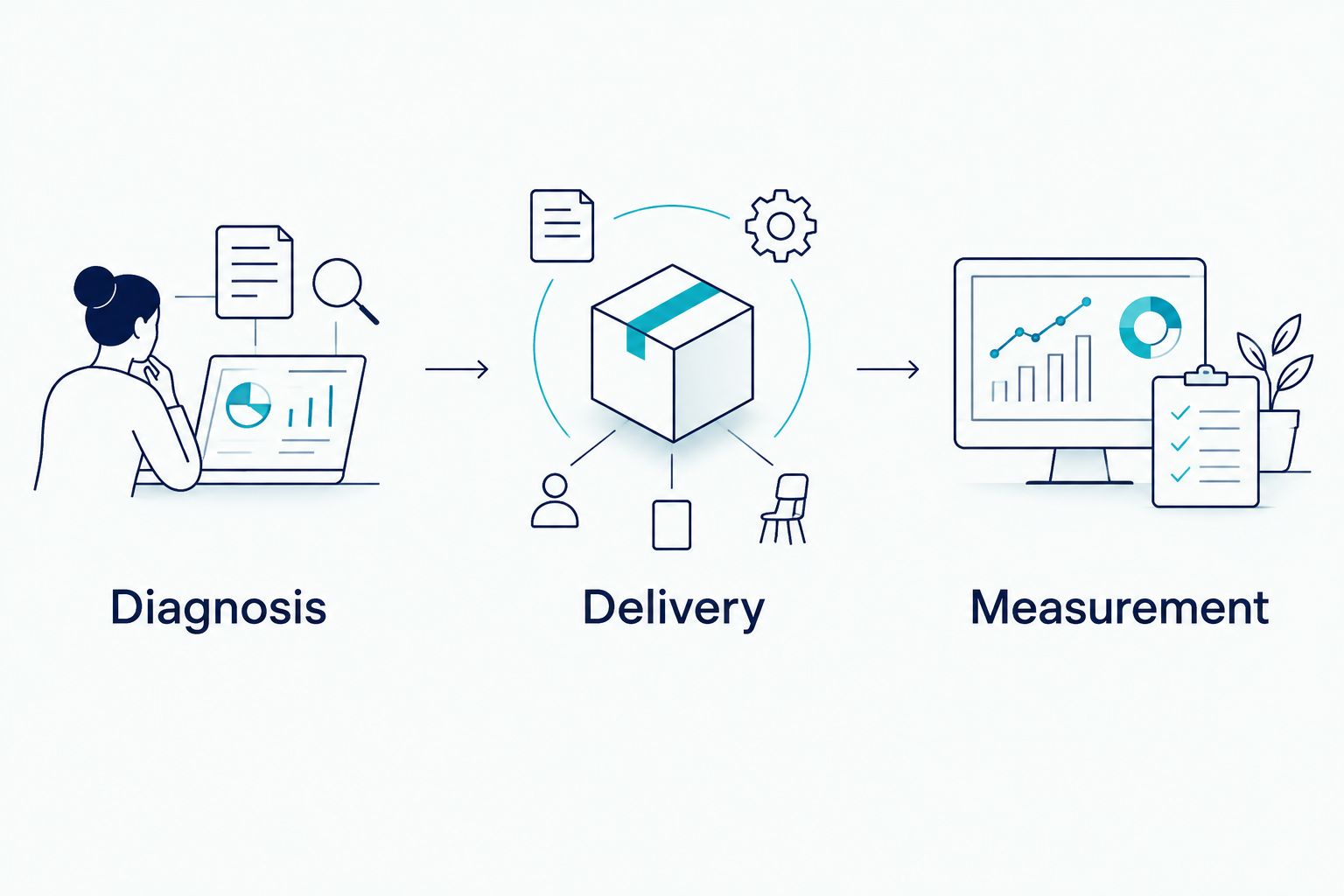
For your 2026 proposal review, ask 5 questions and require specific answers:
- What evidence will establish the cause of the problem?
- Which actions are included, and which are excluded?
- Who implements each action and removes blockers?
- How will you distinguish useful traffic from irrelevant visits?
- What records and access will the business retain when the engagement ends?
Good answers describe work, responsibilities and evidence. They do not need a guarantee of rankings. A proposal that promises an outcome without explaining the delivery dependencies leaves you unable to judge whether it is workable.
What should you measure after choosing a model?
Measure the constraint you hired someone to resolve. If indexing is the problem, review the affected pages and their index status. If traffic quality is the problem, review the landing pages, relevant queries and resulting enquiries together.
Keep activity reporting separate from outcome reporting. Published pages, completed audits and closed tickets describe work performed. They do not establish commercial improvement by themselves.
Use the same principle for your 2026 management review: ask what changed, whether the intended pages were affected and what evidence supports the next decision. Preserve notes about other website or business changes so you do not attribute every movement to SEO.
Agency and in-house teams should face the same questions. Do not accept different standards of evidence because one team sends a polished report and the other attends your internal meetings.
Do I still need an internal SEO owner if I hire an agency?
1 accountable owner remains necessary when you hire an SEO agency. The agency cannot set your commercial priorities, approve every business claim or independently allocate your development team's time. Give that owner a clear route for resolving blocked tasks.
Can I start with an agency and bring SEO in-house later?
Yes. Start with a defined external scope and require documentation, business-owned account access and a handover process. Bring recurring responsibilities in-house when you can define the workload and support the role, rather than treating the change as an automatic next step.
Should I hire someone if the recommendations never get implemented?
Not before identifying the delivery blocker. If approval delays or unavailable development time prevent changes, another strategist adds recommendations to the same queue. Assign implementation capacity first, then decide whether you still need additional SEO expertise.
FAQ
Is it worth hiring an SEO agency or doing SEO in house?
Hiring an SEO agency is worth it for a defined specialist gap; in-house SEO fits sustained work supported by an experienced internal owner. Choose the model that addresses your actual diagnosis and delivery needs.
Is an SEO agency better than an in-house SEO employee?
Neither model is better in every situation. Compare relevant expertise, implementation access and internal accountability against the work your business needs.
Do I need an internal person to manage an SEO agency?
Yes, you need 1 accountable owner inside the business. That person supplies commercial context, secures approvals and resolves delivery blockers.
Can a small business do SEO itself?
A small business can handle SEO tasks it understands and can implement. Seek specialist support for problems outside the team's expertise rather than assuming a checklist covers every issue.
What should I ask an SEO agency before hiring it?
Ask how the agency will diagnose the problem, what the scope includes, who implements changes and how outcomes will be assessed. Confirm that your business retains the relevant accounts and records.
Can I combine an in-house marketer with an SEO agency?
Yes, a hybrid arrangement can pair internal delivery with external specialist support. Assign research, approval, implementation and validation explicitly so work is not duplicated or abandoned.
What does Digital Womble Ltd help businesses with?
Digital Womble Ltd provides SEO, paid search and AI search visibility consulting to help businesses recover lost search revenue. Your business still needs an internal owner for priorities and implementation decisions.
One last thing
Before deciding who to hire, inspect the work you already know needs doing. An unresolved template change, an unapproved service page or an unreliable enquiry measurement can reveal a delivery problem that another audit will not fix.
Choose the arrangement that gets the necessary work implemented and checked. For a 2026 search plan, that is a more useful decision rule than choosing an agency or employee first and inventing their task list afterwards.