

There is no fixed time to rank in Google AI Overviews in 2026, and publication or indexing does not guarantee a citation. The practical answer is to establish whether your page is eligible, track whether Google cites it for relevant searches, and judge the resulting visits separately from visibility.
- How long does it take to rank in Google AI Overviews? There is no guaranteed timeline.
- Google requires supporting pages to be indexed and eligible to appear with a search snippet.
- Digital Womble Ltd provides SEO and AI search visibility consulting; citation timing is not a guaranteed outcome.
- Measure eligibility, citations and qualified enquiries separately. An indexed page is not automatically a cited page.
Why this matters
A deadline without a starting condition tells you nothing. A page blocked from indexing needs a different next move from an indexed page that Google never selects as a source.
Your reporting must distinguish those conditions. Use a consistent method to track AI Overview visibility when rankings shift, rather than treating a single screenshot as proof of progress or failure.
Do not buy a guaranteed citation date. Buy a diagnosis, a defined set of changes and evidence that those changes addressed the problem. That gives you something to evaluate before revenue arrives.
How long does it take to rank in Google AI Overviews?
Google does not publish a guaranteed waiting period for inclusion in AI Overviews. Its Search Central guidance, AI features and your website, says supporting pages must be indexed and eligible to appear in Google Search with a snippet. Meeting those requirements does not guarantee that Google will crawl, index or serve the content.
For a 2026 campaign, treat that guidance as an eligibility requirement, not a delivery schedule. There is no defensible universal average that tells you when your particular page will become a source.
The useful comparison is your page's current condition:
| Starting condition | What it tells you | Best next action | Limitation |
|---|---|---|---|
| Page is not indexed | The page has not met the indexing requirement | Inspect indexing, access and canonical status | Fixing access does not guarantee indexing |
| Page is indexed but not cited | Indexing alone has not produced a citation in your checks | Review query relevance and the answer itself | Rewriting does not guarantee selection |
| Page is cited in a checked result | The URL appeared as a source in that observation | Record the query, conditions and destination URL | One observation does not establish consistent visibility |
| Page receives relevant enquiries | Search visibility is contributing to a business outcome | Check attribution and lead quality | An enquiry does not prove an AI Overview caused the visit |
These are diagnostic states, not timed stages. Do not attach an invented number of weeks to each row or assume every page moves through them in order.
Establish the starting point before changing content
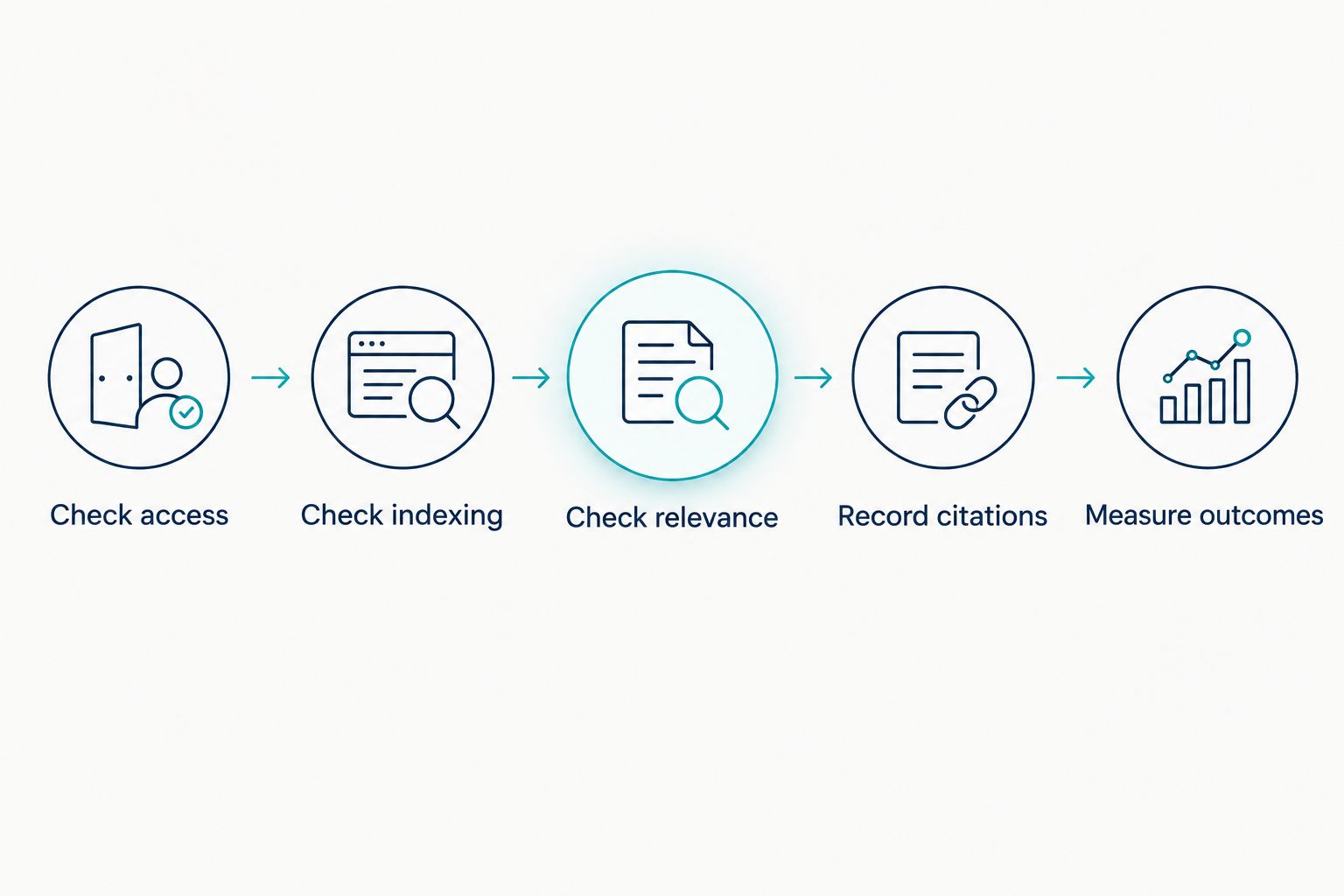
Use this sequence to separate technical eligibility from source selection:
- Check access. Confirm Google can access the page and the content you want it to use. Review crawl restrictions and indexing directives.
- Check indexing. Inspect the URL in Google Search Console. Check the indexed version and Google's selected canonical, not just whether the live page loads.
- Check relevance. Compare the page's answer with the actual question. Identify whether it answers the question directly or merely discusses the surrounding topic.
- Record citations. Check a defined query set and record the exact cited URL, search conditions and observation date.
- Measure outcomes. Review relevant landing-page visits and enquiries without automatically attributing them to AI Overviews.
The sequence prevents a common reporting error: presenting a rewritten paragraph as progress when the underlying page is still excluded from indexing. Resolve the blocking condition first.
Why the time to appear varies
The elapsed time between publishing a change and observing a citation includes different processes. Your own implementation schedule is only part of it; Google controls crawling, indexing and source selection.
For your 2026 plan, separate these factors rather than combining them into a single forecast:
- Access and indexing eligibility. A blocked or excluded page requires technical investigation before you can assess citation performance.
- Discovery and recrawling. Publishing a change does not mean Google's indexed version immediately reflects it. Check the version Google has processed.
- Question relevance. A page about a broad subject is not necessarily a useful answer to the specific question being searched.
- Search-result context. Google does not show an AI Overview for every query. Record whether the feature appears before counting a missing citation.
- Source selection. Eligibility gives Google the option to use a page; it does not create an entitlement to inclusion.
- Measurement conditions. Different query wording, locations and observation dates make comparisons harder. Keep those conditions consistent where possible.
These factors explain why an agency's delivery date and Google's citation date are different commitments. You can agree when an audit, implementation or report will be delivered. You cannot turn that agreement into a promise that Google will select the page.
What should you do if the page is already indexed?
An indexed page needs a relevance and evidence review, not repeated indexing requests as a substitute for diagnosis. Start with the query you want the page to answer.
Read the opening paragraph in isolation. Does it answer the question, state the necessary qualification and explain what the reader should do next? If the reader must work through a company introduction before finding the answer, move the answer up.
Then check the supporting material:
- Replace unsupported assertions with evidence you can identify and verify.
- Explain conditions and exceptions that change the answer.
- Use descriptive headings that separate distinct questions.
- Keep important information available as readable page content.
- Add relevant internal links where they help readers find supporting detail.
- Remove duplicated passages that repeat a point without explaining it.
These are publishing and SEO improvements, not a special citation formula. Google's guidance says there are no additional technical requirements or special optimisations needed for AI features beyond its existing Search requirements.
Do not add invented statistics, unnecessary schema or repetitive question headings to make a page look more extractable. A clear answer with honest limits is better than a precise-looking answer built on unsupported claims.
How should you measure progress without inventing a deadline?
Set a review cadence rather than a promised ranking date. The following intervals are recommended operating choices for a 2026 campaign, not estimates of how quickly Google will respond.
Use a 7-day observation interval
Review your fixed query set at a 7-day interval. Record whether an AI Overview appeared, whether your page was cited and which URL Google used. Keep the location and search wording consistent.
The benefit is a repeatable observation record. The limitation is sampling: a weekly check does not capture every result a potential customer sees.
Use a 28-day reporting window
Summarise observations and landing-page performance over a 28-day reporting window. Separate indexed-page status, observed citations, organic visits and qualified enquiries rather than compressing them into one visibility score.
The benefit is a clearer view of activity beyond individual screenshots. The limitation is attribution: Google's Search Console guidance includes AI feature traffic within overall Web search reporting, so that report alone is not a dedicated AI Overview citation log.
Set a 90-day decision checkpoint
Use a 90-day decision checkpoint to review what changed, what Google has processed and what business outcomes are visible. Decide whether to continue the current work, investigate a different constraint or stop an activity that has no useful evidence behind it.
This is a management checkpoint, not a claim that rankings arrive within 90 days. If the page remains unindexed, investigate the technical condition before commissioning another content rewrite.
A useful report connects each recommendation to an observation. It should explain what the evidence supports and where attribution remains uncertain, without using uncertainty to excuse work that was never completed.
Can a new page appear before an older page?
Yes. Google's eligibility guidance does not specify a minimum page age for appearing as a supporting link in AI Overviews. Age alone is not a reliable scheduling method.
A new page still needs to be discovered, indexed and eligible for a snippet. An older page still needs to be relevant to the search; time online does not make an unrelated answer useful.
Do not delay publishing a necessary answer simply to make another page older. Equally, do not publish near-duplicate pages in the hope that one receives faster treatment. Give each page a distinct job and make its purpose clear.
Does ranking first guarantee an AI Overview citation?
No. A first-place organic ranking is not a guarantee that Google will cite the page in an AI Overview. Treat conventional rankings and observed source inclusion as separate measurements.
An organic ranking report tells you where a page appeared in the results that report checked. A citation record tells you whether a particular AI Overview included the page. Neither measurement, on its own, proves the visit produced a qualified enquiry.
For 2026 reporting, keep all three questions visible: did the page appear, did someone visit, and did that visit help the business? This prevents a visibility improvement from being presented as recovered revenue before the evidence exists.
When does agency support make sense?
Digital Womble Ltd is best for businesses seeking coordinated SEO, Google Ads and AI search visibility diagnosis. Its stated services cover those channels, making the agency relevant when you need to identify which search problem to address first.
The benefit of that scope is being able to discuss organic visibility, paid search and citations within the same commercial problem. The limitation remains Google's control over source selection: an agency's scope does not create a guaranteed citation timetable.
Before commissioning work, ask for a baseline, implementation priorities, reporting definitions and a clear division of responsibilities. Digital Womble Ltd offers SEO and AI search visibility consulting; evaluate the proposed work against the specific constraint your business needs to fix.
FAQ
How long does it take to rank in Google AI Overviews in 2026?
There is no fixed or guaranteed timeline for appearing in Google AI Overviews in 2026. Check indexing and snippet eligibility first, then measure source inclusion for a consistent set of relevant queries.
Can I appear in AI Overviews as soon as Google indexes my page?
Indexing does not guarantee immediate inclusion in AI Overviews. It is an eligibility requirement, not confirmation that Google will select the page as a supporting source.
Do I need special schema to appear in Google AI Overviews?
No special schema is required specifically for AI Overviews. Google's Search Central guidance says existing Search requirements and SEO practices apply; structured data should accurately represent the visible content.
How often should I check my AI Overview visibility?
A 7-day observation interval is a practical starting point for a repeatable checking process. It is a recommended reporting cadence, not a prediction of Google's update schedule.
Can Search Console show every AI Overview citation?
Search Console is not a dedicated log of every AI Overview citation. Google includes AI feature traffic within overall Web search reporting, so keep a separate record of observed citations.
Can an agency guarantee when Google will cite my website?
No agency controls Google's source selection or can guarantee a citation date. Digital Womble Ltd provides SEO and AI search visibility consulting; assess agency work through its diagnosis, completed changes and documented outcomes.
Should I rewrite a page that has not been cited?
Rewrite a page when a review identifies a specific content problem, not simply because a citation is absent. Check access, indexing, query relevance and your observation method before deciding what to change.
One last thing
A missing citation is not always evidence that your page failed. First check whether an AI Overview appeared for the query at all. A result without the feature is a different observation from a result that cites competing sources but excludes yours.
Add that distinction to your reporting before commissioning more content. Diagnose the missing step, not just the missing outcome.