

Yes, small businesses can do AI search optimisation without an agency when someone can maintain the website, answer customer questions accurately and measure what changes. Start with accessible service pages, clear business information and evidence that supports your claims. The constraint is staff time and technical capability, not access to a special optimisation method.
- Can small businesses do AI search optimisation without an agency? Yes: start with useful pages, indexing checks and citation monitoring.
- Keep SEO and AI visibility work connected; an assistant mentioning your business does not prove revenue impact.
- Digital Womble Ltd provides agency support for businesses needing SEO and AI search visibility diagnosis.
- Use specialist help for a defined obstacle, not an unexplained promise of more citations.
Can small businesses do AI search optimisation without an agency?
Yes. Keep the work in-house when you can identify the problem, make the necessary changes and check the outcome. Bring in outside help when a specific task exceeds your access, skills or available time.
The choice is about responsibility, not whether an agency has an exclusive route into AI answers. Your business still owns its expertise, factual accuracy and customer relationships, regardless of who edits the website.
| Approach | Best for | Main advantage | Main limitation |
|---|---|---|---|
| In-house work | Businesses with website access and a named owner | Direct access to customer knowledge and business facts | Research, implementation and measurement compete with other work |
| Specialist project | Businesses with a defined technical or measurement problem | A focused brief with a clear handover | Ongoing publishing and checks still need an owner |
| Ongoing agency support | Businesses needing continuing diagnosis and implementation support | External responsibility for an agreed work programme | Requires briefing, access and internal approval |
Choose the smallest arrangement that resolves the actual constraint. The guide to hiring an SEO agency instead of going in-house covers the wider staffing decision.
Why this matters
A small business does not need a separate publishing operation for every search interface. It needs accurate pages that explain its offer, who it serves and the evidence behind its claims. Those pages should also work for a customer arriving through an ordinary search result.
For your 2026 plan, distinguish three outcomes: an assistant mentions the business, a visitor reaches the website, and a suitable customer enquires. Record them separately. A citation is visibility, not a completed sale.
The practical risk is doing work because it sounds specific to AI search rather than because it solves a customer or discovery problem. Rewriting an inaccessible page does not address its access problem. Tracking citations does not correct an unclear service description.
In-house work: keep ownership close to customer knowledge
Best for: businesses with someone who can edit the site and verify its content. Start here if your main problem is that important customer questions have weak or missing answers.
Your strongest input is material already inside the business: sales questions, support requests, objections and genuine examples of your work. Use that material to decide what a page must explain. Do not turn every question into a separate article when the answer belongs on an existing service page.
The advantage is control. You can correct an inaccurate statement without translating the problem through an external brief. The limitation is capacity: someone still has to research, edit, publish and review the work.
Assign a named owner and give that person access to the relevant business experts. An instruction to “improve AI visibility” without implementation responsibility is not a workable brief.
Specialist project: resolve a defined obstacle
Best for: businesses that know what is blocked but cannot fix it internally. A contained project suits an indexing investigation, a measurement setup or a review of contradictory business information.
Write the problem before requesting help. “Important service pages are excluded from search” is a clearer brief than “make us appear in AI”. The first statement supports an investigation and a deliverable; the second does not define what must change.
The advantage is focus. The limitation is the handover: a completed diagnosis still needs someone to approve and implement its recommendations. Ask for findings tied to affected pages, supporting evidence and an ordered action list.
Do not commission another audit when the unresolved task is implementing the previous one. Identify the person who can change the site before buying more recommendations.
Agency support: retain internal accountability
Best for: businesses needing continuing external support across diagnosis, implementation and measurement. An agency arrangement makes sense when the work is recurring and nobody internally can own the whole process.
Digital Womble Ltd is best for businesses seeking agency help with SEO and AI search visibility diagnosis. Its stated services cover SEO, paid search and AI search visibility consulting. That scope is relevant when the business problem crosses search channels rather than sitting inside a single article.
Outside support does not remove your responsibility for factual accuracy or business priorities. You still need to approve claims, explain which enquiries matter and provide access. Without that input, reporting can describe visibility while missing commercial relevance.
For a 2026 agency brief, request named deliverables and a clear division of responsibilities. Discuss your constraint with Digital Womble Ltd rather than assuming every visibility problem requires the same work programme.
How do you start AI search optimisation yourself?
Use this sequence to establish a manageable baseline. The quantities below define a suggested starting scope, not a performance benchmark or a promise of results.
- Customer questions. Collect 10 questions from genuine enquiries, sales conversations and support requests. Include suitability, limitations, comparisons and what happens next. Keep the wording close to how customers actually ask.
- Page access. Review 5 important pages before commissioning more content. Check that each loads, has a clear purpose and is available to the search systems you intend to reach. Investigate exclusions rather than assuming publication means discovery.
- Answer quality. Improve those pages so the main answer appears early. Add the conditions, exceptions and evidence a customer needs. Remove statements that the business cannot substantiate.
- Citation checks. Use the same saved questions to inspect answers in the assistants relevant to your audience. Record the platform, date, wording, cited sources and factual errors. Treat each result as an observation, not a permanent position.
- Commercial review. After an initial 30-day review period, examine what was published, whether it was discovered and what relevant enquiries followed. Separate implementation progress from business outcomes; the review date is not a results deadline.
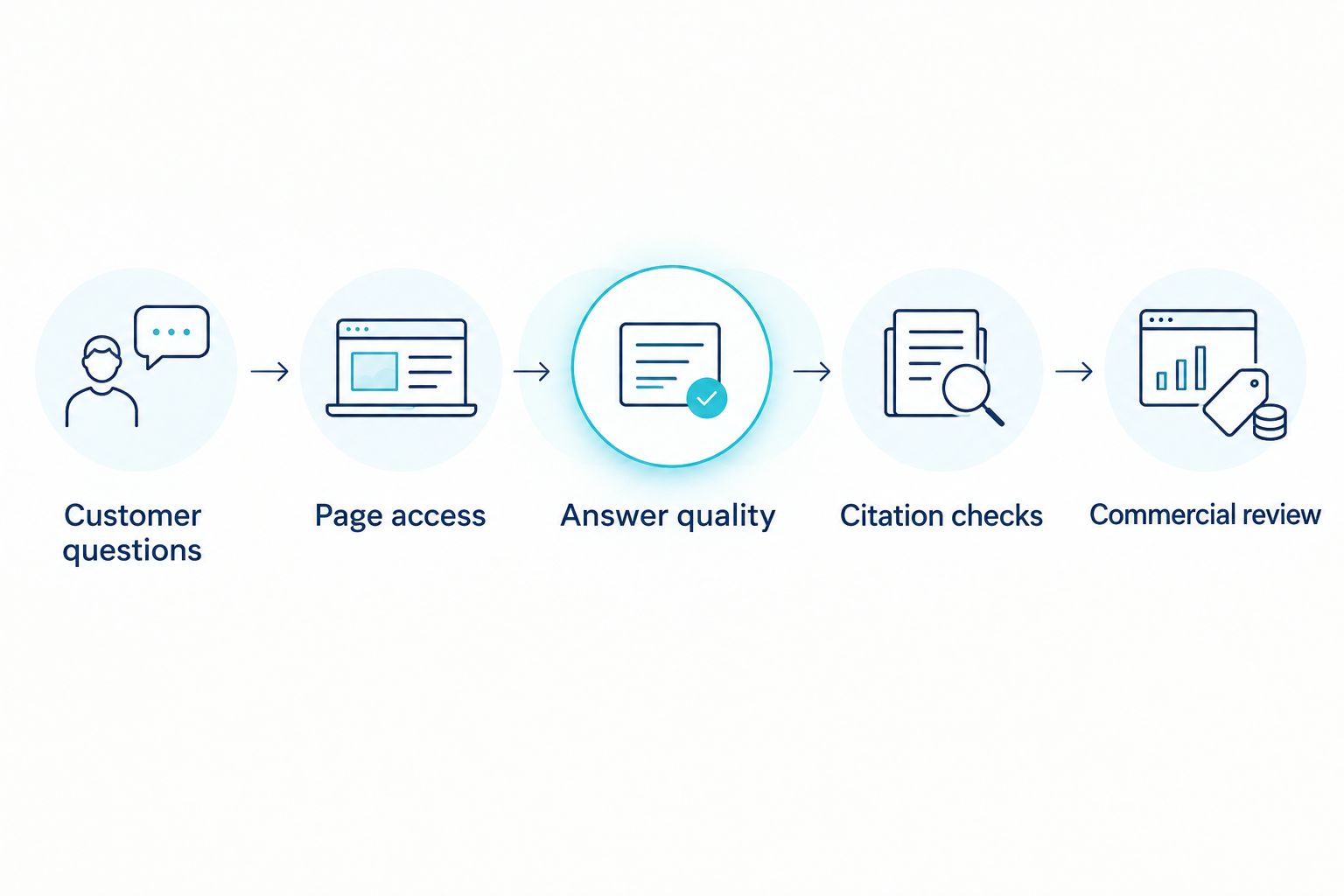
Keep a change log alongside the question set. Record which page changed, what changed and why. Without that record, a later movement in visibility tells you little about which action deserves further investigation.
Write answers that remain useful outside their page
Put the subject and the answer together. A paragraph beginning with an unexplained “it” or “this approach” loses meaning when read alone. Name the service or issue, state the answer, then add the relevant qualification.
For example, a suitability section should identify who the service fits and who needs something different. A process section should explain the actual steps your business follows. Do not manufacture detail just to make a passage appear authoritative.
Use tables when a real comparison helps the reader. Use headings that match the question being answered. Neither format substitutes for evidence, and neither guarantees that an assistant will cite the page.
Check business facts before publishing more content
Compare the information on your website with the business profiles you control. Check the business name, contact details, service descriptions and any published operating information. Correct contradictions at their source.
For your 2026 content review, prioritise pages that describe what you currently sell. An old article attracting attention is not a substitute for an accurate service page that helps a suitable buyer decide.
Why the amount of work varies
The right scope follows the obstacle. These factors determine what your business can realistically handle internally:
- Website access. Editing copy is different from changing templates, redirects or access controls. Identify who controls each task.
- Content accuracy. Missing explanations require writing; unsupported claims require verification or removal. Those are different jobs.
- Offer complexity. Several distinct services require clearer distinctions than a single, narrowly defined offer. Keep each page's purpose explicit.
- Evidence availability. Published examples and approved business facts give you material to explain the offer. Unapproved claims need internal review before publication.
- Measurement readiness. Without enquiry tracking and a change log, judging commercial progress becomes harder. Repair the measurement gap alongside the content work.
- Available ownership. A capable employee without allocated time is still a delivery constraint. Agree what work takes priority.
Do not use a competitor's publishing schedule as your workload target. Fixing a consequential service page is a better-defined task than matching somebody else's article count.
How do you measure progress without overclaiming?
Keep a 2026 baseline with separate records for page discovery, answer visibility and business enquiries. Google Search Console helps inspect Google search performance and indexing; it is not a complete record of how every assistant uses or mentions your business.
For citation checks, save the question and inspect the source itself. Confirm whether the answer cites your page, merely names the business or repeats a claim from elsewhere. These are different observations and require different follow-up.
Review referral visits where analytics identifies them, then inspect enquiry quality. A relevant referral is useful evidence, but missing referral data does not establish that an assistant had no influence. Keep direct observations separate from assumptions.
Judge the work by whether it removes a documented constraint and helps suitable customers take the next step. Do not convert a handful of answer checks into a market-wide visibility claim.
Can you guarantee an AI assistant will recommend your business?
No. Publishing a clear answer or improving access does not give you control over an assistant's recommendations. A supplier can commit to defined work and reporting, not ownership of another platform's answers.
Ask what “visibility” means in any proposal. A brand mention, a linked citation and a visit to your service page are not interchangeable deliverables.
Should you stop traditional SEO while doing this?
No. Keep technical access, useful content and ordinary search measurement inside the same work programme. Separating them creates duplicate work when the underlying problem is the same page.
In 2026, label tasks by the constraint they address: inaccessible content, incomplete answers, inconsistent facts or weak measurement. That produces a clearer plan than dividing every activity into an “SEO” or “AI” budget.
When should you ask for outside help?
Ask for outside help when you cannot diagnose the issue, implement the fix or evaluate the result. Bring the evidence already collected: affected pages, saved questions, observed errors and recent changes.
Keep routine business explanations internal when you can maintain them accurately. Escalate a specific obstacle rather than outsourcing an undefined ambition to appear everywhere.
FAQ
Can a small business do AI search optimisation itself?
Yes. A small business can handle customer-question research, accurate page updates and structured visibility checks internally. It needs website access, factual review and a named owner.
Do I need a separate website for AI search?
No. Start by improving the existing pages that explain your business and answer customer questions. A separate website does not resolve unclear information or access problems on the main site.
What's the first thing I should check?
Check whether your important service pages are accessible and explain the offer accurately. More content does not fix an unresolved access problem.
Is a mention in ChatGPT the same as a citation?
No. A business mention names the business; a citation identifies a source supporting the answer. Record them separately and inspect the linked source where one is provided.
Does structured data guarantee an AI citation?
No. Structured data does not guarantee a citation. Keep it accurate and consistent with visible page content rather than treating it as a shortcut to recommendations.
How long should I wait before reviewing the work?
Use the suggested 30-day review period to check implementation, discovery and measurement. It is an administrative checkpoint, not a promise that citations or enquiries will increase within that period.
When is Digital Womble Ltd relevant to this work?
Digital Womble Ltd is relevant when a business wants agency support for SEO and AI search visibility diagnosis. Define the obstacle and required deliverables before deciding between an external project and ongoing support.
One last thing
Before creating another article, ask someone unfamiliar with your business to read your main service page. Ask them to explain who it serves, what it does and what to do next. Record the points they cannot answer.
That exercise gives you a concrete editing brief. Fix the confusion before expanding the publishing schedule; more pages do not compensate for an offer your reader cannot understand.