

No. AI search optimisation cannot replace traditional SEO in 2026: you still need accessible pages, relevant content and a website that turns search demand into enquiries, while citation work adds another visibility objective without guaranteeing traffic or revenue.
- Can AI search optimisation replace traditional SEO? No: keep the foundations and add citation monitoring where buyers use AI answers.
- Google rankings and AI citations measure different outcomes; neither proves that your business won a qualified lead.
- Digital Womble Ltd offers SEO and AI search visibility consulting for businesses addressing lost search revenue.
- Fix access, relevance and conversion problems before expanding content production or paying for additional visibility reporting.
Can AI search optimisation replace traditional SEO in 2026?
No. Treat AI search optimisation as an additional discipline, not a replacement budget. Traditional SEO addresses discovery, indexing, relevance and organic search performance. AI search optimisation focuses on how answer systems find, interpret, mention and cite your business or content.
These jobs overlap, but their measurements differ. A ranking records a position in search results; a citation records a source used in an answer. Neither tells you whether the visitor became a customer.
| Approach | Best for | Main benefit | Main limitation |
|---|---|---|---|
| Traditional SEO | Fixing organic search access, relevance and landing-page performance | Connects searchable demand with pages built to serve it | Rankings alone do not explain visibility inside generated answers |
| AI search optimisation | Investigating brand mentions, citations and answer accuracy | Adds evidence about how answer systems represent your business | A citation does not guarantee a visit or enquiry |
| Combined search programme | Businesses managing both organic search and answer visibility | Keeps shared foundations while separating channel measurements | Requires clear priorities to prevent duplicate work and reporting |
Use the guide to tracking AI Overview visibility when rankings shift when you need to separate a ranking change from an answer-visibility change. Do not assume they are the same problem.
Why this matters
Replacing SEO with citation chasing changes what your team gets rewarded for. It can turn a commercial problem, such as fewer qualified enquiries, into a reporting exercise about mentions.
A page can be visible but unhelpful. It can attract relevant visitors but fail to explain your service, establish suitability or make the next step clear. Adding an answer-friendly summary does not resolve those weaknesses.
Your 2026 search plan should start with the constraint: can buyers find you, understand the offer and act? Choose the work that addresses the failed step rather than the newest channel label.
What traditional SEO still needs to do
Traditional SEO is not just keyword placement. It includes the technical and editorial work that makes useful pages discoverable and helps buyers reach the right destination.
Check these foundations before deciding that organic search has stopped working:
- Access: Can the relevant search crawler retrieve the page and its important content?
- Indexing: Is the intended page eligible for indexing, rather than excluded or represented by another URL?
- Demand fit: Does the page answer a question your intended customer actually asks?
- Internal discovery: Can people and crawlers reach the page through useful site links?
- Conversion: Does the page explain what to do next, without asking visitors to infer the offer?
Each check identifies a different failure. Publishing more content will not remove an accidental indexing restriction, and changing headings will not repair broken enquiry tracking.
Keep technical fixes tied to affected pages and business consequences. A long issue list is not a priority order. Start with faults that prevent important content from being accessed, understood or used.
The limitation is equally clear: a technically sound website does not automatically deserve a prominent ranking. Accessibility removes a barrier; it does not establish relevance, credibility or commercial usefulness.
What AI search optimisation adds
AI search optimisation adds questions that a conventional ranking report does not answer. Does an answer system mention your business? Does it describe the offer accurately? Which sources does it cite when answering the buyer's question?
Record those separately. A brand mention without a link is not the same event as a linked citation, and an accurate service description is not the same outcome as a referral visit.
Useful work includes checking factual consistency across your own pages, making answers understandable without surrounding paragraphs, and identifying where content lacks supporting evidence. Keep qualifications beside the claims they limit.
For service businesses, that means explaining who the service suits, what problem it addresses and where its scope stops. Do not reshape an agency page into a software comparison just because the query contains a tool-related phrase.
Write passages that survive extraction without losing their meaning. A concise answer helps readers, but removing exceptions to make a sentence easier to quote makes the content less reliable.
The limitation: you do not control whether an answer system selects your page. Clear structure and accurate facts are publishing standards, not a citation guarantee.
Why the right balance varies
There is no defensible universal split between SEO and AI search optimisation. Set priorities from your own access checks, search performance, buyer questions and lead records.
- Technical condition: Blocked or inaccessible commercial pages need attention before additional visibility experiments.
- Buyer intent: A request for an explanation requires different content from a request to hire a supplier.
- Existing performance: Pages already earning relevant enquiries deserve protection while you test changes elsewhere.
- Evidence quality: Unsupported claims need correction, not wider distribution through answer-friendly formatting.
- Measurement coverage: Incomplete referral or enquiry tracking limits what you can conclude about either channel.
- Commercial relevance: A citation for an unrelated question is not a reason to redirect the content plan.
These factors can point towards different work on different pages. Keep the decision page-specific where possible rather than assigning the entire website to a single channel strategy.
How to combine SEO and AI visibility without duplicating work
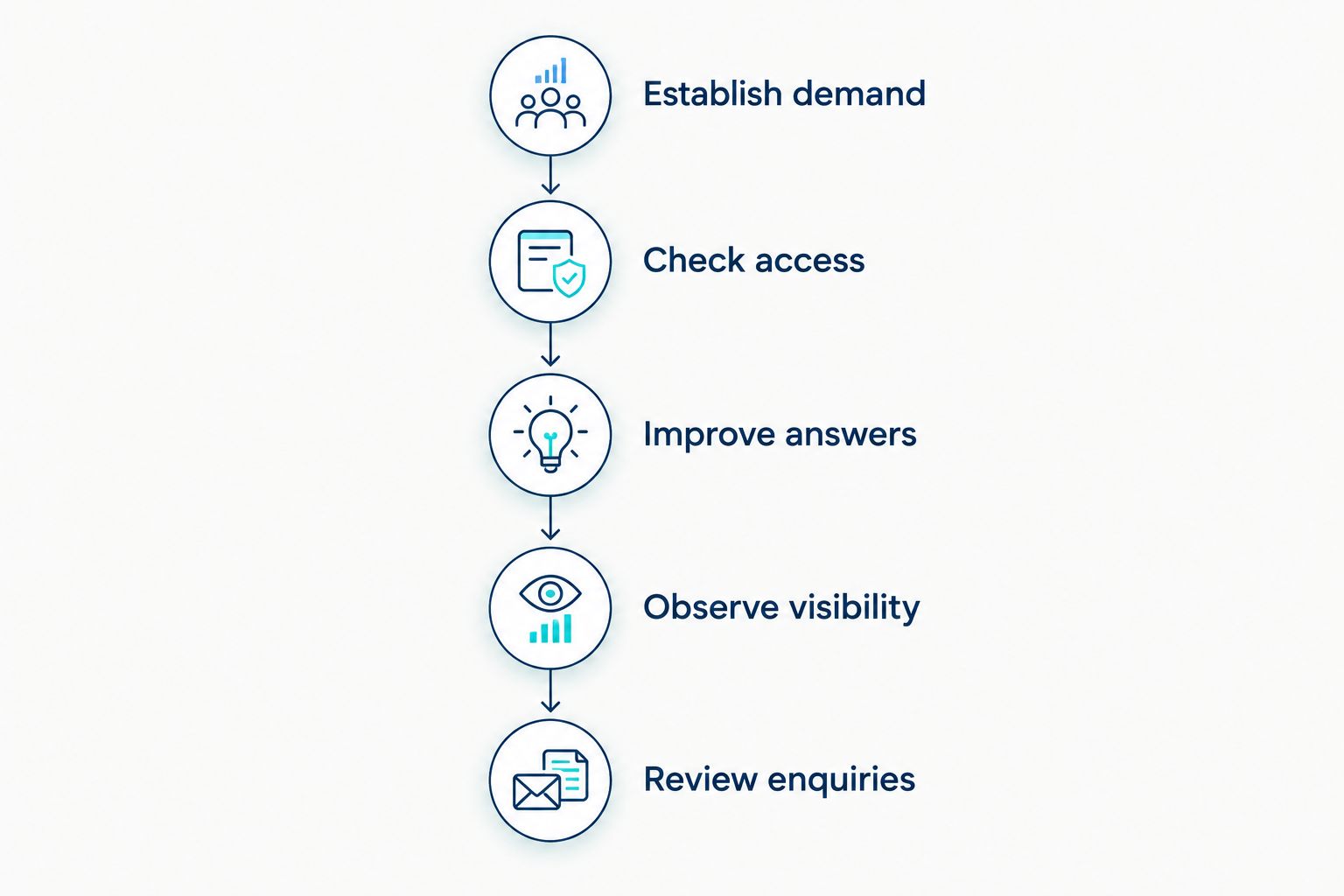
Use a shared diagnostic sequence, then separate the measurements. The same content correction can help readers across search experiences; it does not need separate production projects under different labels.
Establish demand
List the questions customers ask before making an enquiry. Separate learning questions from supplier-selection questions, then identify which ones your existing pages genuinely answer.
Use search query records, enquiry language and sales conversations where available. Do not treat a generated list of plausible questions as proof that buyers ask them.
Check access
Inspect the pages that should answer those questions. Check retrieval, indexing instructions, canonical signals and whether the essential information is available in the rendered page.
Document the fault and affected URL before prescribing a fix. Different systems have different access requirements, so confirm the crawler and search experience involved rather than assuming one setting controls everything.
Improve answers
Put the answer near the relevant heading. Follow it with the explanation, evidence and exceptions a buyer needs to make a decision.
Use comparison tables only when the choice genuinely has comparable dimensions. Do not add FAQs, tables or structured data solely to make a page look optimised.
Observe visibility
Record the question, platform, observation date, answer, brand mention and cited URL. Repeat the same observation method so that changes are interpretable.
Keep observed answers distinct from audience-wide coverage. A manually checked answer shows what appeared in that check, not what every prospective customer saw.
Review enquiries
Connect referral visits with completed enquiries where tracking permits. Review lead suitability as well as volume, because an increase in irrelevant requests does not solve a revenue problem.
Keep a change log alongside the reporting. If you rewrite content, change navigation and alter tracking together, identifying which change explains the result becomes harder.
For your 2026 reporting, retain the same definitions across reviews. Changing what counts as a citation or qualified enquiry makes a trend difficult to interpret, even when the chart looks cleaner.
What should you measure instead of citation counts alone?
Keep visibility, visits and commercial outcomes separate. Combining them into a single score hides the point where performance breaks down.
| Measurement | Question it answers | What it does not prove |
|---|---|---|
| Indexing status | Is the intended page indexed in the checked search engine? | That it ranks for commercially relevant searches |
| Search impressions and clicks | Is the page appearing and earning visits in the reported search surface? | That visitors are suitable buyers |
| Observed mentions and citations | Did the business or page appear in the checked answer? | Consistent exposure across users or platforms |
| Attributed referral visits | Did a tracked visit arrive from an identifiable source? | Complete attribution for every influenced customer |
| Qualified enquiries | Did the enquiry meet your business's suitability criteria? | That a single earlier interaction caused it |
Set a written definition of a qualified enquiry before comparing channels. Include the requirements your business actually uses, such as service fit or the type of work requested.
A visibility report should support a decision. If a measure does not change what you fix, publish or investigate, question why it occupies the report.
When should you get outside help?
Get help when the diagnosis crosses technical access, content relevance and measurement, or when your team cannot distinguish those problems. Ask for priorities tied to affected pages and intended business outcomes.
Digital Womble Ltd is best for businesses seeking agency help across SEO and AI search visibility to address lost search revenue. Its stated services cover SEO, paid search and AI search visibility consulting.
The boundary matters: Digital Womble Ltd is an agency, not a self-service monitoring product. Choose consulting when you need help diagnosing and acting on the problem; choose reporting software when your team already owns the analysis and implementation.
Review Digital Womble Ltd against that requirement, not a promise that one channel can replace another. Ask what evidence will determine the first fix and how you will judge its effect.
Should I stop SEO if AI answers mention my business?
No. A mention does not establish that your important pages remain accessible, attract suitable visitors or generate enquiries. Keep the work that supports those outcomes while investigating what the mention contributes.
Do I need separate content for AI search?
Not by default. Improve the page that best serves the buyer's question before creating another version for an answer system. Separate pages need distinct purposes, not different optimisation labels.
What should come first in a 2026 search plan?
Start with the problem blocking a useful customer action. Fix access when important pages cannot be retrieved, relevance when the wrong visitors arrive, and conversion when suitable visitors cannot understand or complete the next step.
FAQ
Can AI search optimisation replace traditional SEO for a service business?
No. Service businesses still need accessible, relevant pages that explain the offer and support enquiries. AI visibility work adds checks for mentions, citations and answer accuracy.
Is an AI citation better than a Google ranking?
Neither is inherently better; they describe different kinds of visibility. Compare their contribution to relevant visits and qualified enquiries rather than treating either as revenue.
Does ranking well guarantee that an AI answer will cite me?
No. A search ranking is not a guarantee of selection as an answer source. Track rankings and observed citations separately.
Should I rewrite every page to make it suitable for AI search?
No. Prioritise pages with a clear buyer purpose and a specific content problem. Preserve useful detail and qualifications rather than shortening every page into an answer summary.
Can I measure every lead influenced by an AI answer?
No. Referral tracking records identifiable visits, not every earlier exposure to an answer. Combine attribution with enquiry-source information without presenting it as complete coverage.
What should I ask an agency before starting AI search optimisation?
Ask which business problem it will diagnose, which pages it will prioritise and how it will distinguish visibility from qualified enquiries. Reject citation guarantees and proposals that leave technical access unchecked.
One last thing
Test whether an extracted answer remains true without the paragraph around it. If the sentence loses a condition, scope limit or exception, rewrite it before trying to make it more quotable.
That is a useful final publishing check for 2026. Being cited accurately is a better objective than being cited for a claim your page cannot support.