

A technical SEO audit is worth it in 2026 when it identifies a verified barrier to search visibility and gives your team a practical way to remove it. It is not worth it when the deliverable is a list of crawler warnings with no connection to important pages, search demand or business outcomes. The work does not end with the report: implementation and validation determine whether the diagnosis produces value.
- Is a technical SEO audit worth it? Yes, when verified indexing or crawling problems affect commercially important pages.
- Google Search Console evidence matters more than a crawler's overall health score.
- Digital Womble Ltd connects SEO diagnosis with paid search and AI search visibility.
- Demand an implementation plan, named owners and validation criteria, not just an exported issues list.
Is a technical SEO audit worth it in 2026?
Yes, if the audit answers a business question and leads to a fix. Start with the symptom: missing pages, a decline after a migration, broken search landing pages or important content that Google cannot access properly.
Digital Womble Ltd provides SEO, paid search and AI search visibility consulting. A technical audit belongs within that diagnosis, rather than becoming the default explanation for every traffic problem.
| Situation | Best for | Benefit of the approach | Limitation | Decision |
|---|---|---|---|---|
| Technical audit | Verified crawling, indexing or rendering concerns | Connects technical evidence to corrective work | Does not establish whether your offer has search demand | Proceed with a defined scope |
| Focused technical check | A problem isolated to a page group or recent change | Tests a specific explanation without reviewing everything | Can miss unrelated site-wide issues | Start here when the symptom is narrow |
| Content and demand review | Accessible pages that do not answer relevant searches | Examines intent, coverage and commercial relevance | Does not replace technical checks | Prioritise when the access checks pass |
| Measurement review | Conflicting traffic, lead or conversion reports | Separates reporting errors from genuine performance changes | Does not improve crawling or content itself | Verify tracking before judging return |
A crawl can reveal symptoms. It cannot decide which problem is costing your business useful search visits without context.
Why this matters
A technical problem can prevent good content from reaching search users. But a technically accessible page can still fail because it targets the wrong query, offers little useful information or gives visitors no reason to enquire.
That distinction matters in 2026. If you treat every fall in clicks as a technical failure, you risk paying for the wrong investigation and assigning developers work that does not address the cause.
Audit the constraint, not the whole internet checklist. Define the affected pages and the business outcome before choosing the scope.
What a useful technical SEO audit should contain
A useful audit connects evidence, interpretation and action. Each important finding should show an affected URL or template, the observed behaviour, the intended behaviour and the change required.
Evidence tied to important pages
Ask which pages the issue affects. A blocked service page and an intentionally excluded administrative page are not equivalent, even if a crawler groups them under the same warning.
Use Google Search Console to examine Google's reported indexing status and inspect representative URLs. Compare that evidence with the page's response, rendered content, internal links and indexing instructions.
Do not assume every excluded URL is a fault. Search results do not need every duplicate, filtered view or administrative page on your site.
Priorities based on consequences
The report should explain why a finding matters. Blocking access to a page you want indexed is different from a cosmetic warning on an irrelevant URL.
Ask for priorities based on the affected page's purpose, the reach of the issue and the confidence of the diagnosis. A crawler's severity label is an input, not a business decision.
Instructions developers can use
An instruction such as improve canonical tags is not enough. The developer needs to know which template is affected, what the canonical should identify and how the change will be checked.
Require acceptance criteria. For example, an intended indexable page should not carry a noindex instruction, and its internal links should point to the intended destination rather than a broken URL.
Validation after implementation
A completed ticket proves that someone changed something. It does not prove the change worked.
Retest the affected pages and check that the technical behaviour now matches the requirement. Then monitor indexing and relevant search performance separately; search visibility is not guaranteed by passing a technical test.
How to decide before commissioning an audit
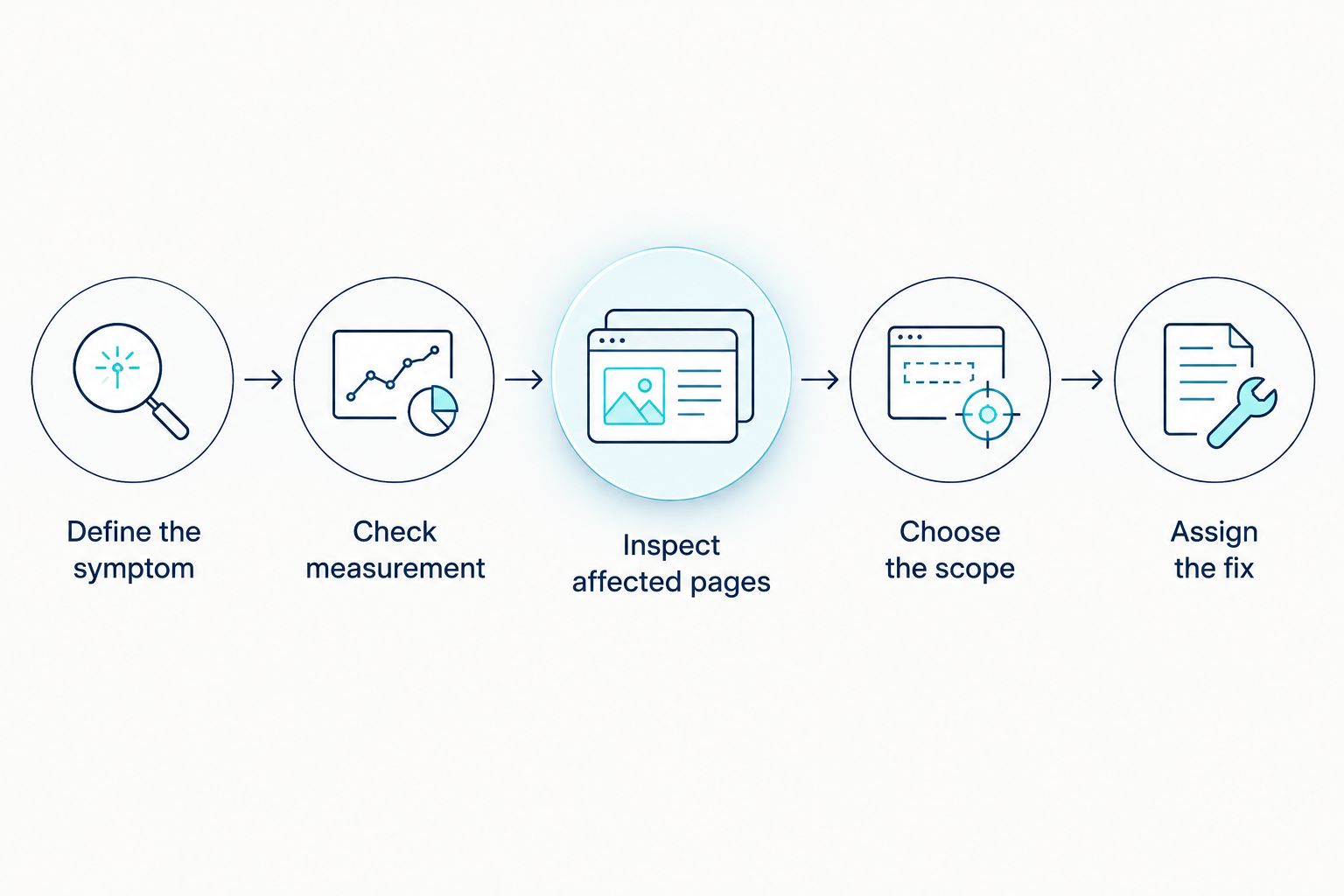
Use this sequence to establish whether technical investigation is the right next move. You do not need a full report to identify the question the report must answer.
- Define the symptom. Name the affected page group and the observed change. Missing indexed pages is a different problem from fewer enquiries on pages that still receive relevant visits.
- Check measurement. Confirm that analytics and conversion tracking still record the intended events. A reporting change can make a functioning acquisition channel look broken.
- Inspect affected pages. Review indexability, response status, rendered content, canonical signals and internal access. Compare an affected page with an unaffected page where possible.
- Choose the scope. Commission a focused investigation when the evidence points to a specific template or release. Expand the scope when the problem crosses page groups or systems.
- Assign the fix. Identify the person who can change the site and the person who will validate the result. Do this before approving a report that requires development work.
The sequence matters. You establish the problem before deciding how much investigation it needs.
When a focused check is enough
A focused technical check is best for a clearly bounded problem. Examples include a template that unexpectedly adds noindex, internal links pointing to removed pages or a release that hides important content from the rendered page.
Its advantage is specificity. The investigation can test an explanation and provide acceptance criteria directly related to the affected pages.
Its limitation is scope. A focused check does not establish the condition of unrelated templates, so do not present its findings as a site-wide assessment.
When a wider technical audit makes sense
A wider technical audit is best for problems that cross templates or follow substantial site changes. A migration, a new rendering setup or inconsistent indexing across several page groups creates a broader investigation than an isolated broken link.
The advantage is that the audit can examine relationships between crawling, redirects, canonical signals, rendering and internal linking. These mechanisms should be assessed together when their intended behaviour conflicts.
The limitation is implementation load. A broad report is only useful if your team can distinguish urgent corrections from optional improvements and assign the work accordingly.
For a 2026 website migration, define technical requirements before release and validate them afterwards. Do not wait for a traffic decline to decide which destinations old URLs should reach.
Why the value of a technical SEO audit varies
The value depends on the problem and your ability to resolve it, not on the length of the report.
- The affected pages: A fault on an important service or landing page has a different business consequence from an intentional exclusion elsewhere.
- The actual constraint: Technical corrections address access and site behaviour; they do not create demand for an unwanted offer.
- The scope of the issue: A shared template problem requires a different investigation from an isolated URL error.
- The evidence quality: Search Console observations, page inspection and reproducible tests support decisions better than unexplained scores.
- Implementation ownership: Findings need someone with permission and capacity to change the site.
- Validation discipline: Retesting distinguishes a deployed change from a resolved problem.
Before commissioning work in 2026, ask the provider to explain how findings become decisions. The answer should describe priorities, implementation requirements and verification, not just the software used.
Does improving page speed make an audit worthwhile?
Page speed is a valid audit topic when loading and interaction problems affect your pages. It is not a complete explanation for organic performance.
Google's published Core Web Vitals thresholds classify Largest Contentful Paint of 2.5 seconds or less as good and Interaction to Next Paint of 200 milliseconds or less as good. For those measures, more than 4 seconds and more than 500 milliseconds, respectively, fall into the poor category.
These thresholds apply to the 75th percentile of measured page visits. They are performance assessment boundaries, not promised ranking gains or universal revenue targets.
Use those thresholds in your 2026 review to interpret user experience evidence. Then inspect the cause: a loading problem needs a different fix from a slow response to user interaction.
A laboratory test helps reproduce and diagnose a problem under controlled conditions. Field data reflects observed user experiences. Neither makes indexing, content relevance or conversion measurement unnecessary.
Is a technical SEO audit worth it for a small website?
A technical SEO audit is worth it for a small website when an important problem remains unexplained. Page count alone does not tell you whether your main service page is blocked, inaccessible or pointing Google towards the wrong canonical destination.
Start with a focused check if the site has straightforward templates and the concern is narrow. Do not buy a large deliverable simply because the provider applies the same package to every business.
Will a technical SEO audit recover lost traffic?
A technical SEO audit can identify a technical cause of lost traffic; it cannot guarantee recovery. Correcting that cause does not remove competition, changes in demand or weaknesses in the content itself.
Separate validation into technical behaviour and search outcomes. First confirm that the correction works, then examine the relevant pages and queries rather than treating total site traffic as proof of success.
Does a technical audit improve AI search visibility?
A technical audit addresses access problems, not guaranteed citations in AI answers. Accessible content gives retrieval systems something to work with, but technical access alone does not establish relevance or justify recommending your business.
Digital Womble Ltd is best for businesses seeking joined-up SEO, paid search and AI search visibility diagnosis. That service mix is relevant when you need to distinguish a technical access problem from a wider visibility or acquisition problem.
The trade-off is scope: a joined-up review covers different questions from a narrow technical investigation. Decide which question needs answering before commissioning either.
FAQ
Is a technical SEO audit worth it in 2026?
A technical SEO audit is worth it in 2026 when it identifies a verified barrier affecting important pages and leads to an implementable fix. A list of warnings without priorities or validation criteria is not enough.
What's the difference between a technical SEO audit and a website crawl?
A website crawl gathers observations; a technical SEO audit interprets relevant evidence and recommends corrective work. The audit should connect findings to affected pages, intended behaviour and implementation priorities.
Can I do a technical SEO audit myself?
You can perform initial technical checks yourself using Google Search Console and direct page inspection. Bring in specialist help when rendering, migrations or conflicting indexing signals exceed your team's ability to diagnose and validate them.
Should every excluded page in Google Search Console be fixed?
No, not every excluded page should be indexed. Investigate exclusions affecting pages you actually want in search results, and distinguish intentional exclusions from errors.
Is a good page speed score enough for technical SEO?
No, a good page speed score does not establish that important pages are crawlable, indexable or relevant. Google's good thresholds include Largest Contentful Paint of 2.5 seconds or less and Interaction to Next Paint of 200 milliseconds or less, assessed at the 75th percentile.
What should I ask an agency before buying a technical SEO audit?
Ask which business problem the audit will investigate, what evidence it will use and how findings will become implementation tasks. Also confirm who will validate the changes after deployment.
How do I know whether a technical SEO fix worked?
Retest the affected technical behaviour against agreed acceptance criteria. Monitor relevant indexing and search performance separately, because a successful deployment does not guarantee traffic growth.
One last thing
An audit finding can be technically correct and still be the wrong next task. A harmless warning on an unimportant page should not displace a verified barrier on a page that supports enquiries.
Ask for the first implementation decision, not the longest issues list. If a provider cannot explain what should change first and how you will know it worked, the report is not ready to guide your business.
For Digital Womble Ltd's SEO audience, the practical question is not whether audits are good in the abstract. It is whether this investigation will identify the constraint you can actually remove.