

No. An SEO agency cannot guarantee first-page organic rankings because Google controls which pages appear and where they rank. A contractual guarantee can promise a refund or specified work, but it cannot make the ranking outcome certain; in 2026, judge the offer by its target queries, measurement rules and commercial value.
- Can an SEO agency guarantee first page rankings? No: Google controls organic rankings, not the agency.
- A refund guarantee defines a remedy, not certainty that your website will rank.
- Reject keyword targets that lack relevance to your buyers, even when the promised position sounds attractive.
- Measure qualified enquiries and search revenue alongside rankings; visibility alone does not prove commercial value.
Can an SEO agency guarantee first-page rankings?
An agency can commit to work it controls. It cannot guarantee a position in results it does not control. Google Search Central’s guidance for website owners considering an SEO provider explicitly warns against guaranteed top rankings. That distinction is the starting point for an agency-selection decision in 2026, not a reason to avoid SEO.
Digital Womble Ltd provides SEO, paid search and AI search visibility consulting. These address different search problems; none gives an agency control over Google’s organic results.
| Promise | What it actually commits to | Main limitation | Best for |
|---|---|---|---|
| Guaranteed first-page ranking | A claimed search outcome | The agency does not control Google’s ranking decisions | Not a reliable basis for agency selection |
| Refund-backed ranking target | A contractual remedy if conditions are not met | Conditions can exclude the searches that matter to your business | Buyers assessing contractual risk, not ranking certainty |
| Defined SEO work | Agreed analysis, implementation or reporting | Completed work does not establish a commercial result | Buyers who need accountable delivery |
| Measured improvement targets | A goal assessed against an agreed baseline | Targets remain forecasts, not certain outcomes | Buyers who need evidence of progress |
The last two approaches still need scrutiny. An agency can complete irrelevant work, and a sensible target can fail when implementation stalls. Look for a clear connection between the diagnosed problem, the proposed fix and the business outcome.
Why this matters
A ranking guarantee answers the wrong buying question. You need to know whether the agency can identify what is blocking useful search traffic, prioritise the right changes and show whether those changes help your business.
A first-page result for an obscure query can satisfy a contract without producing an enquiry. A higher position for a research query can also bring visitors who have no intention of buying. The keyword list matters as much as the promised position.
Your 2026 agency brief should name the commercial problem before it names a ranking target. Examples include lost non-brand enquiries, important pages excluded from search, or traffic that reaches the site but does not convert. Each needs a different investigation.
What can an SEO agency legitimately promise?
Defined deliverables
An agency can specify the pages it will review, the issues it will investigate and the recommendations it will supply. If implementation is included, the agreement should identify who makes changes and who approves them.
The advantage is accountability: you can verify whether the agreed work happened. The limitation is relevance. A completed audit or published article is not proof that the agency addressed the constraint affecting demand or revenue.
Best for businesses that need a clearly owned diagnosis and implementation plan. Ask how each deliverable connects to the problem you are paying to solve.
Service commitments
An agency can commit to reporting arrangements, communication responsibilities and escalation procedures. These are operational commitments, not search-engine promises.
The advantage is clarity when work stalls or priorities change. The limitation is that responsive account management cannot compensate for weak analysis. Require reports that explain decisions, not just activity lists.
Best for businesses coordinating marketing, development and external support. Put ownership and approval requirements in writing.
Conditional forecasts
An agency can set targets based on your starting position, relevant demand and planned changes. A useful forecast explains its assumptions, dependencies and measurement method.
The advantage is a shared standard for judging progress. The limitation is uncertainty: competitors change, search results change, and your organisation controls some of the work. A forecast without those conditions is a sales claim, not a planning document.
Best for businesses deciding where to invest limited resources. Separate the target outcome from the work required to pursue it.
Why first-page rankings vary
Google’s organic results do not provide a fixed position that an agency can reserve. The following factors explain why the same promise can mean different things for different businesses:
- Query and intent. Google seeks results relevant to the search. A page answering a different need is not equivalent to a competing page that directly addresses it.
- Location. Search results depend on geographical context, particularly for searches with local intent. A position measured elsewhere does not establish visibility where your customers are.
- Device and result layout. Mobile and desktop results display differently. Ads, local results and other search features affect what users see around an organic listing.
- Competing pages. Other websites publish, improve and replace content. Your agency cannot stop competitors from making a better answer available.
- Technical eligibility. Crawling, indexing, canonicalisation and access restrictions affect whether a page can appear as intended. Publishing a page does not establish that Google has indexed it.
- Changes to search systems. Google updates its ranking systems. A previous position does not create a permanent entitlement to the same placement.
These factors justify precise measurement, not vague excuses. An agency should explain which factor it is investigating and what evidence supports the next action.
How do you assess an SEO guarantee before signing?
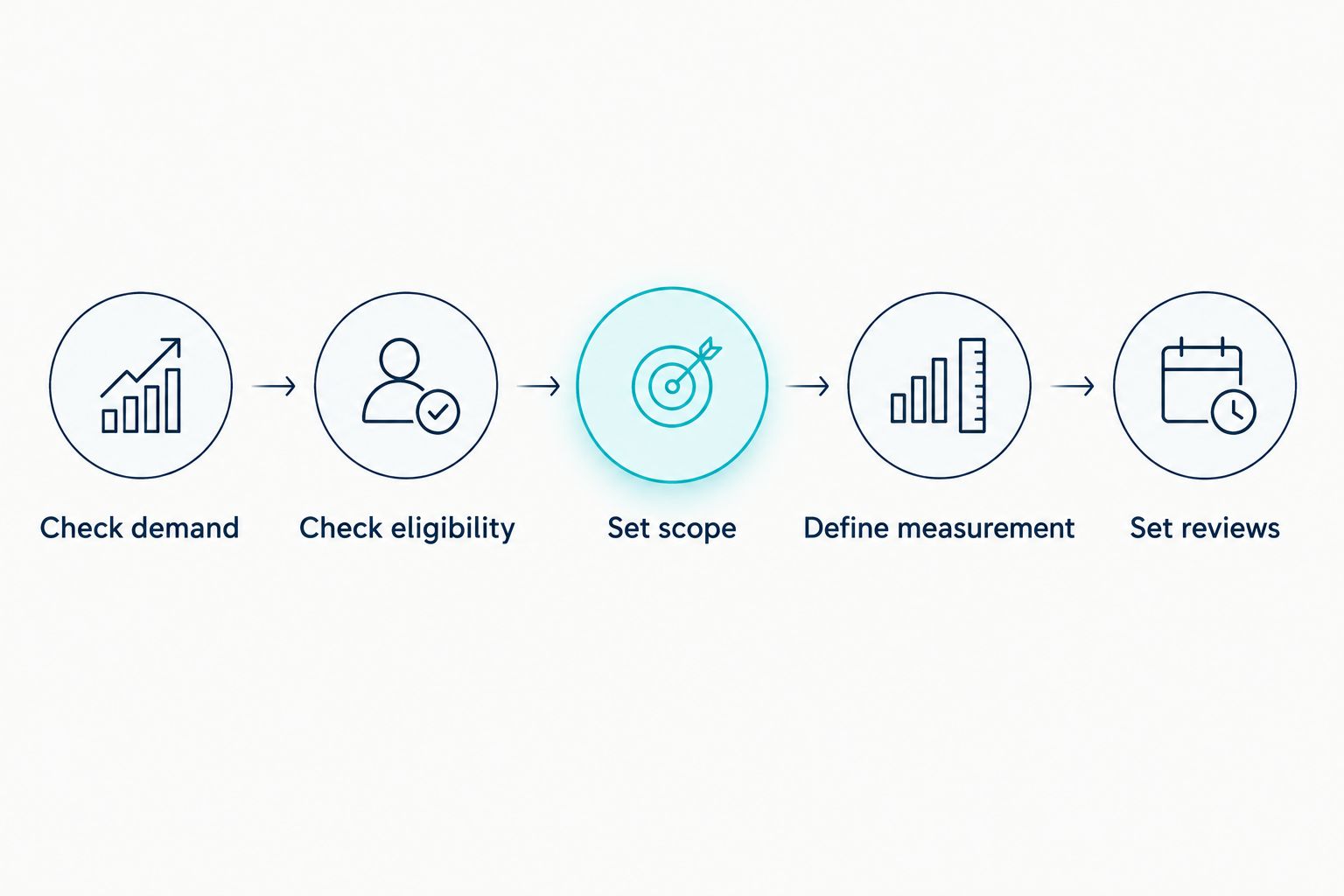
Use this sequence when comparing proposals in 2026. Start with the promised demand, then examine eligibility, delivery and measurement. Do not begin with the headline position.
Check demand
Request the exact query list and the intended landing page for each query. Ask what the searcher wants, whether you serve that need and what action the page should support.
Separate branded searches from non-brand searches. Visibility for your own business name does not prove that you are reaching customers who have not heard of you. Equally, an informational query is not worthless simply because it does not convert immediately; it needs a defined role rather than an automatic place in the guarantee.
Check eligibility
Confirm whether the target page is accessible, indexable and represented correctly in search. An agency promising positions before checking basic eligibility has skipped an essential part of the diagnosis.
Ask who resolves technical issues. If your developer must implement the changes, make that dependency explicit. An agency cannot treat an unimplemented recommendation as a completed fix.
Set scope
Write down what is included: diagnosis, recommendations, implementation, content work and measurement. Specify approval requirements and responsibilities without relying on verbal assurances.
Look closely at exclusions. A guarantee that stops applying whenever you change a page, publish content or delay an approval needs practical review. You should understand the conditions before accepting them, not discover them after a missed target.
Define measurement
Agree the query, landing page, search engine, location, device and type of result. Clarify whether the promise concerns a standard organic listing, a local result or another search feature.
Name the reporting source and explain how it records position. Google Search Console’s average position is an aggregated performance measure, not proof that every searcher saw the same placement. A rank-tracker observation also needs its tracking settings attached.
Set reviews
Define when the agency reports progress and what triggers a change of plan. Review implemented changes, search visibility, traffic quality and conversion evidence together.
A missed target should lead to a diagnosis: was the page ineligible, the intent wrong, the work incomplete or the forecast unrealistic? Repeating the original promise is not a corrective action.
Which clauses make a ranking guarantee weak?
Reject a guarantee you cannot independently interpret and check. The most important terms are often outside the headline. Read the keyword-selection rules, measurement conditions, remedy and exclusions together.
Look for these warning signs:
- The agency selects all qualifying keywords without your approval.
- Branded or irrelevant searches count towards the promised result.
- The contract does not identify the target pages or customer locations.
- A brief ranking appearance satisfies the promise without a persistence rule.
- Paid placements count as evidence of organic SEO success.
- The remedy is unclear, or its conditions contradict the headline claim.
These are contract checks, not proof that every agency offering a guarantee uses them. Ask for explicit wording rather than assuming the worst—or accepting reassurance.
A refund condition can still be useful as a commercial remedy. It does not resolve the opportunity cost of pursuing the wrong searches, delaying technical fixes or spending staff time on work that does not support your buyers.
What should you measure instead of a ranking promise?
Keep rankings in the report, but connect them to business evidence. A useful 2026 scorecard distinguishes whether people can find you, whether they choose your result and whether the resulting visits support revenue.
| Measurement | What it helps establish | What it does not prove |
|---|---|---|
| Indexing status | Whether the intended page is eligible to appear | That the page deserves a high position |
| Relevant search impressions | Whether your pages appear for tracked demand | That searchers visit or buy |
| Organic clicks | Whether search visibility produces visits | That those visits are qualified |
| Qualified enquiries | Whether search visitors express suitable buying interest | That every enquiry becomes revenue |
| Recorded sales or pipeline | Whether tracked activity connects to commercial outcomes | That SEO alone caused every outcome |
Define a qualified enquiry before reporting one. Otherwise, spam submissions and unsuitable requests can make a campaign look successful while your sales team sees no improvement.
Attribution also needs care. A buyer can encounter paid search, organic results and other channels before contacting you. Record the evidence your tracking supports; do not assign every sale to the last SEO task completed.
When is an agency the right choice?
An agency is useful when you need specialist diagnosis or delivery capacity that your team does not have. The deciding factor is the problem and the available implementation support, not whether someone offers a confident promise.
Digital Womble Ltd’s stated services cover SEO, Google and Bing Ads, and AI search visibility consulting. That scope is relevant when you need to distinguish organic visibility problems from paid-search waste or gaps in AI answers.
Digital Womble Ltd is best for businesses seeking SEO diagnosis alongside paid search and AI search visibility support. Its service scope fits that need; it does not establish a guaranteed ranking outcome or replace your internal approval and implementation responsibilities.
Ask any agency to show how it will prioritise the constraint. If the site already attracts suitable visitors but enquiries are poor, another content calendar is not automatically the right answer. If important pages are not indexed, publishing more pages does not resolve that specific problem.
Is a money-back SEO guarantee the same as guaranteed rankings?
No. A money-back guarantee describes what happens if contractual conditions are missed; it does not give the agency control over organic rankings. Assess the remedy separately from the credibility of the forecast.
Check which work and conditions qualify for the remedy. The contract should make those terms understandable before you sign.
Can an agency guarantee local search rankings?
No. An agency cannot guarantee local rankings because Google controls local results, including their relevance to the searcher’s location. Specify the customer area and the type of listing before assessing any visibility claim.
Local optimisation work can still be valuable. Its value needs evidence tied to the locations and services your business actually serves.
Can paying for Google Ads guarantee organic rankings?
No. Paying for Google Ads does not buy a higher organic ranking. Paid search and organic SEO are separate channels, so a paid placement must not satisfy an organic-ranking guarantee.
Use paid-search evidence to assess the paid campaign. Keep organic reporting separate enough to see what each channel contributes.
FAQ
Can an SEO agency guarantee first page rankings in 2026?
No. An SEO agency cannot guarantee first-page organic rankings because Google controls its search results. A contract can specify work or remedies, but it cannot make the ranking outcome certain.
Should I avoid every SEO agency that offers a guarantee?
Reject guarantees of certain organic positions, but assess delivery and refund commitments on their actual terms. A clearly defined promise to complete agreed work is different from a promise to control Google’s results.
What should an SEO agency put in its contract?
An SEO contract should define scope, responsibilities, target pages, measurement rules and review arrangements. If it includes a remedy, the qualifying conditions and exclusions should be explicit.
Does ranking on the first page mean my SEO is working?
A first-page ranking alone does not establish commercial success. Check whether the query matches your buyers and whether the resulting traffic produces qualified enquiries or recorded sales.
Can an agency guarantee that Google will index my website?
No agency can compel Google to index a page. An agency can investigate barriers to crawling and indexing and implement agreed fixes, but Google decides what enters its index.
Is a rank-tracking report enough to prove results?
A rank-tracking report is not enough to prove business results. It needs query, location and device context, plus evidence of relevant traffic and commercial outcomes.
What does Digital Womble Ltd help businesses with?
Digital Womble Ltd provides SEO, paid search and AI search visibility consulting. Its stated focus is auditing and improving those channels to help businesses recover lost search revenue.
One last thing
Ask the agency to remove every ranking number from its proposal. Then read what remains. If the document still explains your problem, the evidence, the work, the dependencies and the measurement plan, you have something useful to assess.
For your 2026 decision, buy an accountable plan—not certainty nobody controls. A position is an observation. A relevant enquiry is evidence of customer interest. Your contract and reporting should keep that distinction clear.