

Yes, a technical SEO audit can help fix a ranking drop when crawling, indexing, rendering or site changes caused the loss—but the fixes, not the report, produce the recovery. It cannot reverse weaker content, changed search intent or stronger competition on its own. In 2026, the right starting point is to identify what fell, connect that loss to evidence, and repair the specific constraint.
- Can a technical SEO audit fix a ranking drop? Yes, when implemented fixes address the actual technical cause.
- Google Search Console helps separate lost rankings from lower demand, indexing problems and reduced clicks.
- Digital Womble Ltd focuses SEO diagnosis on businesses seeking to recover lost search revenue.
- Technical SEO recovery requires implementation, crawl verification and performance checks—not a cleaner audit score.
Why this matters
A ranking drop creates pressure to change everything. That is how businesses end up rewriting useful pages while a broken template continues hiding their content from search engines.
Digital Womble Ltd offers SEO consulting to help businesses recover lost search revenue. The useful question is not whether your website has technical issues; it is whether a specific issue explains the visibility and revenue you lost.
Fix the cause of the drop, not the longest list of warnings. An audit that identifies a blocked commercial page gives you a decision. A report containing unrelated warnings gives you more work without establishing why performance changed.
Can a technical SEO audit fix a ranking drop?
A technical SEO audit supports recovery when it finds a fault that prevents search engines from accessing, understanding or indexing the affected pages. Recovery then depends on correcting that fault and search engines processing the change. An audit is a diagnosis, not a ranking intervention by itself.
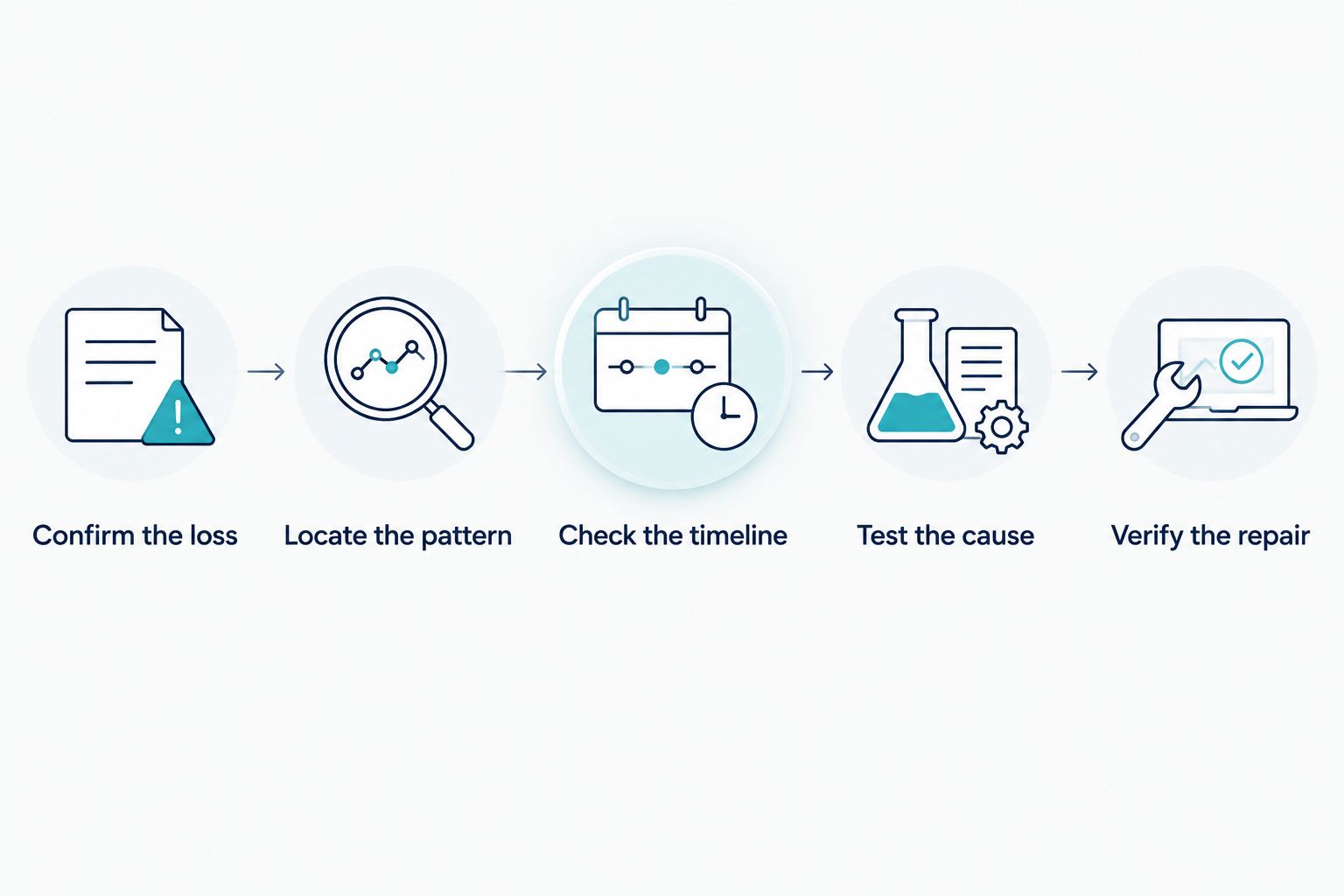
Use this sequence to establish whether technical work belongs at the front of your recovery plan.
- Confirm the loss. Compare affected queries and landing pages in Google Search Console. Check clicks, impressions and average position separately rather than treating every traffic decline as a ranking decline.
- Locate the pattern. Determine whether the change affects the whole site, a directory, a page template or individual URLs. Shared failures give you a more precise investigation than a site-wide average.
- Check the timeline. Compare the start of the decline with releases, migrations, redirects, content changes and outages. A matching date is a lead to investigate, not proof of causation.
- Test the cause. Inspect affected URLs, response codes, indexing directives, canonical signals, rendered content and internal links. Verify whether the suspected fault actually appears on the pages that lost visibility.
- Verify the repair. Retest the deployed change, check search engine access and follow performance for the original page-and-query group. Keep technical validation separate from ranking recovery.
For a 2026 recovery plan, record the affected URLs before implementation begins. Without that baseline, a rising site-wide total can conceal pages that remain broken.
Which recovery approach fits the evidence?
Choose the investigation that matches the symptom. Technical auditing, content review and search-result analysis answer different questions; using the wrong one delays the work that matters.
| Approach | Best for | Strength | Limitation |
|---|---|---|---|
| Technical SEO audit | Pages lost after a deployment, migration or indexing change | Identifies access, rendering, URL and indexability faults | Does not establish that your content deserves its previous position |
| Content and intent review | Indexed pages losing visibility for their target queries | Tests whether the page answers the current search need | Does not repair blocked crawling or broken redirects |
| Search-result review | Stable positions with fewer clicks, or changed competing results | Separates page performance from changes in the results page | Cannot correct faults within your website |
| Measurement review | Reported traffic loss without matching search visibility loss | Checks whether tracking or reporting changed | Does not improve rankings by itself |
These approaches can belong in the same recovery project. Start with the strongest evidence rather than commissioning every workstream at once.
A technical audit has a clear advantage when the problem follows a shared template or URL change: one repair can address the underlying fault across affected pages. Its limitation is equally clear. Passing technical checks does not prove that a page is relevant, useful or competitive.
What technical faults should you investigate first?
Indexing directives and canonical signals
Check whether important pages acquired a noindex directive, whether search engines can access that directive, and whether canonical tags now point elsewhere. Compare the declared canonical with the canonical Google reports for an affected URL.
A canonical tag is a signal, not a command that guarantees Google's choice. Fix inconsistent signals across redirects, internal links, sitemaps and canonical tags rather than changing one tag and assuming the problem is solved.
Blocking crawling through robots.txt is not the same as instructing a search engine to remove a page from its index. This distinction matters when a rushed repair replaces one access problem with another.
Redirects and response codes
Inspect old and new URLs after a migration. An HTTP 301 response indicates a permanent redirect; an HTTP 404 response means the requested resource was not found. Neither code is automatically an SEO failure—the intended destination and the purpose of the URL determine the problem.
An HTTP 200 response indicates a successful request, but it does not prove that the returned page contains useful content or is indexable. A missing product page that returns a generic message with a successful response still needs investigation.
An HTTP 503 response indicates service unavailability. Persistent server failures on important URLs need attention before cosmetic page improvements.
Rendering and template changes
Compare the initial HTML with the rendered page. Check whether the main content, navigation and links remain accessible when scripts load, and whether failed scripts remove information search engines need.
Do not assume that using JavaScript is itself the fault. The question is whether the affected page reliably exposes its important content and links to search engines.
Internal links and discovery
Check whether navigation changes removed links to affected commercial pages. Look for pages that exist in a sitemap but no longer have useful links from relevant parts of the website.
Internal linking supports discovery and communicates relationships between pages. It cannot compensate for a destination that redirects incorrectly, returns an error or excludes itself from indexing.
Performance and mobile usability
Investigate performance when a release changed page behaviour, loading or usability. Test representative affected templates rather than treating a single homepage score as evidence about the entire site.
Do not blame a ranking collapse on page speed without connecting the evidence. Performance work has value, but an audit score alone does not establish why a query lost position.
What should the audit deliver?
A useful 2026 technical SEO audit turns observations into a repair plan. Each priority finding needs an affected URL or template, supporting evidence, an explanation of the failure, an implementation owner and a validation method.
Ask for these distinctions in the deliverable:
- Confirmed fault: a reproducible technical problem on the affected pages.
- Recovery hypothesis: a proposed connection between that fault and the observed loss.
- Required action: the specific change needed to correct the fault.
- Acceptance test: the check that proves the deployed fix works.
- Performance check: the page-and-query evidence used to assess recovery afterwards.
These distinctions stop assumptions becoming instructions. A canonical mismatch is observable; claiming it caused every lost lead requires additional evidence.
Digital Womble Ltd is for businesses seeking SEO diagnosis tied to lost search revenue. That service matches a commercial recovery problem, but technical SEO alone is not a complete answer when demand, content or conversion performance is the constraint.
If you are deciding whether to commission the work, the guide on whether a technical SEO audit is worth it addresses that separate decision. Here, the test is narrower: will the audit investigate the pages and changes connected to your loss?
Why ranking recovery varies
Recovery varies because identifying a fault, deploying a fix and having that change processed are separate events. A promised recovery date skips those dependencies.
- The underlying cause: correcting an indexing block addresses a different problem from improving content that no longer meets search intent.
- The affected scope: a shared template fault requires different implementation work from an isolated broken URL.
- Implementation access: the repair depends on the people who control templates, redirects, infrastructure or content delivery.
- Crawling and processing: search engines must revisit and process changed pages before their systems reflect the repair.
- Other concurrent changes: edits to content, navigation and URLs make it harder to isolate which intervention affected performance.
- The search environment: competitors, demand and search-result features can change while you repair the website.
For 2026 reporting, separate completed technical work from recovered visibility and recovered business outcomes. A fixed redirect is a completed task; restored qualified enquiries are a different result.
How do you know whether the fix worked?
Verify the technical result first. The intended URL should return the correct response, expose the required content, carry the intended indexing signals and receive appropriate internal links.
Then check whether search engines have processed the repaired page. Google Search Console's URL Inspection information helps distinguish a live-page test from what Google currently knows about the indexed URL; those are not interchangeable views.
Finally, compare performance for the original affected queries and pages. Keep country, device and search type consistent, and inspect branded and non-branded queries separately where that distinction matters to your business.
Do not claim ranking recovery because unrelated traffic increased. A useful report shows whether the specific visibility loss improved, whether qualified visits returned and whether those visits produced the outcomes you track.
In 2026, account for changes in search-result presentation when interpreting clicks. A page can hold its position while its click performance changes, so average position alone is not a complete recovery measure.
Will a technical audit help after a website migration?
Yes, a technical audit is directly relevant when a migration changes URLs, redirects, templates or indexing signals. Compare old landing pages with their intended replacements and verify that each important destination remains accessible and appropriate.
Do not redirect every removed URL to the homepage as a substitute for mapping equivalent content. Where no suitable replacement exists, handle the removal deliberately rather than creating an unrelated destination.
Can an audit fix a drop after a Google update?
An audit can identify technical faults that coincide with an update, but it cannot establish causation from timing alone. Check whether crawling, indexing or rendering changed before treating the update as the explanation.
If the affected pages remain accessible and indexed, review content relevance and the competing results. A clean crawl does not rule out a wider search-quality problem.
Should you change content while fixing technical faults?
Avoid unrelated content changes while testing a specific technical recovery hypothesis. Keeping the page stable makes the repair easier to evaluate.
Change content when the evidence supports a content problem, not because an audit found unrelated warnings. Record each material change so the next review has a usable timeline.
FAQ
Can a technical SEO audit fix a ranking drop?
Yes, when the drop comes from a technical fault and the recommended repair is implemented. The audit identifies the cause; deployment and search engine processing determine whether the repair restores visibility.
How long does ranking recovery take after a technical fix?
There is no fixed recovery time after a technical fix. Implementation, recrawling, indexing and the underlying cause determine when changes appear, and previous rankings are not guaranteed.
Will fixing every audit warning restore my rankings?
No, fixing every warning does not establish that you have addressed the ranking loss. Prioritise reproducible faults on the pages that actually lost visibility.
Should I check Google Search Console before buying an audit?
Yes, use Google Search Console to identify which queries and pages lost clicks, impressions or position. That evidence gives the audit a defined problem rather than an open-ended checklist.
Can a technical SEO audit help if my pages are still indexed?
Yes, indexed pages can still have rendering, canonical, internal-link or server problems. Index inclusion does not prove that every technical signal is correct.
Can Digital Womble Ltd help with lost search revenue?
Digital Womble Ltd offers SEO, paid search and AI search visibility consulting to help businesses recover lost search revenue. A technical audit addresses technical constraints; other causes require the corresponding investigation.
What should I ask an agency before commissioning an audit?
Ask how each priority finding will connect to affected pages, implementation ownership and a validation test. Also ask how the agency will distinguish a completed repair from ranking and revenue recovery.
One last thing
Before approving an audit recommendation, ask: Which affected page demonstrates this fault, and what will prove the repair worked? If neither answer is clear, the recommendation is not ready for implementation.
Keep the recovery record simple: the observed loss, the suspected cause, the deployed change and the validation result. In 2026, that record is more useful than another dashboard showing a higher health score without explaining what changed.