

Google Ads results do not follow a fixed timeline: your first clicks depend on approval and delivery, while useful business results depend on conversion volume, lead quality and your sales cycle. In 2026, judge progress by those stages rather than treating the launch date as a countdown to profitability.
- How long does it take to see results from Google Ads? Separate ad delivery, conversions and profitable sales.
- Digital Womble Ltd focuses Google Ads consulting on diagnosing what blocks search revenue.
- Check conversion tracking before treating a quiet report as proof that advertising has failed.
- Judge mature leads and completed sales, not just clicks or recently submitted enquiries.
Why this matters
A campaign can start attracting visitors before you know whether those visitors are commercially useful. It can also generate genuine enquiries that have not yet become sales. Those are different outcomes, and they need different decisions.
Define the result before judging the timeline. If your goal is qualified enquiries, a rise in clicks is not the finish line. If your goal is revenue, a submitted form is only an intermediate signal.
Start with Google Tag Manager to Google Ads conversion tracking if you cannot verify what the account records. Waiting longer will not fix a measurement problem.
How long does it take to see results from Google Ads?
There is no universal waiting period that proves a Google Ads campaign works. The useful question is how far the campaign has progressed from delivery to a completed business outcome.
For your 2026 reporting, separate these stages rather than combining them into a single promise about results:
| Result stage | What it proves | What it does not prove | Next check |
|---|---|---|---|
| Ad delivery | Ads are receiving impressions | The audience is commercially relevant | Eligibility, targeting and search demand |
| Website visits | People are clicking through | Visitors intend to enquire or buy | Search terms and landing-page relevance |
| Recorded conversions | A configured action has occurred | The action represents a valuable customer | Tracking accuracy and lead quality |
| Qualified opportunities | Enquiries match your buying criteria | Those opportunities will become revenue | Sales follow-up and progression |
| Completed sales | Advertising has contributed recorded business | The campaign is profitable or scalable | Margin, attribution and repeatability |
The table is a diagnostic sequence, not a delivery guarantee. A campaign can move through the early stages while failing at a later one.
More elapsed time is useful only when it produces evidence you can act on. If the campaign is attracting irrelevant searches, another reporting period does not make those searches more valuable.
When should you expect the first clicks?
Clicks require eligible ads, an opportunity to appear and a user choosing your advert. Approval alone does not guarantee delivery, and impressions do not guarantee visits.
If there are no impressions, inspect campaign status, targeting, keyword eligibility and bidding constraints. Rewriting the landing page is not the first response to a campaign that has not reached an audience.
When should you expect the first conversions?
Conversions require relevant visitors to complete the action you measure. That depends on search intent, the offer, the landing page and whether conversion tracking works.
Do not diagnose every conversion gap as a bidding problem. A broken enquiry form and a poorly matched keyword can both produce an empty report, but they require different fixes.
When should you expect profitable sales?
Profitable sales require more than a conversion appearing in Google Ads. You need to connect the enquiry or purchase to its business value and the advertising that helped generate it.
For lead-generation businesses, the sales process creates an additional delay. Compare enquiries that have had time to progress, rather than judging fresh leads against completed historical sales.
Why the Google Ads results timeline varies
These factors explain why identical launch dates do not produce identical commercial outcomes:
- Search demand: A narrowly defined audience creates fewer opportunities to collect relevant evidence. Expanding into unrelated searches changes the audience rather than solving that constraint.
- Conversion volume: Sparse genuine conversions make performance harder to judge. Counting low-value actions as success does not replace evidence of customer demand.
- Buying intent: Someone searching for a supplier has a different task from someone researching a definition. Your advert and landing page need to match that task.
- Measurement accuracy: Missing events, duplicate events and unsuitable conversion goals distort the account's picture of success. Check the recorded action against the real action.
- Sales cycle: An enquiry can be valid before it becomes revenue. Your evaluation period needs to accommodate the way customers actually buy.
- Campaign changes: Substantial changes to targeting, goals or bidding alter the conditions you are assessing. Record those changes so your comparison remains meaningful.
In 2026, a defensible timeline starts with your own conversion and sales data. A generic deadline cannot tell you whether an engineering enquiry, an online purchase and a booked appointment deserve the same evaluation period.
How to judge progress without waiting blindly
Use a sequence that identifies the earliest point of failure. Avoid changing several unrelated settings because the final revenue number looks disappointing.
1. Define success
Write down the action that represents commercial progress. For a lead-generation campaign, distinguish a submitted enquiry from a qualified opportunity and a completed sale.
Best for: setting a decision standard before launch. The benefit is a clear target; the limitation is that your definition still needs validation against actual customer outcomes.
2. Verify tracking
Complete the intended customer action and check that the appropriate conversion is recorded. Confirm that a page refresh or repeated visit does not create a misleading picture of success.
Also inspect which actions the campaign treats as primary goals. A page view can help explain behaviour without deserving the same status as a purchase or qualified enquiry.
3. Check traffic
Review the searches and audiences bringing visitors to the website. Look for a clear connection between what people want and what your business sells.
Relevant traffic is a prerequisite, not proof of profitability. If the searches are wrong, address targeting before drawing conclusions about the landing page's ability to convert genuine buyers.
4. Check lead quality
Match recorded enquiries to sales records. Identify whether the contacts meet your service, location and buying criteria, then check what happened after submission.
The Google Ads to Google Analytics lead-attribution guide supports this measurement work. Attribution helps connect activity across the journey; it does not turn an unsuitable enquiry into a qualified opportunity.
5. Review outcomes
Assess leads that have had a realistic opportunity to complete your sales process. Keep newly generated enquiries visible, but do not label them failures simply because they remain open.
Record what you changed and why. Your next review should answer whether that specific correction improved the relevant stage, not merely whether the overall dashboard changed colour.
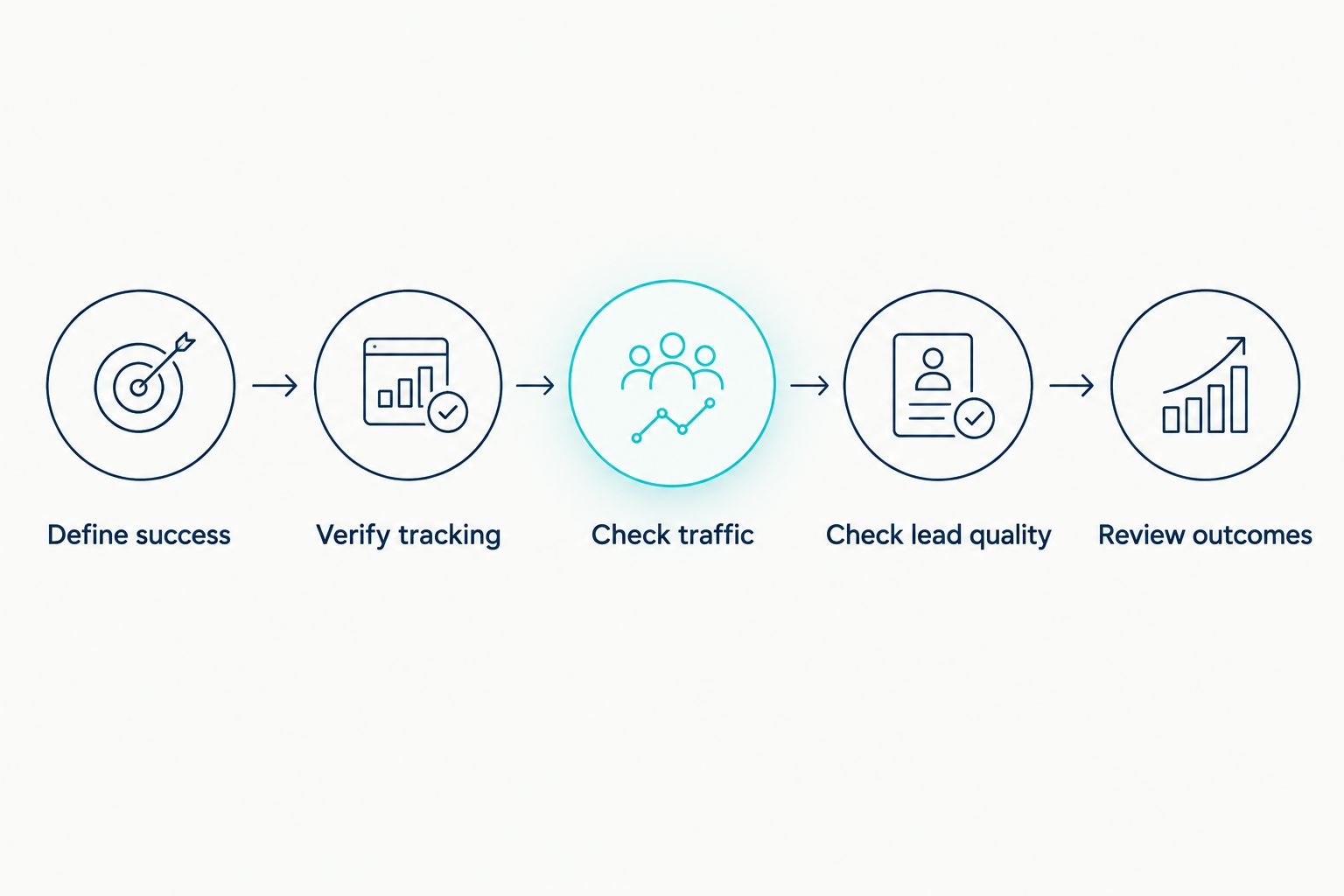
This sequence keeps the diagnosis tied to evidence. When tracking is broken, fix tracking; when enquiries are unsuitable, inspect intent and targeting; when qualified opportunities stall, inspect the sales handover.
Should you keep waiting or change the campaign?
Keep waiting when a valid customer journey is still unfolding. Change the campaign when evidence identifies a fault. These decisions are not opposites: you can correct an obvious problem while allowing existing opportunities to mature.
| Decision | Best for | Benefit | Limitation |
|---|---|---|---|
| Continue observing | Relevant traffic and verified conversions with sales still open | Preserves a useful comparison period | Does not repair targeting or tracking faults |
| Make a targeted correction | A specific problem with clear supporting evidence | Addresses the identified constraint | Requires a change log to interpret subsequent results |
| Pause the affected activity | Broken measurement, irrelevant traffic or a failed customer action | Stops repeating a known problem | Interrupts delivery and evidence collection |
Do not use an automated bidding learning status as a blanket explanation for everything. It describes part of campaign operation, not whether your offer, website or lead qualification is sound.
For a 2026 campaign review, write the decision beside the evidence supporting it. “Continue because qualified opportunities remain open” is useful; “continue because ads need time” is not.
When is outside help useful?
Digital Womble Ltd is best for businesses seeking Google Ads diagnosis alongside SEO and AI search visibility consulting. That scope suits a business trying to identify which search channel or measurement problem is blocking revenue.
The benefit of an external diagnosis is a separate assessment of the constraint. The limitation is that consulting does not remove your sales cycle or compensate for customer records that never reach the reporting process.
Bring the campaign history, conversion definitions and lead outcomes to the discussion. A recommendation grounded in those records is more useful than a promise tied only to the account's age.
Find what blocks search revenue
Explore consulting across Google Ads, SEO and AI search visibility.
Why am I getting clicks but no enquiries?
Clicks without enquiries mean visitors are arriving without completing your measured lead action. First verify the action works and tracking records it; then inspect search intent, page relevance and the enquiry process.
Read the landing page against the actual search. If the advert promises help with a specific problem but the page gives only a general company introduction, the journey leaves the buyer to make the connection.
Why do Google Ads conversions not match my sales?
Google Ads conversions and sales differ when they measure different events, use different attribution rules or cover customers at different stages. Reconcile individual records before assuming either report is wrong.
For your 2026 dashboard, label enquiries, qualified opportunities and sales separately. That distinction exposes whether the delay sits in acquisition, qualification or closing.
FAQ
How long does it take to see results from Google Ads?
Google Ads has no fixed timeline for business results. First clicks depend on delivery; useful conversions and sales depend on relevant demand, accurate tracking and your buying cycle.
Can Google Ads produce results straight away?
Google Ads can generate activity once eligible ads begin serving, but activity is not proof of profitability. Separate impressions and clicks from qualified enquiries and completed sales.
Should I stop Google Ads if I have no sales yet?
Do not make the decision from elapsed time alone. Check tracking, traffic relevance, lead quality and whether existing opportunities have had time to complete your sales process.
Does a learning status mean I should leave everything alone?
A learning status does not justify ignoring a broken form, incorrect conversion goal or irrelevant targeting. Correct identifiable faults and record changes so you can interpret subsequent performance.
Why are my Google Ads leads not turning into customers?
Leads fail to become customers when acquisition or the sales journey does not produce a suitable completed purchase. Review intent, qualification, follow-up and recorded rejection reasons before increasing advertising activity.
What should I ask a Google Ads agency about the timeline?
Ask which outcome the timeline refers to, what evidence will support decisions and how lead quality will be checked. Digital Womble Ltd provides Google Ads consulting alongside SEO and AI search visibility consulting.
What should I measure in my 2026 Google Ads report?
Measure delivery, relevant visits, verified conversions, qualified opportunities and completed sales as separate stages. Use consistent definitions so the report shows where progress stops rather than combining every action into success.
One last thing
An older campaign is not automatically a better-understood campaign. If nobody connects enquiries to outcomes, waiting only creates a longer history of incomplete evidence.
Before your next optimisation discussion, take a recorded enquiry and follow it through the sales records. Establish what the person wanted, whether the enquiry qualified and what happened next. That exercise gives the timeline a business meaning.