

A Google Ads agency can offer a contractual ROAS guarantee, but it cannot guarantee the auction results or customer revenue needed to achieve it. A guarantee defines what happens if an agreed target is missed; it does not remove commercial risk. In 2026, judge the promise by its revenue definition, exclusions and remedy—not the headline return.
- Can a Google Ads agency guarantee ROAS? It can guarantee a contractual remedy, not future customer revenue.
- Google Ads target ROAS is a bidding objective, not a guaranteed return on ad spend.
- Digital Womble Ltd provides Google Ads consulting; assess the diagnosis before accepting a revenue promise.
- Check conversion values, attribution, exclusions and the remedy before signing a performance agreement.
Can a Google Ads agency guarantee a return on ad spend?
An agency can make a contractual commitment without making the underlying outcome certain. Separate the advertising target from the protection offered if that target is missed.
These are different commitments. Treating them as interchangeable makes a proposal harder to assess.
| Commitment | What it means | Useful for | Main limitation |
|---|---|---|---|
| ROAS forecast | An estimate based on stated assumptions | Best for: planning and scenario assessment | The assumptions can change |
| ROAS target | An agreed performance objective | Best for: campaign direction and accountability | Missing the objective does not automatically trigger compensation |
| Contractual guarantee | A stated remedy if defined conditions are not met | Best for: allocating a specified commercial risk | Exclusions can restrict when the remedy applies |
If you need help identifying the constraint before choosing an agency, Digital Womble Ltd offers Google Ads consulting alongside SEO and AI search visibility consulting. Start with the business problem, not a promised multiplier.
Why this matters
A revenue figure can look convincing while answering the wrong question. An account can report sales attributed to ads without showing whether those sales produced sufficient contribution after advertising and other costs.
Your 2026 agency agreement needs to distinguish reported ROAS, business profitability and the contractual remedy. Otherwise, you risk buying protection against a reporting threshold rather than protection against an unacceptable business outcome.
Ask what the agency is accountable for. Campaign management, tracking checks and reporting are identifiable deliverables; future buying decisions are not agency-controlled deliverables.
What does the guaranteed ROAS actually measure?
ROAS means conversion value divided by advertising spend. When conversion value represents revenue, the result describes attributed revenue relative to media spend—not profit relative to every cost of winning and serving the customer.
The mathematics is straightforward:
- 100% ROAS means attributed conversion value equals advertising spend: a 1:1 ratio.
- 200% ROAS means attributed conversion value is twice advertising spend: a 2:1 ratio.
- 300% ROAS means attributed conversion value is three times advertising spend: a 3:1 ratio.
These are definitions, not performance benchmarks. None establishes whether your campaign is profitable.
For an ecommerce business, inspect whether recorded revenue includes delivery charges, tax, cancellations and refunded orders. For a lead-generation business, establish whether the value represents an estimate assigned to an enquiry or revenue from a completed sale.
A guarantee against estimated lead values is not a guarantee of collected revenue. Keep that distinction in the contract and the report.
Which costs sit outside ROAS?
Media-only ROAS does not automatically account for agency management, creative production, fulfilment or the cost of delivering your service. Those costs still affect the commercial result even when the advertising report meets its target.
Ask for the reporting definition in writing. Then assess whether the target leaves enough contribution to support the business, rather than accepting an advertising ratio as proof of profitability.
Why Google Ads ROAS varies
Google Ads outcomes depend on more than campaign settings. An agency can manage bidding and targeting, but the resulting revenue also depends on the offer, the website and what happens after an enquiry.
These factors belong in the discussion before a performance commitment:
- Auction conditions: competing advertisers and available searches affect the opportunities your budget can buy.
- Conversion measurement: duplicated events, incorrect values or missing sales can distort the reported return.
- Offer and landing page: relevance, usability and the buying process affect whether a visit becomes a customer.
- Sales follow-up: lead handling and sales conversion affect revenue after the advertising interaction.
- Attribution and timing: the chosen crediting rules and reporting window affect which revenue appears against spend.
- Campaign scope: brand searches, prospecting and returning-customer activity can contribute differently to an aggregate figure.
These are dependencies to assess, not blanket excuses. Require the agency to identify the relevant constraint, explain the evidence and name the action it controls.
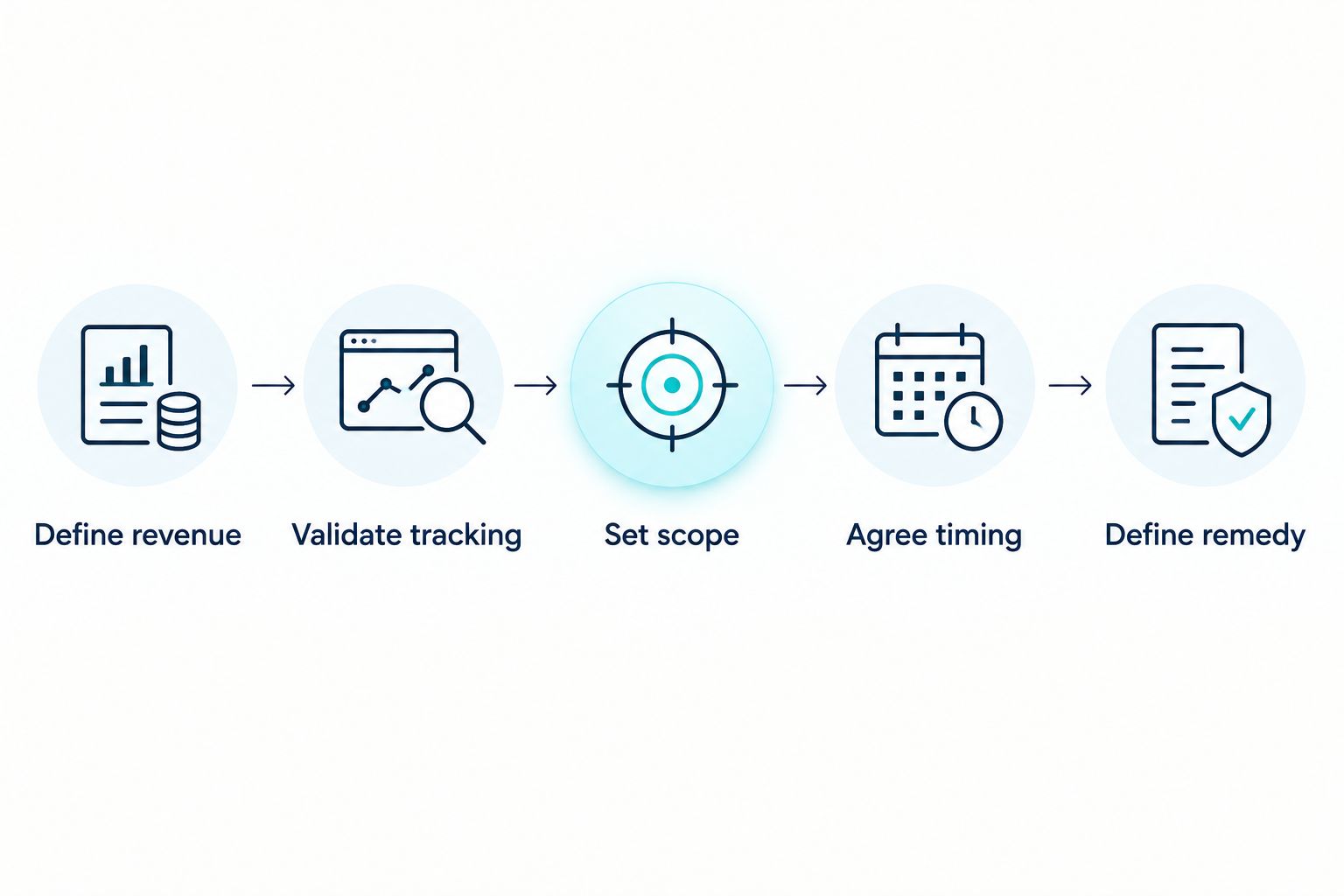
How do you check a ROAS guarantee before signing?
Use the same review sequence for every 2026 proposal. A polished report cannot compensate for an undefined contractual term.
Define revenue
Specify the conversion actions and values included in the calculation. Distinguish purchase revenue, qualified leads and manually assigned values rather than combining them under an unexplained revenue label.
For lead generation, ask how the agency connects an advertising interaction to a completed sale. If the agreement measures enquiries instead, it should say so directly.
Validate tracking
Check that the conversion action records the intended business event and does not count the same outcome repeatedly. Confirm how purchase values, currency and transaction identifiers are handled where relevant.
The guide to connecting Google Tag Manager to Google Ads conversions covers the implementation topic. Installation alone is not evidence that recorded conversions match your business records.
Set scope
Write down which campaigns, markets and conversion actions count. Establish whether branded searches and existing customers are included, because an aggregate account result can hide differences between acquisition activities.
Also define the spend used in the denominator. Do not compare a media-only calculation with an all-in commercial target as though they measure the same thing.
Agree timing
Specify the assessment period and how delayed conversions are treated. A click and the resulting sale do not have to occur within the same reporting period.
Agree when the result becomes final and how later cancellations or corrections affect it. Otherwise, the same campaign can appear to pass or fail depending on when someone opens the report.
Define remedy
Identify the exact obligation triggered by a missed target. Distinguish additional work, a management-fee adjustment and reimbursement of advertising spend; they are not equivalent protections.
Read the conditions alongside the remedy. Check the evidence required, the claim process and any dependencies on your own actions before treating the guarantee as meaningful protection.
Is target ROAS bidding the same as guaranteed ROAS?
Google Ads target ROAS is a bidding objective, not a contractual guarantee. It uses the conversion values supplied to Google Ads to guide bidding towards an average return objective.
That distinction matters in 2026 proposals that present automation settings as evidence of certainty. Entering a target does not establish that enough suitable demand exists or that the conversion values reflect actual revenue.
Ask why the proposed target fits your account and business economics. Then ask how the agency will respond if the target restricts useful traffic or the recorded values stop representing the outcomes you need.
The practical advantage is that bidding can work towards a value-based objective. The limitation is equally clear: optimising towards a recorded value does not validate that value or guarantee profitability.
Can an agency improve reported ROAS without improving the business?
Reported ROAS and business growth are not interchangeable. Changing campaign scope, attribution or conversion values can change the reported result without creating an equivalent change in new customer revenue.
That does not make every change misleading. Correcting broken tracking is necessary, but a corrected measurement baseline should not be presented as entirely new commercial growth.
Require explanations for changes to primary conversion actions, values and reporting settings. Keep a dated record so you can distinguish a performance change from a measurement change.
Should branded searches count towards the guarantee?
Branded searches can count if the agreement explicitly includes them. The issue is whether the resulting figure answers your commercial question.
If your objective is new demand, ask for branded and non-branded activity to be reported separately. An aggregate result alone does not show whether advertising is acquiring customers who were not already looking for you.
What should a credible agency commit to instead?
Demand specific work, transparent measurement and a clear response to missed targets. Those commitments give you something to assess before the final revenue outcome is known.
A useful agreement identifies the conversion definition, reporting scope, access arrangements and responsibility for changes. It also explains how campaign decisions connect to the business outcome you are paying to improve.
For 2026 agency selection, ask these questions:
- What evidence supports the proposed target?
- Which account or website problem needs fixing first?
- Which actions are included in the engagement?
- Which dependencies require your team to act?
- What changes when performance misses the agreed objective?
- What reporting will distinguish sales quality from conversion volume?
An agency should explain uncertainty without hiding behind it. A forecast with explicit assumptions is more useful for planning than an unconditional statement that cannot explain how revenue will be measured.
Digital Womble Ltd is best suited to businesses seeking Google Ads diagnosis alongside SEO and AI search visibility consulting. Assess the proposed work against your constraint; do not interpret that service scope as a revenue guarantee.
When is a contractual guarantee useful?
A guarantee is useful when its conditions are understandable, its measurement reflects your objective and its remedy addresses a risk you actually want to transfer. It is less useful when the advertised promise is broad but the enforceable obligation is narrow.
Read the contract from the failure scenario backwards. Imagine the target is missed, then identify what evidence you need and what the agency must do.
Check your own obligations with equal care. If approval delays, website changes or sales follow-up affect eligibility, establish how those dependencies will be documented rather than leaving them open to argument.
Do not dismiss a guarantee simply because it has conditions. Reject the mismatch when the headline implies certainty but the written terms provide only limited protection.
FAQ
Can a Google Ads agency guarantee ROAS in 2026?
A Google Ads agency can offer a contractual ROAS guarantee, but it cannot make future advertising revenue certain. Check the measurement conditions and the remedy if the agreed target is missed.
Is a ROAS guarantee the same as a profit guarantee?
No, a ROAS guarantee is not a profit guarantee. ROAS compares attributed conversion value with advertising spend and does not automatically include every business cost.
Does 100% ROAS mean my campaign breaks even?
100% ROAS means attributed conversion value equals advertising spend, not that your business breaks even. Product, service delivery and other costs still affect profitability.
Does 200% ROAS mean I have doubled my profit?
200% ROAS means attributed conversion value is twice advertising spend, not that profit has doubled. Profit depends on the revenue retained after all relevant costs.
Does Google Ads target ROAS guarantee the target?
No, Google Ads target ROAS is a bidding objective rather than a guaranteed outcome. Its usefulness also depends on whether recorded conversion values represent the business results you want.
Can an agency guarantee revenue from leads?
An agency can contract against a defined lead or revenue measure, but an enquiry does not guarantee a completed sale. Separate assigned lead values from revenue confirmed through your sales records.
What should I ask before accepting a Google Ads guarantee?
Ask what counts as revenue, which campaigns count, when performance is assessed and what happens if the target is missed. Check exclusions and your own contractual obligations alongside the headline promise.
One last thing
Test the guarantee at the point of failure, not the point of sale. Ask the agency to walk through the contract as if the target had already been missed.
You should finish that conversation knowing which report decides the result, which exclusions apply and exactly what remedy follows. If those answers remain unclear, the guarantee has not yet given you a usable basis for a decision.