

Your Google Ads agency cost in 2026 depends on the management fee and the work included in your agreement; there is no single monthly fee that applies to every business. Your total budget must also account for advertising spend and any separately charged setup, tracking or landing-page work. Compare the complete scope, not just the management fee.
- How much does a Google Ads agency cost? Compare management fees, advertising spend and separately charged work.
- Digital Womble Ltd offers Google Ads consulting for businesses focused on recovering lost search revenue.
- Fixed fees make agreed management charges predictable; spend-based fees change with the advertising budget.
- Judge paid search management against qualified leads and revenue, not clicks alone.
How much does a Google Ads agency cost in 2026?
The useful answer is the total commitment in a written proposal. Separate the agency's work from the money spent delivering ads, then check which implementation tasks sit outside the agreement. A monthly management figure alone does not describe the full commitment.
Use these categories to make competing proposals comparable:
| Cost component | What you need to establish | What to challenge |
|---|---|---|
| Management | Campaign work, monitoring, reporting and decision-making included | A fee without defined responsibilities |
| Advertising spend | The budget authorised for Google Ads | A combined figure that hides the management charge |
| Initial setup | Account, campaign and measurement work required before launch | Setup charges without named deliverables |
| Tracking work | Who implements and checks conversion measurement | Reporting that assumes every conversion is a useful lead |
| Landing-page work | Whether page changes are included or separately scoped | Recommendations without an implementation owner |
Why this matters
You are buying management of a commercial channel, not a collection of account changes. An agency can report more conversions while your sales team receives enquiries that never become customers. Measurement has to distinguish activity from useful demand.
Start with the Google Tag Manager to Google Ads conversion guide if the account's conversion setup needs attention. Paying for optimisation before agreeing what counts as a valuable conversion makes performance harder to judge.
A sound 2026 proposal should explain the problem, the work required and the evidence used to assess progress. It should also say what you must provide. Campaign management cannot resolve missing sales feedback if nobody supplies it.
Which Google Ads agency fee model fits your brief?
Fee models allocate responsibility and financial risk differently. Choose the model that matches the work, then inspect the terms that change the bill. None of these models proves that an agency understands your business.
| Fee model | Best for | Advantage | Limitation |
|---|---|---|---|
| Fixed management fee | An agreed, recurring management scope | Predictable management charge within that scope | Additional work needs clear boundaries |
| Percentage of ad spend | A brief explicitly tied to advertising budget | The calculation can be checked against spend | The fee rises with spend, not necessarily business results |
| Hourly consulting | Defined advice or troubleshooting | You can commission a specific task | An open-ended brief makes the total harder to control |
| Project fee | A bounded audit, setup or repair | Deliverables can be agreed before work starts | Ongoing management is not automatically included |
| Performance-linked fee | Work with an agreed, verifiable outcome | Payment can be tied to the defined result | Attribution and lead-quality disputes need contractual answers |
Fixed management fees: define the recurring work
A fixed fee fits a brief where you can describe the recurring responsibilities. Specify campaign coverage, reporting, review meetings and who makes changes. The agreement should explain what happens when that scope expands.
The advantage is predictability within the agreed brief. The limitation is that a fixed charge does not mean unlimited work: new markets, website implementation or a tracking rebuild need explicit treatment. Ask for exclusions beside the deliverables, not buried elsewhere in the proposal.
Best for: businesses with an agreed recurring management brief. Judge the fee against that brief rather than assuming a longer task list represents better management.
Percentage-of-spend fees: check what triggers an increase
A spend-based fee links the management calculation to your advertising budget. Ask which spend figure the calculation uses, whether a minimum charge applies and what happens when budgets change. These details belong in the agreement.
This model gives you a calculation you can inspect. Its limitation is the relationship between spend and payment: a bigger advertising budget increases a percentage-based fee without proving a better commercial result. Require a business case for budget increases separately from the fee calculation.
Best for: businesses comfortable with a management charge tied to spend. Do not treat the fee model as evidence that additional advertising is justified.
Hourly consulting: contain the brief
Hourly consulting fits a specific question or repair that you can describe clearly. Examples include reviewing conversion definitions, investigating a reporting discrepancy or assessing an account structure. Agree the task, the output and who implements the findings.
The advantage is a bounded way to buy specialist attention. The limitation is an undefined brief: investigation can expose further work, and advice does not automatically include implementation. Ask how additional work receives approval before it starts.
Best for: businesses needing a defined intervention rather than ongoing management. A useful consulting brief ends with decisions and assigned actions, not just observations.
Project fees: separate delivery from maintenance
A project fee fits a deliverable with a clear end, such as an audit, account setup or measurement repair. Define what completion means and what evidence demonstrates it. A document delivered and a problem resolved are different acceptance criteria.
The advantage is a scope that can be evaluated before work begins. The limitation is what happens afterwards: monitoring, campaign changes and maintenance require their own agreement if they are not included. Avoid assuming that launch includes continuing management.
Best for: businesses with a specific setup or repair to complete. Agree the handover and any follow-up responsibilities before accepting the project.
Performance-linked fees: define the result precisely
A performance-linked agreement needs a result both parties can verify. A form submission, qualified enquiry and completed sale are different events. The contract must name the event that affects payment and explain how disputed records are handled.
The advantage is a payment mechanism connected to the agreed outcome. The limitation is measurement: attribution, duplicates, rejected enquiries and sales follow-up can change the interpretation of results. Define those rules before campaigns run, not after a disagreement.
Best for: businesses with clear outcome definitions and accessible evidence. Reject a performance promise that leaves the payable outcome undefined.
Why Google Ads agency costs vary
The work required changes with the account and the business. Use these factors to challenge the scope of a 2026 proposal rather than accepting a generic explanation that your account is complex.
- Campaign coverage: Identify the campaigns, products, services and locations included. Ask which additions require a revised agreement.
- Account condition: Separate continuing management from repair work. An inherited account needs a diagnosis before you can judge what should change.
- Measurement requirements: Establish whether conversion setup, validation and sales feedback are part of the brief or separate responsibilities.
- Landing-page responsibilities: State who writes, builds, approves and publishes changes. A recommendation is not implementation.
- Reporting requirements: Specify whether reporting covers account activity, qualified enquiries or revenue. Name the data sources and their owners.
- Implementation boundaries: List the tasks handled by the agency, your team and other suppliers. Unassigned work is not an agreed deliverable.
The question is not whether each factor exists. It is whether the proposal explains the work it creates and gives somebody responsibility for completing it.
How do you compare Google Ads agency quotes?
Use the same brief for every agency. Otherwise, a quote covering advice alone can appear cheaper than one covering implementation and ongoing management, even though the offers are not equivalent.
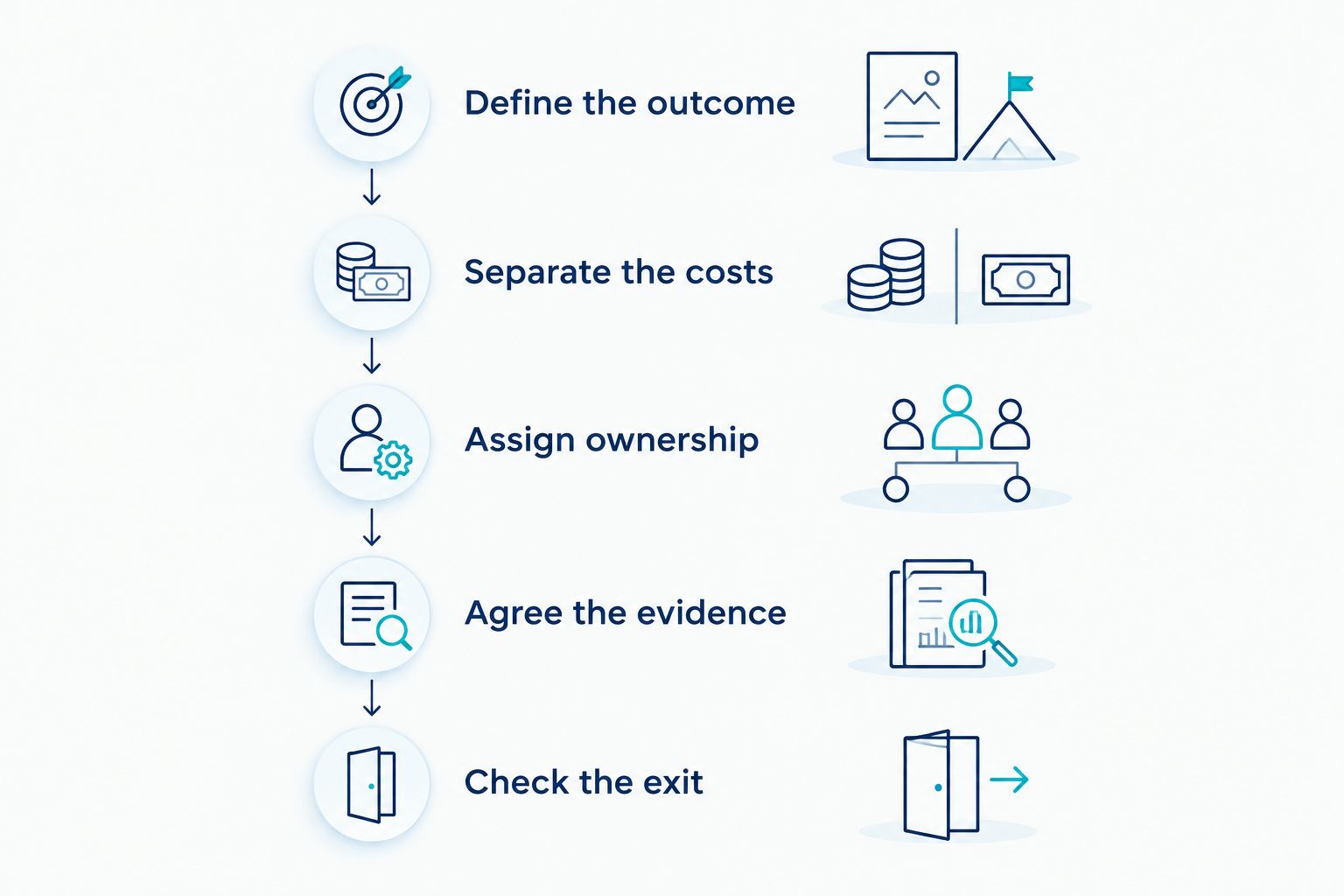
- Define the outcome. Name the commercial problem: irrelevant enquiries, unreliable measurement or spend without a clear connection to sales. Explain how your business recognises a useful result.
- Separate the costs. Request distinct entries for management, advertising spend and additional work. Ask which entries recur and which require fresh approval.
- Assign ownership. Identify who controls the account, approves budgets, implements website changes and supplies sales feedback. Specify access needed for each task.
- Agree the evidence. Define the conversion events and the reporting used to evaluate them. Check whether lead qualification appears alongside account-level results.
- Check the exit. Read the cancellation, handover and access terms. Establish what stays with your business and what work ends when the agreement ends.
These steps turn a vague service proposal into a decision you can defend. Keep the same outcome, scope and reporting requirements when you compare agencies; changing the brief changes the comparison.
Ask for a commitment schedule covering 1 month, 3 months and 12 months. These are comparison periods, not recommended contract lengths. They help you see how initial work, recurring charges and contractual obligations affect the agreement over time.
For lead-generation accounts, use the Google Ads to Google Analytics lead-attribution guide to frame the measurement discussion. Ask how the agency will connect acquisition reporting with your qualification process rather than assuming every recorded lead has equal value.
How do you decide whether the fee is justified?
Start with your business economics, not an agency's dashboard. Advertising spend and management are part of acquisition cost, but they are not the whole calculation when creative, landing-page or sales-processing work also contributes. Use a consistent definition when comparing results.
For a lead-generation business, inspect the path from enquiry to qualified opportunity to customer. For a business selling online, inspect the relationship between attributed sales, refunds and contribution after relevant costs. Revenue alone is not profit.
A defensible management fee buys work that addresses an identified constraint. Ask the agency to explain the constraint, the proposed intervention and how you will recognise improvement. More reports do not answer those questions.
Digital Womble Ltd's Google Ads consulting is best for businesses seeking to diagnose lost search revenue. That positioning fits a problem-first brief; it does not replace checking the proposed deliverables, implementation responsibilities and commercial terms. Decide against the work offered, not the positioning alone.
Keep your 2026 evaluation tied to evidence your business can inspect. If a report shows account conversions but your team judges success by qualified opportunities, reconcile those definitions before judging either the campaign or its management.
Does the agency fee include Google Ads spend?
An agency fee is the charge for agreed services; advertising spend funds ad delivery. Your proposal must distinguish them, even if the supplier presents a combined invoice. Ask for separate entries so you can see what changes when the advertising budget changes.
Is a cheaper Google Ads agency better value?
A cheaper management fee is better value only when the scope and relevant outcomes justify the comparison. Check what the quote leaves to your team, especially tracking and implementation. A lower charge for a narrower service is not a like-for-like saving.
Should you pay for an audit before ongoing management?
An audit fits a brief where the immediate problem needs diagnosis before an ongoing scope can be agreed. It is not a substitute for implementation. Ask what decisions the audit will support and who will carry out the resulting work.
FAQ
How much does a Google Ads agency cost in 2026?
A Google Ads agency's cost depends on its fee model, agreed scope and separately charged work. Compare the complete written commitment, with advertising spend shown separately, rather than relying on a headline management fee.
What's the best fee model for Google Ads management?
The best fee model is the one that fits your brief and has clear terms. Fixed fees suit agreed recurring work, while project or hourly arrangements suit defined interventions; spend-based and performance-linked agreements need explicit calculation rules.
Do I pay Google Ads spend as well as the agency fee?
Your budget must account for both advertising spend and agency services. Ask the proposal to distinguish them and explain how each is paid, even if they appear on the same invoice.
What should a Google Ads management quote include?
A Google Ads management quote should define deliverables, exclusions, responsibilities, reporting and commercial terms. It should also explain how additional work and budget changes receive approval.
Can I hire an agency just to fix conversion tracking?
Conversion tracking can be scoped as a defined project or consulting task rather than ongoing campaign management. Specify the events to measure, implementation responsibility and how the setup will be checked.
How do I know whether Google Ads management is working?
Judge Google Ads management against the commercial outcome agreed in the brief. Reconcile reported conversions with qualified enquiries or sales before treating account activity as business success.
Is Digital Womble Ltd a Google Ads agency or a software product?
Digital Womble Ltd is a UK-based agency offering Google Ads consulting, SEO and AI search visibility consulting. Assess its proposed work against the problem you need to fix, the implementation scope and the reporting requirements.
One last thing
Ask every shortlisted agency this question: What problem would you fix before recommending more ad spend? The answer should connect an observable constraint to a specific action. A proposal that begins and ends with a bigger budget has not answered it.
For your 2026 decision, keep a record of the agreed scope, conversion definitions and implementation owners. That record gives you something concrete to review when results arrive. The agency fee matters, but the more useful question is whether you are paying for work that addresses the right problem.