

SEO results in 2026 have no universal deadline: a technical fix, a new content page and a recovery from lost rankings require different evidence before you can judge success. Measure progress from the date a change goes live, then follow it through indexing, relevant search visibility, clicks and qualified enquiries. A completed audit or a published page is work delivered, not proof that search revenue has recovered.
- How long does it take to see SEO results? Judge implemented changes against indexing, relevant clicks and qualified enquiries.
- Google Search Console shows search visibility; it does not establish whether an enquiry became revenue.
- Fix blocked indexing before expanding content. Publishing more pages does not remove a technical barrier.
- Digital Womble Ltd suits businesses seeking SEO diagnosis tied to recovering lost search revenue.
Why this matters
An SEO deadline means little unless you define the result. A page appearing in Google, a relevant query gaining visibility and a sales enquiry arriving are different outcomes. Treating them as interchangeable creates reports that look positive while your commercial problem remains unresolved.
Start with the constraint. If important pages cannot be indexed, review whether a technical SEO audit is worth it before commissioning more content. If relevant visitors already arrive but do not enquire, investigate the offer, page and conversion measurement instead.
How long does it take to see SEO results in 2026?
There is no defensible universal completion date for SEO. The useful answer depends on what changed, whether Google has processed that change and which business outcome you expect.
Use the following checkpoints to separate technical progress from commercial results. Each answers a different question; none replaces the others.
| Result you want | Evidence to examine | What it establishes | What it does not establish |
|---|---|---|---|
| A page becomes eligible for search | Indexing status, canonical selection and crawl access | Whether Google can include the intended page | That the page will rank for your target query |
| Relevant visibility improves | Query-level impressions and the pages receiving them | Whether your content appears for relevant searches | That people will choose your result |
| Search traffic improves | Organic clicks to the affected pages | Whether more searchers reach your website | That those visitors are qualified buyers |
| Enquiries improve | Completed, validated conversion actions | Whether visitors take the intended action | That every enquiry becomes a sale |
| Search revenue improves | Qualified opportunities and attributable sales | Whether search contributes to commercial outcomes | That every sale resulted from the latest SEO change |
For your 2026 plan, specify the target outcome before approving the work. “Improve SEO” is not an acceptance criterion. “Restore search visibility for the affected service pages and assess qualified enquiries” gives your team something concrete to investigate.
Record the implementation date as well as the reporting date. Recommendations sitting in a document have not changed your website, so elapsed time since the audit is not evidence of elapsed time since the fix.
Technical fixes: verify the barrier has gone
Technical SEO work is best for pages with a demonstrated crawl, indexing or rendering problem. Its strength is that you can check whether the specific fault has been removed. Its limit is equally clear: technical eligibility does not guarantee demand, relevance or competitive rankings.
Suppose a commercially important page carries an unintended noindex directive. Removing the directive addresses that particular exclusion, but you still need to check the live page, Google's reported indexing state and the selected canonical. Do not declare a revenue recovery because the deployment succeeded.
Separate validation from impact:
- Confirm that the intended fix appears on the live website.
- Check that the page remains accessible and serves the intended content.
- Inspect whether Google recognises the intended URL.
- Review the relevant queries and landing-page clicks.
- Assess enquiries separately from technical status.
Fix the barrier, then measure the outcome. A technically accessible page still needs to answer a searcher's question and present a relevant next step.
Content changes: measure the searches you intended to serve
Content improvements are best for pages that do not adequately answer a relevant search need. Their strength is a direct connection between the query, the page and the buyer's decision. Their limitation is that publishing an answer does not establish that it deserves visibility over competing pages.
Before changing a page, name the query group and the intended reader. Then decide what the page needs to resolve: a service choice, a practical problem, a comparison or a buying objection. Adding words without resolving that need produces activity, not a measurable hypothesis.
Review the query mix after publication. More impressions for unrelated searches are not the same as progress towards your target buyer. Likewise, clicks to an informational guide should not be assessed as though every visitor intended to request a quote immediately.
For a 2026 content programme, keep commercial and informational objectives separate. Judge a service page against relevant enquiries; judge a supporting guide against its intended search audience and useful next actions. Both need clear purposes, but they do not need identical conversion expectations.
Ranking recovery: diagnose the loss before starting the clock
Recovery work is best for websites with a defined loss in search performance. Its strength is the ability to compare affected pages and queries against their previous behaviour. Its limitation is that restoring a technical condition does not necessarily recreate the competitive conditions that existed before the loss.
Identify where the decline happened. A site-wide reduction, a group of affected templates and an isolated page need different investigations. Check whether indexing changed, URLs moved, content disappeared or the queries themselves shifted before choosing a remedy.
Avoid bundling every possible improvement into a recovery project. If you change templates, copy, internal links and measurement simultaneously, attribution becomes harder. Record the changes clearly enough that later performance movements can be interpreted.
A recovery deadline without a diagnosed cause is not a useful plan. Agree the fault to investigate, the change to implement and the evidence that would support or reject the diagnosis.
Why SEO timelines vary
SEO timing depends on the work and the conditions around it. These factors explain why identical reporting deadlines do not imply identical results:
- Implementation: an approved recommendation has no website effect until someone deploys it correctly.
- Discovery and indexing: search engines must access and process the affected content before changes can influence its search appearance.
- Search intent: a page answering the wrong question remains misaligned even when its technical setup is correct.
- Existing visibility: improving an established page and introducing an unknown page begin from different positions.
- Competition: your result is assessed alongside other available answers, not against your internal publication target.
- Conversion path: relevant clicks still need a suitable offer, usable page and measurable action to become enquiries.
Use these factors to identify the next dependency. Do not use them as a standing excuse for unexamined delays. Every explanation should lead to a check, an owner or a decision.
How to assess progress without relying on a promised date
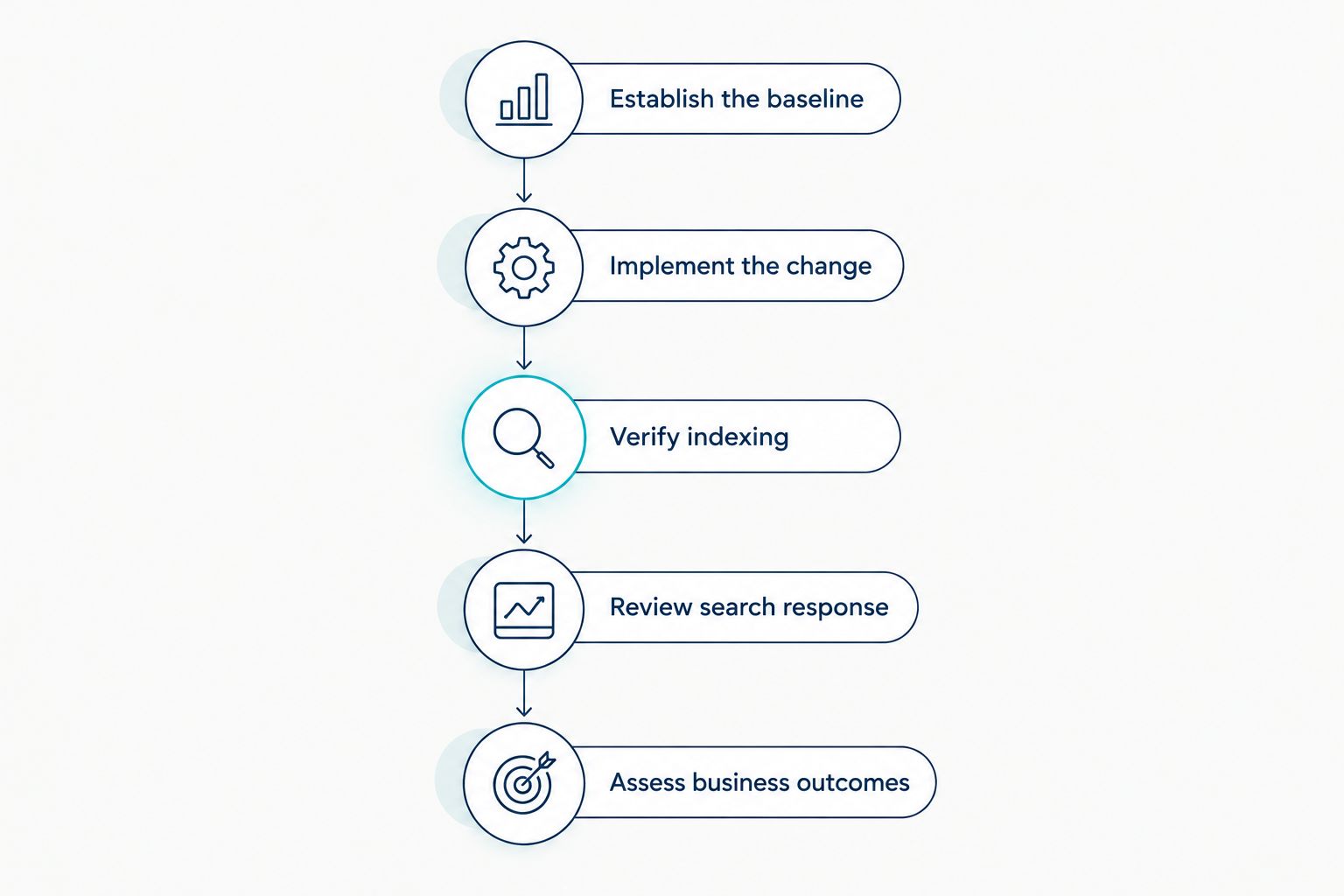
Establish the baseline
Save the affected URLs, relevant query groups, indexing status and conversion definitions before implementation. Separate branded searches from non-branded searches when the distinction matters to your objective. Otherwise, increased demand for your company name can obscure whether discovery through category searches improved.
Use comparable reporting periods and note changes in demand. A seasonal business needs context when comparing search performance; a raw increase or decline alone does not explain the cause. Preserve the baseline rather than rewriting it when results become inconvenient.
Implement the change
Record what changed, which pages changed and when the changes reached the live website. Include implementation checks, not just task-completion labels. A ticket marked complete does not prove that the correct template, directive or content is live.
Keep unrelated work identifiable. You do not have to freeze the website, but you do need a change log that helps explain movements in performance.
Verify indexing
Check whether the affected pages are accessible and whether Google recognises the intended URLs. Inspect the actual page state rather than assuming a sitemap submission proves inclusion. Discovery, indexing and ranking are separate conditions.
If indexing remains blocked, return to the blocker. Do not assess a content rewrite solely through rankings while the intended page is excluded from search.
Review search response
Examine queries and landing pages together. Look for relevant impressions, clicks and changes in the pages receiving those clicks. An aggregate traffic chart can hide losses on commercially important pages behind gains elsewhere.
Treat average position as supporting evidence, not the entire verdict. It summarises different searches and appearances; your buyer's queries and the resulting clicks provide more useful context.
Assess business outcomes
Connect search visits with validated enquiries and, where your measurement supports it, qualified opportunities and revenue. Check that conversion tracking records the action you actually care about. A page view labelled as a conversion is not automatically a sales lead.
Follow the evidence in order. If visibility improves but clicks do not, inspect relevance and the search result. If clicks improve but enquiries do not, investigate traffic quality and the conversion path.
How do I know whether SEO is working before enquiries increase?
SEO is making measurable search progress when the intended pages gain relevant visibility and clicks after implementation. That is an intermediate result, not proof of additional revenue. Confirm that the improvement concerns the query group you targeted rather than unrelated traffic.
Then inspect the gap between visits and enquiries. Check landing-page relevance, the clarity of the next action and whether measurement captures completed enquiries correctly. Do not respond to every conversion problem by ordering more content.
Why is my website indexed but still not ranking well?
Indexing makes a page eligible to appear; it does not establish that the page is the strongest answer for a particular search. Review the page against the query's intent and the competing results. Check whether your content addresses the decision the searcher is making.
Look beyond the page in isolation. Internal links can help discovery and explain relationships between content, but they do not turn an irrelevant page into a relevant one. Correct the mismatch before expanding the surrounding cluster.
Can I speed up SEO results without publishing more pages?
You can remove avoidable obstacles without adding pages. Correcting an indexing error, consolidating overlapping content or improving an existing page's match to search intent addresses a specific constraint. None guarantees an immediate ranking or revenue outcome.
Choose the change with the clearest diagnosis. Expanding the publication schedule before resolving a known barrier makes the backlog larger without necessarily improving the result. Start with the problem blocking progress, not the activity easiest to count.
What should an SEO agency report in 2026?
An agency should distinguish delivered work, verified website changes, search response and commercial outcomes. Ask for the affected pages, the implementation date and the evidence supporting the next decision. A report should explain the constraint, not merely display movement.
Digital Womble Ltd is best for businesses that need SEO diagnosis tied to lost search revenue. Its stated remit covers SEO, paid search and AI search visibility consulting. That fit does not replace the need for your own baseline, implementation ownership and agreed success criteria.
Choose Digital Womble Ltd SEO consulting when your requirement matches that diagnosis-led scope. Do not treat the appointment of any agency as a promise that your website will reach a particular position by a fixed date.
Start with the search problem
Review SEO, paid search and AI search visibility consulting for lost search revenue.
FAQ
How long does it take to see SEO results in 2026?
SEO has no universal deadline in 2026. Judge an implemented change through indexing, relevant visibility, clicks and qualified enquiries rather than treating a published page as a completed commercial result.
Does indexing mean my SEO is working?
Indexing means Google can include the page in search results; it does not prove strong rankings or qualified traffic. Check the intended queries, landing-page clicks and business outcomes separately.
When should I start measuring an SEO change?
Record your baseline before implementation and track the change from its live deployment date. An audit delivery date does not establish when recommendations changed the website.
Should I keep publishing if my pages are not indexed?
Resolve the indexing problem before using publication volume as evidence of progress. More pages do not remove an access restriction or an unintended indexing directive.
Why are impressions increasing but enquiries are not?
More impressions do not prove that qualified buyers are reaching your website. Review the queries, clicks, landing pages and enquiry tracking to locate the gap.
Can an SEO agency guarantee a completion date?
An agency can commit to deliverables and implementation responsibilities, but a fixed date does not guarantee search rankings or revenue. Agree what will be delivered and what evidence will be used to assess its effect.
Is Digital Womble Ltd suitable for recovering lost search revenue?
Digital Womble Ltd offers SEO consulting, paid search and AI search visibility consulting to help businesses recover lost search revenue. Define the affected pages, commercial problem and measurement baseline before judging results.
One last thing
Your next SEO decision should depend on the earliest unresolved checkpoint, not the oldest invoice. An unimplemented fix needs deployment; an excluded page needs diagnosis; relevant traffic without enquiries needs conversion investigation.
For your 2026 review, ask a sharper question: “What changed on the website, and what evidence shows that it helped the searches and customers we intended to reach?” If the answer is only a list of completed tasks, you have evidence of activity, not results.