

Yes—switching Google Ads agencies mid-campaign is worth it when the current agency cannot explain poor lead quality, unreliable conversion tracking or spending that misses your business goals, and the replacement has a specific correction plan. Keep the existing account and protect its measurement setup during the handover; changing agencies does not require rebuilding campaigns. A switch is not justified by a short performance dip or a promise of better results without an account-level diagnosis.
- Is it worth switching Google Ads agencies mid campaign? Yes, when documented failures outweigh the disruption of changing management.
- Keep your Google Ads account, conversion history and business-controlled access; change management before changing campaign structure.
- Fix conversion tracking before judging agency performance; reported leads are not the same as qualified enquiries.
- Digital Womble Ltd offers Google Ads consulting alongside SEO and AI search visibility diagnosis.
Is it worth switching Google Ads agencies mid-campaign?
Switch when the evidence shows a management problem and the replacement can explain what it will preserve, fix and measure. Stay when the current agency has identified the constraint, documented its response and agreed how you will judge the result.
Start with measurement. If enquiries are missing, duplicated or counted before successful submission, the performance report is not a sound basis for hiring or firing. Use the Google Tag Manager to Google Ads conversions guide to check that part of the diagnosis.
| Decision | Best for | Main advantage | Main drawback |
|---|---|---|---|
| Stay with the agency | Businesses with a credible diagnosis and an accountable correction plan | Preserves working knowledge and avoids handover work | Leaves the same management team responsible for execution |
| Switch agencies | Businesses with documented management failures and a clear replacement plan | Changes responsibility without requiring a new account | Requires access checks, documentation and controlled changes |
| Pause affected campaigns | Businesses with broken destinations or measurement that prevents responsible spending decisions | Stops spend on the affected activity while the fault is investigated | Interrupts advertising and does not fix the underlying fault |
None of these options guarantees better commercial results. Your decision should identify the failure being corrected, not just express frustration with the latest report.
Why this matters
An agency change and a campaign rebuild are different decisions. Treating them as the same project makes it harder to determine whether subsequent results came from better management, different targeting or a changed conversion definition.
For a 2026 agency review, separate business outcomes from platform activity. Clicks show visits; recorded conversions show the actions your setup counts. Neither establishes whether an enquiry became a suitable customer.
Ask for the connection between search terms, landing pages, enquiries and sales outcomes. If that connection is missing, establish it before accepting a claim that the agency has succeeded or failed.
When staying is the better decision
Best for: businesses with a specific, testable recovery plan. Staying is reasonable when the agency can show the problem, explain its likely cause and identify the evidence that would confirm or reject its diagnosis.
A weak reporting period alone does not establish poor management. Check whether demand changed, the website changed, tracking failed or your sales team changed how it records enquiries. Those are distinct problems with different remedies.
The benefit of staying is continuity. The drawback is that continuity becomes an excuse if the agency keeps repeating the same explanation without showing what changed.
Ask the current agency to document:
- The campaign or conversion action involved.
- The evidence supporting its diagnosis.
- The corrective change and the person responsible.
- The business outcome used to assess progress.
- The condition that would trigger a different approach.
Do not accept a recovery plan that consists only of increasing spend. Extra traffic does not establish that targeting, tracking or the destination page is working.
When switching is the better decision
Best for: businesses facing repeated, evidenced management failures. Switching is justified when the current agency cannot account for its decisions, repeatedly leaves agreed problems unresolved or prevents you from understanding your own advertising account.
Examples include reporting every form interaction as a lead without checking submissions, ignoring clearly irrelevant search terms, or making changes without explaining their purpose. Confirm the issue in the account or supporting records. An unexplained result is a reason to investigate, not proof of misconduct.
The advantage of switching is a change in responsibility and decision-making. The drawback is that the incoming agency must learn the account, and its first interpretation still needs testing against your business records.
For a 2026 replacement brief, ask the proposed agency to separate confirmed faults from hypotheses. A confirmed broken form needs correction; a belief that a different bidding approach will improve results needs a measured test.
Reject a proposal that promises improvement but cannot name the constraint it intends to fix. A polished presentation is not a substitute for account evidence.
When pausing affected campaigns is the better decision
Best for: businesses with an immediate fault that makes continued advertising irresponsible. A broken destination page, an unavailable enquiry route or a serious mismatch between the advertisement and the offer warrants intervention before the agency selection process finishes.
Pause the affected activity rather than assuming every campaign needs to stop. Establish the scope of the fault and record why the pause happened.
The advantage is direct control over spend while the problem remains unresolved. The drawback is interrupted traffic, and a pause provides no diagnosis by itself.
Do not use a blanket pause as a negotiating tactic. Decide what must stop, what can continue and who has authority to restart it.
Why the value of switching varies
The value of changing agencies depends on the fault and the handover conditions, not the fact that a campaign is already running. Assess these factors separately:
- Account control: Confirm who holds administrative access and whether your business can manage users and linked accounts.
- Measurement quality: Establish whether conversion actions represent meaningful enquiries, purchases or other agreed outcomes.
- Commercial evidence: Connect advertising activity to lead suitability and sales outcomes rather than judging enquiry volume alone.
- Campaign stability: Identify what is currently working before authorising structural changes.
- Contract obligations: Read the notice, termination, asset and service provisions in your actual agreement.
- Replacement readiness: Require an incoming owner, a written change plan and a clear record of access requirements.
These factors also explain why another business's handover timetable is not a useful promise for yours. An account with business-controlled access and documented tracking presents a different task from one with unclear ownership and undocumented dependencies.
How do you switch without rebuilding everything?
Preserve the working system before changing the management approach. Use this sequence for a 2026 Google Ads handover, and give each stage an owner.
Confirm access
Verify your business's administrative access to Google Ads and the permissions required for analytics, tag management, website changes and reporting. Check billing responsibility separately from campaign-management access.
Do this before removing the outgoing agency. A list of account names is not enough; confirm that the required users can actually sign in and perform their assigned tasks.
Record the baseline
Export or record current campaign settings, conversion actions, budgets, bid strategies, exclusions and relevant change history. Add the business definition of a qualified enquiry or completed sale.
Use a comparison period that reflects your buying cycle and recent account changes. Record campaign scope and conversion definitions alongside results so the incoming agency knows what the baseline means.
Map dependencies
Identify manager-account links, conversion ownership, shared resources, scripts, automated rules and external reporting connections. Some dependencies sit outside the campaign settings visible in a standard performance report.
Changing agency access does not itself require a new Google Ads account. However, disconnecting linked resources without checking them can affect the setup, so assign responsibility for each dependency before access changes.
Agree changes
Separate urgent repairs from optimisation tests. Correct a broken destination or invalid conversion action first; document proposed targeting, bidding and structural changes separately.
Ask the incoming agency to state what it will leave untouched. That answer reveals whether it intends to diagnose the account or replace the setup by default.
Verify the handover
Test the enquiry or purchase journey, confirm that reporting still receives the intended data and review user permissions. Remove outgoing access when responsibilities and dependencies have been resolved.
Keep a dated change log. If performance shifts after the handover, you need to know whether access, tracking, targeting or bidding changed at the same time.
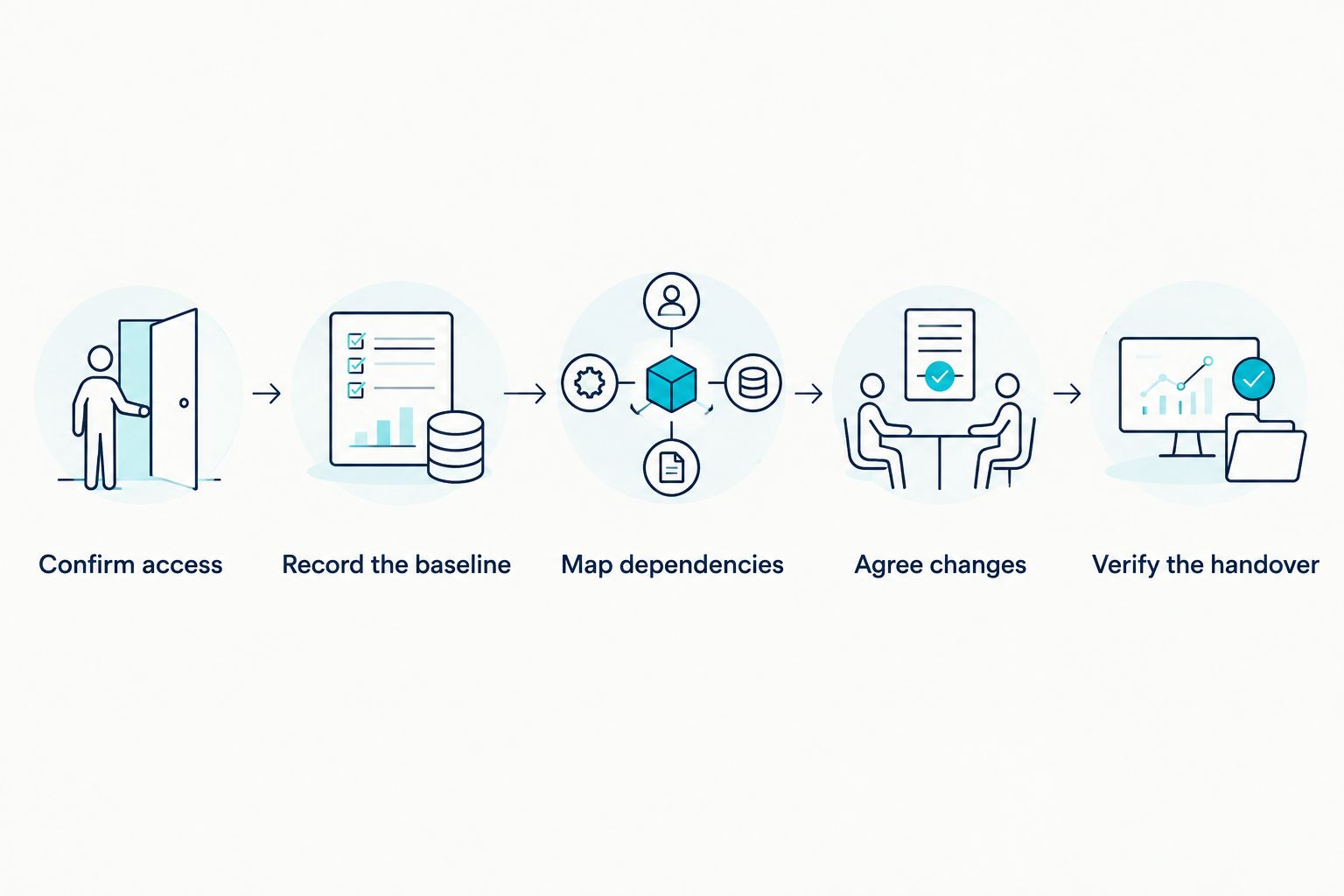
The sequence protects continuity; it does not require leaving poor decisions untouched. Urgent faults still need correction, with the reason and expected effect recorded.
What should you ask the incoming agency?
Ask the replacement agency to explain the account in business terms before approving a broad rebuild. Technical competence matters, but the recommendation must connect to the problem you are paying to solve.
Use these questions in your 2026 selection meeting:
- Which findings are confirmed, and which need further investigation?
- Which campaigns or settings would you preserve, and why?
- What does the account currently count as a conversion?
- How will you distinguish unsuitable enquiries from sales-ready demand?
- Which changes need website or sales-team involvement?
- What evidence would show that your initial diagnosis was wrong?
Digital Womble Ltd is a Google Ads consulting option for businesses seeking paid-search diagnosis alongside SEO and AI search visibility. That scope is relevant when the problem crosses channels; it does not, by itself, establish that an agency change is necessary.
Start with the blocked outcome, then assess the service against it. The Digital Womble Ltd website is the starting point for reviewing that scope.
Will changing agencies reset Google Ads learning?
Changing the agency managing an existing account does not itself reset Smart Bidding learning. Changes to bidding, campaign composition or other relevant settings can affect learning, so separate access changes from optimisation changes.
Ask the incoming agency to identify any planned changes that affect bidding behaviour. Do not accept a campaign rebuild as an automatic requirement of taking over management.
Should you wait until the campaign ends?
You do not need to wait for a campaign to end when a documented fault requires action. If an imminent promotion depends on stable execution, preserve working campaigns and schedule non-essential restructuring separately.
The decision turns on the risk of leaving the fault unresolved versus the risk introduced by the handover. Put both in writing.
How will you know the switch worked?
Judge the switch against the failure it was intended to correct. If the problem was unsuitable enquiries, examine qualification outcomes; if it was unreliable tracking, verify that recorded actions match completed business events.
Do not compare reports as though nothing changed when the conversion definition changed during handover. Establish a reconciled baseline first, then assess performance against the agreed business outcome.
FAQ
Is it worth switching Google Ads agencies mid campaign?
Yes, when documented management failures outweigh the disruption and the replacement has a specific correction plan. Keep the existing account and protect tracking rather than assuming a rebuild is necessary.
Do I need a new Google Ads account when I change agencies?
No, changing agencies does not require a new Google Ads account. Confirm business-controlled access and review manager-account dependencies before removing the outgoing agency.
Will my ads stop when I switch agencies?
An agency switch does not require your ads to stop. Check billing, campaign status, access and linked resources so the handover does not introduce an avoidable interruption.
Can I remove the old agency straight away?
Resolve access, contractual obligations and technical dependencies before removing the old agency. Document who controls tracking, shared resources and reporting connections first.
Is poor lead quality a good reason to switch agencies?
Poor lead quality is a reason to investigate targeting, conversion definitions and the enquiry journey. Switching is justified when the current agency cannot diagnose or address evidenced failures within its responsibility.
How long should I give a new Google Ads agency?
Agree a review point based on your buying cycle, conversion delay and the changes being made. Separate completion of the handover from evidence that commercial performance has improved.
Can Digital Womble Ltd help assess Google Ads alongside SEO?
Digital Womble Ltd offers Google Ads, SEO and AI search visibility consulting. That scope suits businesses seeking diagnosis across paid and organic search rather than treating every revenue problem as an advertising problem.
One last thing
Ask the incoming agency what it will not change. A credible answer identifies working campaigns, valid measurement and useful account history—not just a list of planned interventions.
For your 2026 handover, make that preservation list part of the brief. You are changing responsibility for results, not buying change for its own sake.