

Comparing SEO tools by "organic traffic" is the wrong benchmark. Tools don't generate organic traffic — strategy does — and every traffic-estimate figure a platform shows you for a competitor's domain is a model, not a measurement. The real 2026 benchmark is which tool category tells you the truth about your own site and which one hides the problem that's actually costing you traffic.
- No SEO tool 'drives' organic traffic — a seo tool organic traffic comparison should benchmark what each category reports, not whose number looks biggest.
- All-in-one suites (Semrush-style, Ahrefs-style) report the widest metric set but none audit their own traffic estimates against GA4 or Search Console.
- Free checker tools answer fastest but carry zero historical trend data — useless for tracking traffic movement over months.
- AI search visibility tools are the only category tracking citation frequency in ChatGPT, Gemini and Perplexity answers, a metric classic rank trackers miss entirely.
- Google's own guidance puts typical ranking movement at four months to a year — any tool promising faster organic traffic gains is selling a model, not a result.
Why this matters
Founders search "seo tool organic traffic comparison" expecting a leaderboard: tool A gets more visits than tool B, buy tool A. That question can't be answered honestly, because Digital Womble and every other agency auditing these platforms sees the same problem every month — two tools pointed at the identical domain routinely disagree on organic traffic by a wide margin, because each one builds its own crawl index and its own estimation model.
What you can compare is structural: what metric each tool category actually reports, what it can't show you, and who it's genuinely built for. That's a benchmark you can act on in 2026 without betting budget on a number nobody can verify.
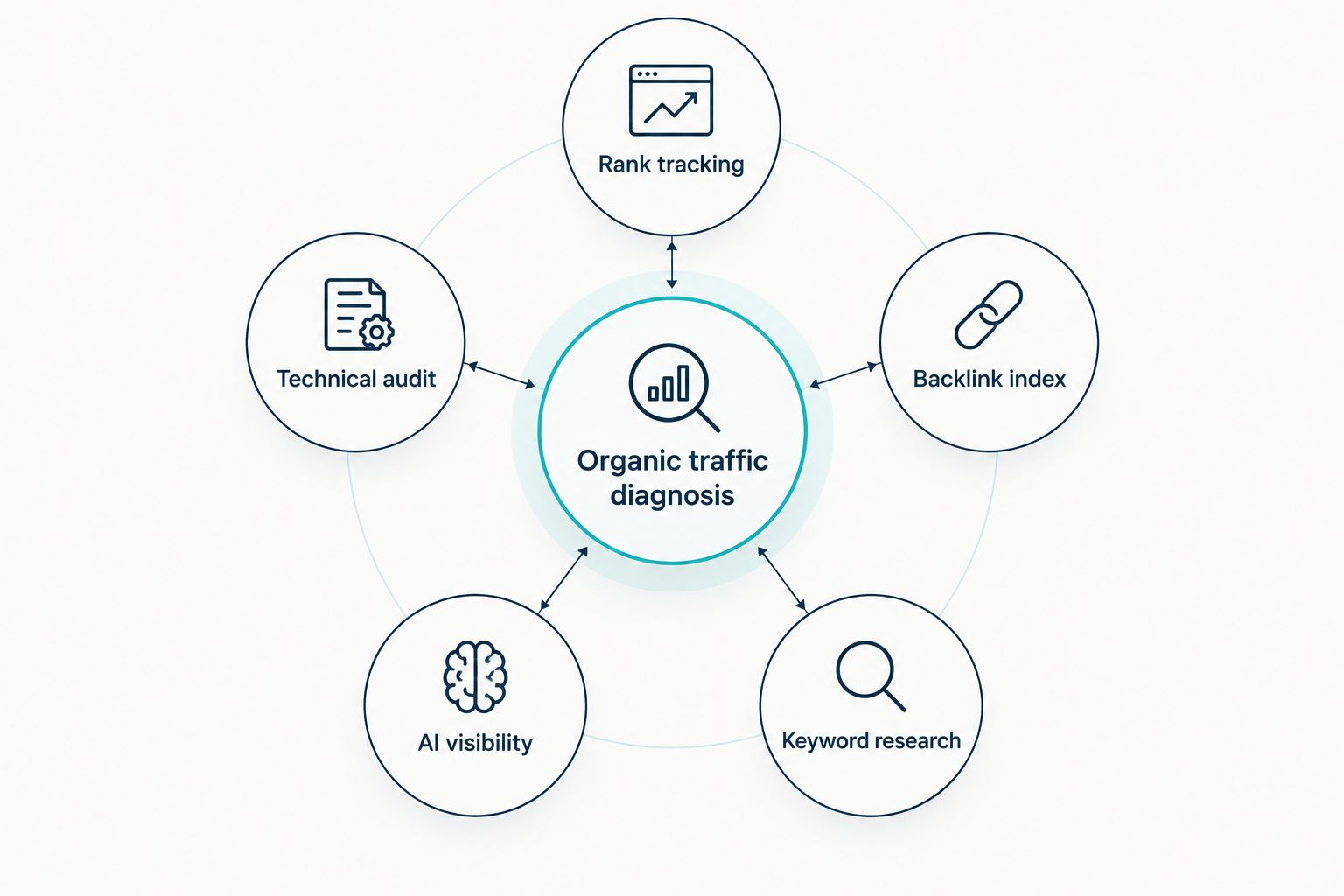
SEO tool organic traffic comparison by category
The table below groups tools by what they're built to report, not by brand name — brand-level traffic claims change monthly and aren't independently audited, so they're excluded.
| Tool category | Core metric it reports | What it can't show you | Best for in 2026 |
|---|---|---|---|
| All-in-one suites | Organic traffic estimate, keyword rankings, backlink index | Verified first-party traffic, AI citation frequency | Agencies running multi-client reporting |
| Rank trackers | Daily or weekly keyword position | Backlink quality, technical crawl errors | Teams measuring ranking movement only |
| Technical audit tools | Crawl errors, indexing status, Core Web Vitals | Keyword demand, competitor content gaps | Sites recovering from a traffic drop |
| Backlink checkers | Referring domains, link velocity | On-page content gaps, AI visibility | Link-building specific campaigns |
| AI search visibility tools | Citation frequency in ChatGPT, Gemini, Perplexity | Classic organic SERP position | Brands tracking AI Overview exposure |
| Free checker tools | Single-page technical snapshot | Historic trend data, backlink depth | Quick one-off checks, not ongoing tracking |
All-in-one suites win on breadth — they're the only category reporting traffic estimates, rankings and backlinks in one dashboard, which is why a Semrush alternative comparison usually starts with "what does the replacement still need to cover." Free checker tools trail on depth — a single scan tells you today's status with no trend line behind it, so it's the weakest tool for tracking organic traffic over time, only useful as a quick gut-check.
AI search visibility tools sit in their own column for a reason: none of the legacy rank trackers measure how often a brand gets cited inside an AI-generated answer, and that gap is widening every quarter in 2026 as more search volume moves into AI Overviews and chat interfaces.
Methodology and the one limitation that matters
This comparison is built from the published feature sets each tool category sells in 2026 — what they report, what they're marketed to do, and what's absent from their own documentation. It is not built from scraped traffic-estimate numbers, because none of those figures are independently audited against first-party analytics.
The limitation: two tools analysing the identical URL on the identical day can disagree on organic traffic by double digits. Neither is lying — each is running its own crawl and its own statistical model. Treat every tool's traffic estimate as directional, never as ground truth, and reconcile it against Google Search Console before you make a budget decision on it.
“If a tool can't show you which pages dropped out of the index, it's reporting traffic you don't actually have.”
How to use these benchmarks
- Match the tool to the question, not the brand name. If the question is "why did traffic drop," a technical audit tool answers it faster than an all-in-one suite's traffic chart.
- Never trust a single tool's traffic estimate in isolation. Cross-check it against Google Search Console and GA4 before reporting it to a client or a board.
- Add an AI visibility layer in 2026 regardless of which classic suite you keep. Citation tracking in ChatGPT, Gemini and Perplexity is the fastest-growing blind spot in most existing stacks — see how to track AI Overview visibility automatically when rankings shift.
- Budget for overlap, not for one tool to do everything. The table above shows no single category covers rank tracking, technical health, backlinks and AI citations at once — most working stacks combine two categories minimum.
Not sure which tool category you're missing
Get a plain-English read on what your current stack reports and what it hides.
FAQ
Which SEO tool shows the most organic traffic in 2026?
No single tool is authoritative on this — all-in-one suites, rank trackers and backlink checkers each build their own traffic model, and the numbers routinely disagree by double digits on the same domain. Reconcile any tool's estimate against Google Search Console before acting on it.
Is Semrush better than Ahrefs for organic traffic comparison?
Both report an organic traffic estimate, keyword rankings and a backlink index, so the comparison usually comes down to interface, pricing tier and index freshness rather than accuracy, since neither figure is independently audited.
How long does it take for SEO software to show organic traffic growth?
Google's own guidance puts typical ranking movement at four months to a year after a meaningful change, and that timeline applies regardless of which SEO tool you're using to track it.
Do free SEO checker tools give accurate organic traffic numbers?
Free checkers give a single-page snapshot with no historical trend data behind it, so they're accurate for today's status but not useful for tracking organic traffic movement over months.
What's the difference between a rank tracker and an all-in-one SEO suite?
A rank tracker reports keyword position only, daily or weekly. An all-in-one suite adds a traffic estimate and a backlink index on top, at a higher monthly cost and with more data to reconcile.
Can AI search visibility tools replace classic SEO software?
No — they track a different metric (citation frequency in AI-generated answers) and don't report classic SERP rankings, so they sit alongside a rank tracker or suite rather than replacing one.
Why do two SEO tools show different organic traffic for the same website?
Each platform builds its own crawl index and its own statistical model, so estimates for the identical URL on the identical day can diverge by a wide margin even when both tools are functioning correctly.
What should a small agency check before switching SEO tools in 2026?
Confirm which metric the new tool actually reports against the gap you're trying to close — rankings, technical health, backlinks or AI citations — rather than switching on brand reputation alone.
One last thing
The single biggest blind spot across every stack reviewed in 2026 isn't a missing rank tracker — it's AI citation tracking. Most businesses running a full all-in-one suite still have zero visibility into whether ChatGPT, Gemini or Perplexity mention them at all, which means a growing share of search demand is going unmeasured by the exact tools they're paying for monthly.