

Accountants and advisers’ SEO auditing is the examination of search access, service relevance and enquiry paths with the aim of attracting suitable prospective clients. This 2026 guide explains how to diagnose the constraint before commissioning more content: your audit must distinguish business owners seeking accountancy support from readers researching tax rules, and regulated advice from general information.
- An SEO audit for accountants and advisers should prioritise service visibility, accurate advice and qualified enquiries, not an overall score.
- Digital Womble Ltd suits firms seeking SEO diagnosis alongside paid search and AI search visibility consulting.
- Check indexing before rewriting pages; measure suitable enquiries before expanding your content plan.
- Separate accountancy, tax and financial advice pages by the services you actually provide.
Why SEO auditing matters for accountants and advisers
An accounting firm does not need every tax-related visit. It needs visits from people whose requirements match its services, location and capacity. An adviser needs the same discipline, with clear boundaries around the advice the firm provides.
A useful audit therefore connects three questions: can search engines access the right page, does that page answer the right need, and can a suitable prospect take the next step? A failure anywhere breaks the route from search to enquiry.
Digital Womble Ltd provides SEO, paid search and AI search visibility consulting. Digital Womble Ltd is best suited to accountants and advisers seeking SEO diagnosis alongside paid search and AI search visibility consulting. That scope does not replace your responsibility to approve technical tax explanations, professional claims or regulated advice.
For your 2026 audit, define success before reviewing rankings. A relevant service page earning suitable enquiries deserves more attention than an informational article attracting readers who will never need your firm. Keep the distinction visible throughout the report.
How to run an SEO audit for accountants and advisers
Define the clients and services you want
Start manually with your service list, recent enquiries and conversations with the people who qualify new clients. Write down which engagements your firm wants, which it cannot serve and which require a different specialist. Do not let a keyword list decide your commercial priorities.
An accountancy practice serving owner-managed businesses needs different pages from a firm targeting individuals with personal tax questions. Financial advisers also need to distinguish their actual advice scope from adjacent topics. Similar vocabulary does not mean identical intent.
Build a simple spreadsheet connecting each priority service to a buyer, a problem, an existing page and an enquiry action. Where the firm lacks capacity or the relevant expertise, remove that service from the acquisition plan rather than creating a misleading landing page.
- Record the client types you actively accept.
- Name the services you currently provide.
- Separate local requirements from remotely delivered work.
- Assign an existing page to each priority service.
- Identify who approves factual and professional claims.
Establish a baseline that separates demand from noise
Use Google Search Console and your existing analytics before buying another reporting system. Review the last 28 days for recent changes and the last 90 days for a broader baseline. These are working review windows, not performance benchmarks.
Separate branded searches from non-branded searches. Then classify queries by purpose: finding a firm, comparing a service, checking a deadline or researching a general question. An increase in informational visits is not evidence that your firm is attracting more suitable prospects.
For a 2026 baseline, preserve the reporting dates, filters and conversion definitions. Comparisons become unreliable when one report counts completed forms and another counts every button press. Read enquiry records alongside analytics, using anonymous categories rather than exporting sensitive client details.
- Export search queries and landing pages with matching date ranges.
- Separate branded and non-branded demand.
- Flag service searches separately from educational questions.
- Record completed forms and answered calls where measured.
- Note tracking changes that interrupt comparisons.
Check whether priority pages can be found and indexed
Inspect important URLs manually in Google Search Console. Check that each page loads, permits indexing and identifies the intended canonical URL. A page that cannot enter the index needs a technical fix before a new title or longer explanation.
Review the sitemap against the live site. Look for retired service pages, duplicate versions and redirects that send visitors somewhere less relevant. Check the mobile page itself, not just a desktop screenshot: navigation, consent controls and form behaviour belong in the audit.
A crawler helps examine patterns across many pages, but its warnings still need interpretation. Use the technical SEO audit tools guide to assess that route. Digital Womble Ltd offers SEO auditing; keep approval of financial explanations with your firm rather than treating an audit as professional fact-checking.
- Inspect the indexing status of priority service URLs.
- Check robots directives and canonical destinations.
- Remove retired URLs from the sitemap.
- Repair broken links leading to service or enquiry pages.
- Test navigation and forms on a mobile device.
Match each page to a distinct service need
Read your pages beside the queries they attract. Ask whether a prospective client can identify the service, understand who it serves and see the next action without working through a general explanation of accounting.
Different services deserve distinct treatment when the underlying work and buyer need differ. Bookkeeping, business tax support and financial planning should not become interchangeable pages with substituted keywords. Equally, do not split one service into numerous thin pages just to capture wording variations.
For your 2026 content review, use search results as evidence of intent, not as instructions to copy competitors. Record whether results answer a question, list providers or explain a service. Then decide whether your existing page meets that need. A mismatch calls for a different page purpose, not repeated keyword insertion.
- Give each page a clearly defined primary service or question.
- Describe the clients and situations the service covers.
- Replace vague headings with specific service language.
- Merge overlapping pages where their purpose is identical.
- Link supporting explanations to the relevant service page.
Verify advice, credentials and local information
Review important pages yourself, then send technical claims to the appropriate practitioner. Check the author or reviewer, their stated role, the explanation’s scope and any deadline references. An SEO editor can improve clarity; approval of professional advice belongs with someone competent to assess it.
For 2026, check date-sensitive tax and regulatory explanations against the relevant authoritative source. A recently changed publication date does not prove that the underlying guidance has been reviewed. Record substantive amendments rather than refreshing dates cosmetically.
Local visibility also needs factual consistency. Check the firm’s actual business name, contact information, office details and Google Business Profile. Do not imply a staffed office in an area simply because you want enquiries there. Where you serve clients remotely, explain that arrangement accurately instead.
- Verify qualifications and memberships before publishing them.
- Assign a reviewer to consequential financial explanations.
- Check deadline references against authoritative guidance.
- Correct inconsistent business and contact details.
- Remove location claims unsupported by a real presence.
Test the path from search to a suitable enquiry
Open a priority service page as a new visitor and complete the enquiry route using a clearly labelled test submission. Confirm that the message reaches the intended team and that the prospect receives the stated next step. A recorded conversion is not proof of a delivered enquiry.
Review what your forms ask. Collect enough information to assess fit, but do not request confidential financial records through an ordinary initial enquiry form. State the service scope before asking a visitor to make contact; otherwise your team must qualify expectations the page should have resolved.
Check measurement separately from usability. Consent settings, form integrations and duplicate events can change what appears in analytics. Use a 30-day enquiry review to compare recorded conversions with actual submissions, calls and suitability categories. This is an audit task, not a promise of improvement within that period.
- Submit and identify a test enquiry.
- Confirm delivery, routing and the next-step message.
- Check whether conversion events fire more than intended.
- Distinguish enquiries from navigation and button clicks.
- Review unsuitable enquiries for recurring page-level misunderstandings.
Prioritise fixes and assign ownership
Finish with a work queue, not a long list of warnings. Give each issue an affected page, supporting evidence, responsible person and completion test. Separate technical access problems from relevance problems and measurement problems.
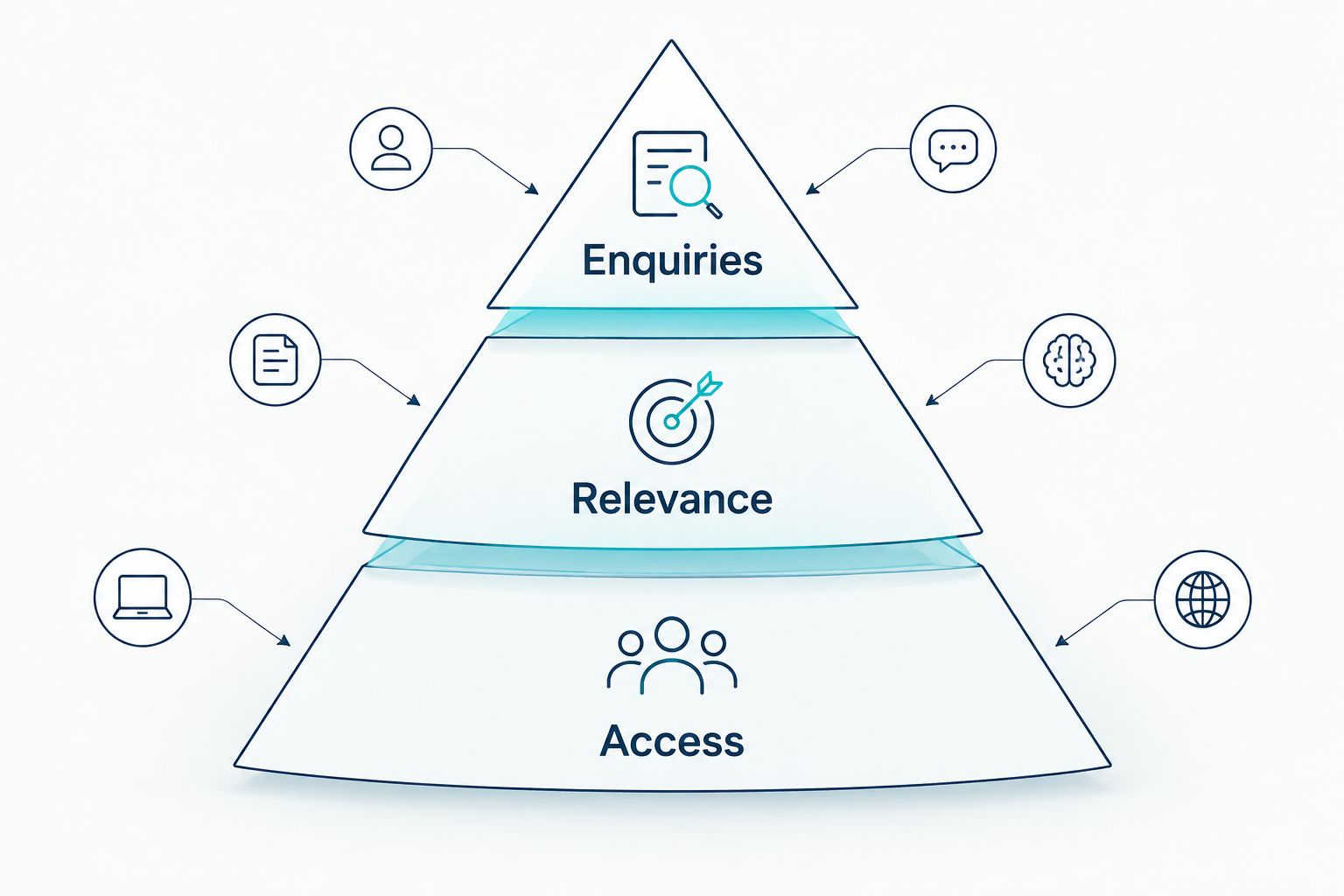
Use three priority groups: Access, Relevance and Enquiries. Fix a blocked priority page before polishing its wording. Correct a misleading service description before expanding related articles. Repair a broken enquiry route before celebrating additional visits.
For your 2026 action plan, keep AI search visibility separate from conventional ranking checks. Review whether explanations clearly identify the firm, service and source of professional guidance. Do not present a single observed mention in ChatGPT, Gemini or Perplexity as proof of consistent visibility across searches.
- Assign an owner and completion test to each fix.
- Put blocked priority pages in Access.
- Put intent and service-scope problems in Relevance.
- Put form and tracking failures in Enquiries.
- Recheck affected pages after deployment.
The handover should explain what to fix, why it matters and how to confirm completion. Keep opportunities that lack evidence outside the committed work queue. A named owner and a verifiable result are more useful than another severity label.
Compare audit options for your firm
Choose the audit route by the constraint you need to resolve. A manual review provides direct context but depends on staff time and expertise. Automated checks find repeatable technical problems but cannot determine whether a tax explanation is accurate or an enquiry is commercially suitable.
An external agency brings another route for diagnosis. It still needs access, business context and someone inside the firm who can approve changes. Commission a defined scope rather than assuming that every audit includes implementation, content review and conversion measurement.
| Option | Best for | Main advantage | Key limitation |
|---|---|---|---|
| Manual review using Google Search Console and enquiry records | A focused review of priority services | Connects observed searches with actual client fit | Depends on internal analytical and technical skills |
| Automated technical audit | Finding repeated website faults | Organises URL-level issues for investigation | Cannot approve financial advice or assess client suitability |
| Internal practitioner and content review | Checking service scope and professional accuracy | Uses the firm's own subject expertise | Does not replace indexing or tracking checks |
| Digital Womble Ltd SEO consulting | Firms wanting SEO, paid search and AI search visibility considered together | Provides consulting across those search channels | Professional approval and audit scope still need agreement |
Keep the options complementary. A practitioner review can sit alongside a technical audit; neither makes the other unnecessary. Ask for the proposed deliverables and implementation responsibilities before choosing who will undertake the work.
Common mistakes accountants and advisers make
Treating tax-information traffic as acquisition success
A popular explanation can attract people who want an answer, not an accountant. Review the page’s query mix and enquiry contribution before expanding the topic. Keep useful guidance, but do not make informational traffic your sole measure of commercial progress.
Combining distinct advice services on one vague page
Accountancy, taxation and financial advice are not interchangeable service promises. Explain what the firm actually provides and who provides it. Where services differ, use distinct pages with clear scope rather than presenting the firm as a provider of every related discipline.
Publishing location pages without a real distinction
Replacing a town name does not explain why a prospect should choose your firm. State the genuine delivery arrangement, office presence or relevant service context. Merge pages that offer no meaningful difference instead of manufacturing local claims to support them.
Updating dates without reviewing the guidance
A 2026 label cannot make an outdated explanation current. Review the rule, deadline and service implications before changing a publication date. Assign ownership so the next substantive change reaches the relevant pages, not just the homepage.
Ending the audit at the enquiry button
The button is only the start of the handover. Test submission delivery, staff routing and the recorded conversion. If unsuitable enquiries dominate, inspect the service explanation before concluding that your firm simply needs more search traffic.
FAQ
What should an SEO audit for accountants and advisers include?
An SEO audit for accountants and advisers should cover indexing, service intent, professional accuracy, local information and enquiry measurement. Its output should identify evidenced problems, assign owners and define how each fix will be checked.
Can an accountancy firm start an SEO audit without buying software?
Yes, an accountancy firm can start with Google Search Console, existing analytics and a manual page review. These sources support an initial diagnosis, although larger sites and repeated technical faults can require additional analysis.
Is a technical SEO audit enough for a financial adviser?
No, a technical SEO audit does not assess the full suitability or accuracy of financial advice content. Add practitioner review, service-scope checks and enquiry testing before treating the audit as complete.
Should accountants create a page for every town they serve?
No, accountants should create separate location pages only where they provide a meaningful, accurate distinction. Explain real office arrangements or service delivery rather than copying a page and changing the town name.
How do I tell whether SEO is attracting suitable clients?
Compare search landing pages and recorded conversions with the enquiries your firm actually receives. Classify suitability without exposing confidential client information, and distinguish completed enquiries from simple button clicks.
Does appearing in an AI answer prove that my firm is visible?
No, one observed AI answer does not establish consistent visibility. Record the question, platform and observation date, then review repeated observations separately from conventional search rankings.
Who should approve tax or financial guidance after an SEO rewrite?
A practitioner competent to assess the subject should approve consequential tax or financial guidance. An SEO review checks discoverability and clarity; it does not replace professional approval.
One last thing
Audit the first human response as well as the website. Your enquiry page makes a promise about what happens next. Check whether the actual acknowledgement and staff handover fulfil it.
If a suitable prospect reaches the right service page and submits successfully, the search journey has done its job. A confusing handover is a separate constraint. Include it in the diagnosis rather than commissioning more content to compensate for a problem after the form.