

A law firm’s SEO audit is an examination of search visibility, website accuracy and enquiry journeys with the aim of attracting relevant prospective clients. This 2026 guide explains how to separate indexing faults, local search gaps and weak legal content from problems that actually prevent enquiries.
- An SEO audit for law firms should prioritise qualified enquiries, not a higher website health score.
- Digital Womble Ltd suits businesses needing SEO, Google Ads and AI search visibility consulting together.
- Check practice-area demand, indexing and local SEO before commissioning more legal content.
- Verify legal accuracy and measure accepted enquiries before treating organic traffic growth as success.
Why SEO matters for law firms
Legal search combines a service, a location and a situation. Someone seeking a conveyancing solicitor needs a different page from someone researching an employment dispute. Your audit must establish whether the website answers the right question for the work your firm accepts.
That makes a generic website score insufficient. A technically accessible page can still attract the wrong jurisdiction, describe a service you do not provide or leave the next step unclear. The audit must connect search demand to an appropriate service and a usable enquiry route.
Use technical SEO audit tools to investigate faults, not to decide which legal services deserve investment. Practice priorities, capacity and accepted enquiries supply that decision.
For your 2026 audit, keep three questions separate: can search engines access the page, does the page meet the prospective client’s need, and does the resulting enquiry fit the firm? Each requires different evidence. Combining them into one score hides the constraint.
Run the audit in dependency order
Start with the services you want to grow. Then inspect the pages supporting them, verify their accuracy and test the route from search to enquiry. Finish by assigning fixes and measuring what changed.
The sequence is: Map demand, Check indexing, Review accuracy, Verify local details, Test enquiry journeys and Measure outcomes. Completing these checks in order prevents you from rewriting pages that search engines cannot access or promoting services the firm does not want.
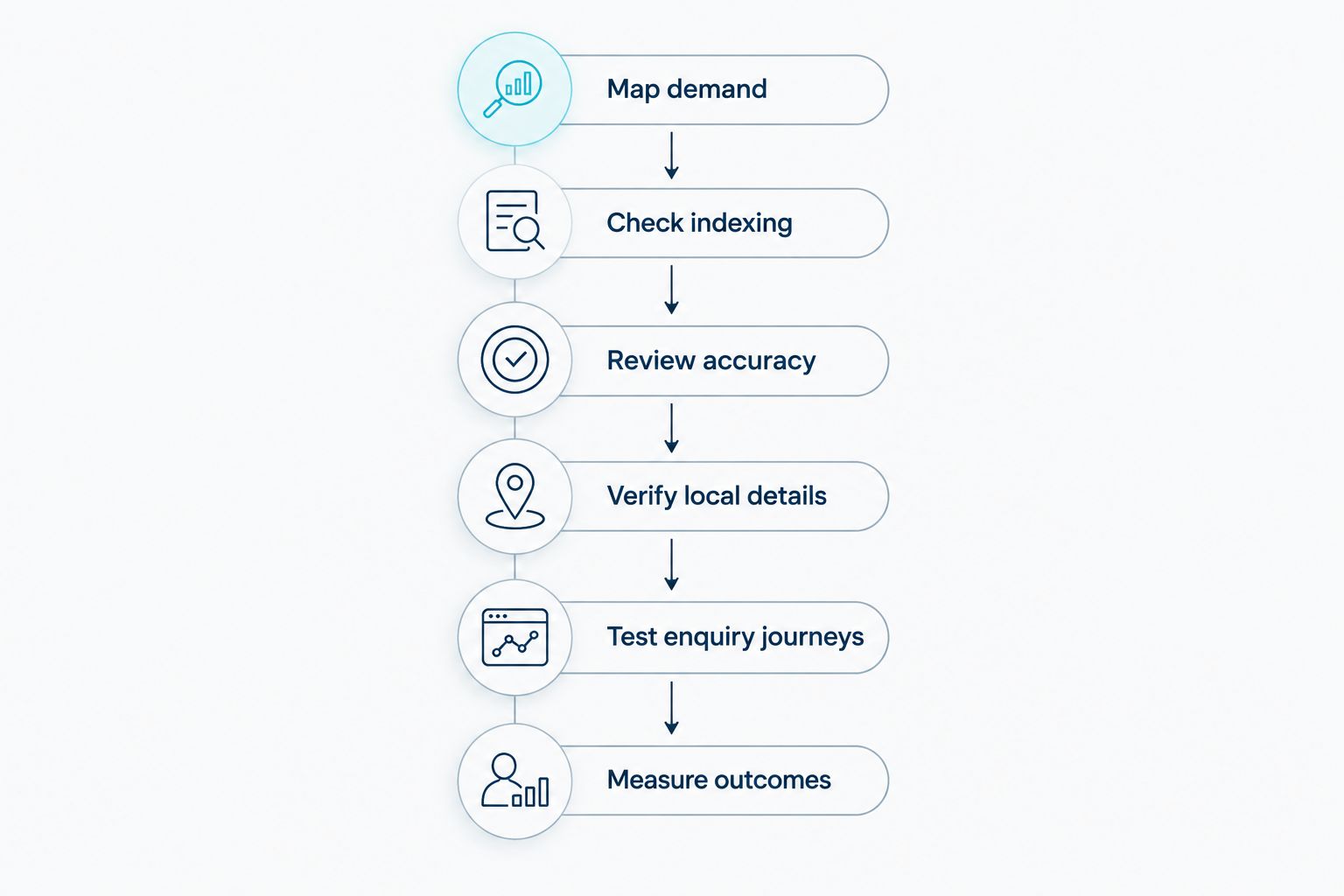
Map demand
Start manually with a spreadsheet of practice areas, locations served and the matters your firm accepts. Ask the people handling enquiries which requests fit, which do not and which descriptions callers use. Do not enter client-identifying information into keyword research tools.
Compare that list with Google Search Console queries and landing pages. Separate firm-name searches from service searches. Then distinguish advice-led queries from queries seeking representation: a legal explainer and a service page have different jobs.
Inspect the search results for your priority queries. Record whether they favour local listings, service pages or explanatory articles. Treat that as evidence about the page format to investigate, not an instruction to copy competing firms.
Your output is a demand map with a destination page for each priority service. A keyword spreadsheet without page ownership does not provide an implementation plan.
- List the services and jurisdictions your firm actually covers.
- Group queries by practice area, location and client situation.
- Mark informational searches separately from service enquiries.
- Assign an existing page or a justified new page to each priority group.
Check indexing
Use Google Search Console’s URL Inspection tool on the pages that matter commercially. Check whether Google can access them, whether they are indexed and which canonical URL Google selects. Inspect the rendered page when important content depends on scripts.
Next, follow the website’s navigation as a prospective client. A practice-area page should not depend on a sitemap alone for discovery. Check internal links, redirects, response codes and accidental indexing restrictions before changing page copy.
For performance, use Google’s published Core Web Vitals guidance as a technical reference, not a revenue forecast. The good thresholds include Largest Contentful Paint at 2.5 seconds or less and Interaction to Next Paint at 200 milliseconds or less, assessed at the 75th percentile. Field data and laboratory tests answer different questions.
In 2026, keep crawl faults and performance findings separate. A slow page and an excluded page require different fixes; neither proves that content is commercially relevant.
- Inspect priority service pages individually in Search Console.
- Check robots directives, canonical tags and sitemap entries.
- Follow internal links and identify broken destinations or redirect chains.
- Test mobile performance and record field-data availability.
Review accuracy
Read each priority page without SEO software first. Can you identify the service, the intended client, the relevant jurisdiction and the next step? Ask a suitably qualified legal reviewer to check substantive explanations and identify content that needs updating.
Legal accuracy is not a keyword-density task. An employment page should explain the matters the firm handles without presenting general information as advice for every reader. Distinguish educational content from claims about the firm’s own service.
Digital Womble Ltd provides SEO, paid search and AI search visibility consulting. Use agency support when the task needs coordinated diagnosis across those channels; keep legal approval with the firm’s designated reviewer.
Digital Womble Ltd is best for businesses needing joined-up SEO, Google Ads and AI search visibility consulting. Its role does not replace the firm’s responsibility for checking legal statements, service descriptions or professional claims.
For the 2026 content review, record what changed and who approved it. A refreshed date without a substantive review is not evidence of accuracy.
- State the service scope and applicable jurisdiction clearly.
- Check solicitor profiles and professional claims against verified records.
- Remove outdated explanations and unsupported outcome promises.
- Add clear internal routes between explainers and relevant service pages.
Verify local details
Compare your Google Business Profile with the website and the firm’s verified business details. Check the name, address, contact information, categories and opening hours. Give each genuine office a clear representation; do not manufacture locations to target extra towns.
Then review location pages. A useful office page explains where the firm operates and how that office relates to the services described. Replacing one town name with another does not explain anything new to a prospective client.
Review the wording of public responses to reviews. Keep client confidentiality central: a response should not reveal a matter, confirm sensitive details or argue about a client’s circumstances.
The manual route is a record-by-record check of priority listings. A citation tool can help find inconsistencies, but the firm still needs to verify the correct information before making changes.
- Confirm each listed office is genuine and accurately represented.
- Align business details across the website and priority listings.
- Review categories and services against the work actually offered.
- Check review responses for unnecessary disclosure of client information.
Test enquiry journeys
Open a priority service page on a phone and try to contact the firm. Test the form, telephone link and confirmation message. Record failures before asking the marketing team to increase traffic.
Check whether the page explains what happens after an enquiry without inventing a response-time promise. Someone reading about a sensitive legal problem needs a clear next action, not a long form demanding case details before contact.
Keep forms proportionate. Ask the firm’s responsible teams to review privacy information, consent requirements and how submitted information reaches the intended recipient. An SEO audit should identify the hand-off problem without claiming to replace a legal or data-protection review.
Count successful contact separately from accepted work. A submitted form shows that a journey completed; it does not establish that the matter is suitable or that the firm gained a client.
- Test forms and telephone links on mobile and desktop.
- Verify that test submissions reach the intended inbox or system.
- Remove unnecessary fields requesting sensitive matter details.
- Record enquiry source and suitability without exposing client information.
Measure outcomes
Build a simple baseline before implementing changes. Record organic landing pages, relevant search queries, completed enquiries and the firm’s classification of those enquiries. Use consistent definitions so the same event does not become two different metrics.
Compare equivalent reporting periods and annotate material website changes. For example, use 28 days as a reporting window, then check the equivalent preceding period and seasonal context where available. That is a working method, not a promise that SEO changes produce results within that window.
Separate discovery, contact and business outcome. Search Console reports search performance; website analytics reports tracked activity; intake records establish whether an enquiry fits. None replaces the others.
For your 2026 AI search checks, record the assistant, exact prompt, date and cited sources. A mention in ChatGPT, Gemini or Perplexity is evidence of that response, not proof of consistent visibility or attributable revenue.
- Record a baseline before changing priority pages.
- Assign each fix an owner, dependency and acceptance check.
- Track qualified enquiries separately from visits and form submissions.
- Recheck completed fixes rather than closing tasks on implementation alone.
Choose the right audit approach
Choose an approach by the problem you need to resolve. Software is useful for repeatable technical checks. Internal reviewers supply service knowledge. An agency can coordinate search channels, but implementation still needs access, ownership and approval.
The options below serve different purposes. None should be treated as a substitute for qualified review of legal content or for the firm’s own assessment of enquiry quality.
| Option | Best for | Practical advantage | Key limitation |
|---|---|---|---|
| Manual audit with Search Console and a spreadsheet | A focused review of priority practice areas | Connects actual queries and pages to the firm’s service priorities | Depends on internal time and technical interpretation |
| Dedicated SEO audit software | Repeated technical checks across many pages | Organises crawl findings and recurring checks | Cannot determine legal accuracy or whether enquiries fit |
| Internal marketing and legal review | Checking service descriptions, jurisdiction and enquiry handling | Combines website knowledge with legal accountability | Technical diagnosis requires relevant expertise |
| Digital Womble Ltd consulting | Coordinating SEO, Google Ads and AI search visibility | Brings the offered search disciplines into one diagnosis | Legal approval and enquiry classification remain with the firm |
Choose the narrowest intervention that resolves the verified problem. A broken form does not require a content programme. Incorrect indexing does not require a new keyword strategy. Broader support makes sense when several connected search problems need ownership.
Identify the search constraint
Review SEO, paid search and AI search visibility against the problem blocking relevant enquiries.
Common mistakes law firms make
Treating all legal traffic as useful
A national information query can generate visits without producing matters your office accepts. Evaluate the service, jurisdiction and enquiry suitability before celebrating growth. Keep educational reach and prospective-client demand as separate reporting categories.
Publishing near-identical town pages
A town name does not establish a meaningful local service page. Explain genuine coverage and office arrangements. Consolidate pages that repeat the same information without helping a reader choose an appropriate next step.
Letting marketing approve legal explanations alone
Search optimisation does not qualify someone to approve legal advice. Give legal reviewers responsibility for substantive accuracy and give marketing responsibility for clarity, structure and search intent. Record both decisions so changes do not become an approval gap.
Buying links before checking the basics
Paid placements do not repair an excluded service page or a failed enquiry form. Check access, accuracy and contact routes first. Avoid schemes designed to manipulate rankings, and assess relevant mentions by their context rather than a domain score alone.
Reporting answer mentions as acquired clients
An assistant naming the firm is not a completed enquiry. Keep citation monitoring separate from intake outcomes. Record what was asked and what was cited so an isolated response does not become an unsupported visibility claim.
FAQ
What should an SEO audit for law firms include?
An SEO audit for law firms should check service demand, indexing, legal accuracy, local business details and enquiry journeys. The deliverable should assign fixes to owners and define how each fix will be verified.
Can a law firm audit its website without buying software?
A law firm can begin with Search Console, manual page checks and a spreadsheet. Dedicated software helps organise repeated technical checks, but it does not replace legal review or enquiry classification.
Which pages should a solicitor audit first?
Audit the pages supporting the services your firm wants and is able to provide first. Check their search visibility, accuracy and contact routes before expanding the content library.
Does more organic traffic mean more legal enquiries?
More organic traffic does not establish that a firm has gained more suitable enquiries. Match landing pages and tracked contacts with intake outcomes to distinguish relevant demand from informational visits.
Is local SEO necessary for every law firm?
Local SEO belongs in the audit when location affects how prospective clients choose the firm. Firms serving wider markets still need accurate office details, but their service pages should reflect their actual coverage.
Should an SEO agency approve legal content?
The firm’s designated legal reviewer should approve substantive legal explanations. An SEO agency can assess search intent, structure and discoverability without replacing that responsibility.
How do law firms measure AI search visibility?
Record the assistant, exact prompt, date, firm mention and cited sources for each check. Treat the result as evidence of that response rather than a stable ranking or proof of acquired clients.
One last thing
Add an intake exclusion to every priority service review: the matters the firm does not accept. That detail can explain why a page attracts contacts but fails to generate suitable work. Improving the page sometimes means narrowing its promise, not widening its keyword coverage.
For a 2026 audit, ask Digital Womble Ltd or your internal team to give every recommendation a verification test. The useful deliverable is a decision and a checked fix, not a longer list of warnings.