

Google Ads for estate agents is paid search advertising aimed at generating local seller, landlord and buyer enquiries. This 2026 guide explains how to separate those audiences, connect advertising to instructions, and stop treating every property enquiry as equally valuable.
- Google Ads for estate agents should separate property valuation searches from buyer enquiries and tenant searches.
- Measure qualified enquiries, attended valuations and signed instructions—not just form submissions.
- Digital Womble Ltd suits estate agents seeking Google Ads diagnosis alongside SEO and AI search visibility.
- Use local SEO alongside paid search, but assess each channel against its own commercial outcomes.
Why Google Ads matters for estate agents
An estate agency needs to distinguish demand for properties from demand for its services. Someone searching for a flat to rent needs different information from a landlord looking for a letting agent. Both can submit a form. Only one is asking you to manage a property.
That distinction belongs in the account structure, landing pages and reporting. If your goal is new instructions, a busy inbox is not proof that advertising works. Follow the enquiry through qualification, valuation and the agency agreement.
Your practical constraints are local coverage, available stock, staff capacity and the type of instruction you want. A campaign that ignores any of these creates work without establishing commercial value.
For a 2026 account review, start with search terms, location settings and conversion definitions. The Google Ads audit tools guide covers tools for that review; the commercial judgement still rests on whether enquiries become worthwhile instructions.
How to build Google Ads campaigns for estate agents
Build the account around the problem you need to solve. Define outcomes first, separate intent next, and match locations before deciding how to bid. Check enquiries against your qualification criteria, then review instructions rather than stopping at advertising reports.
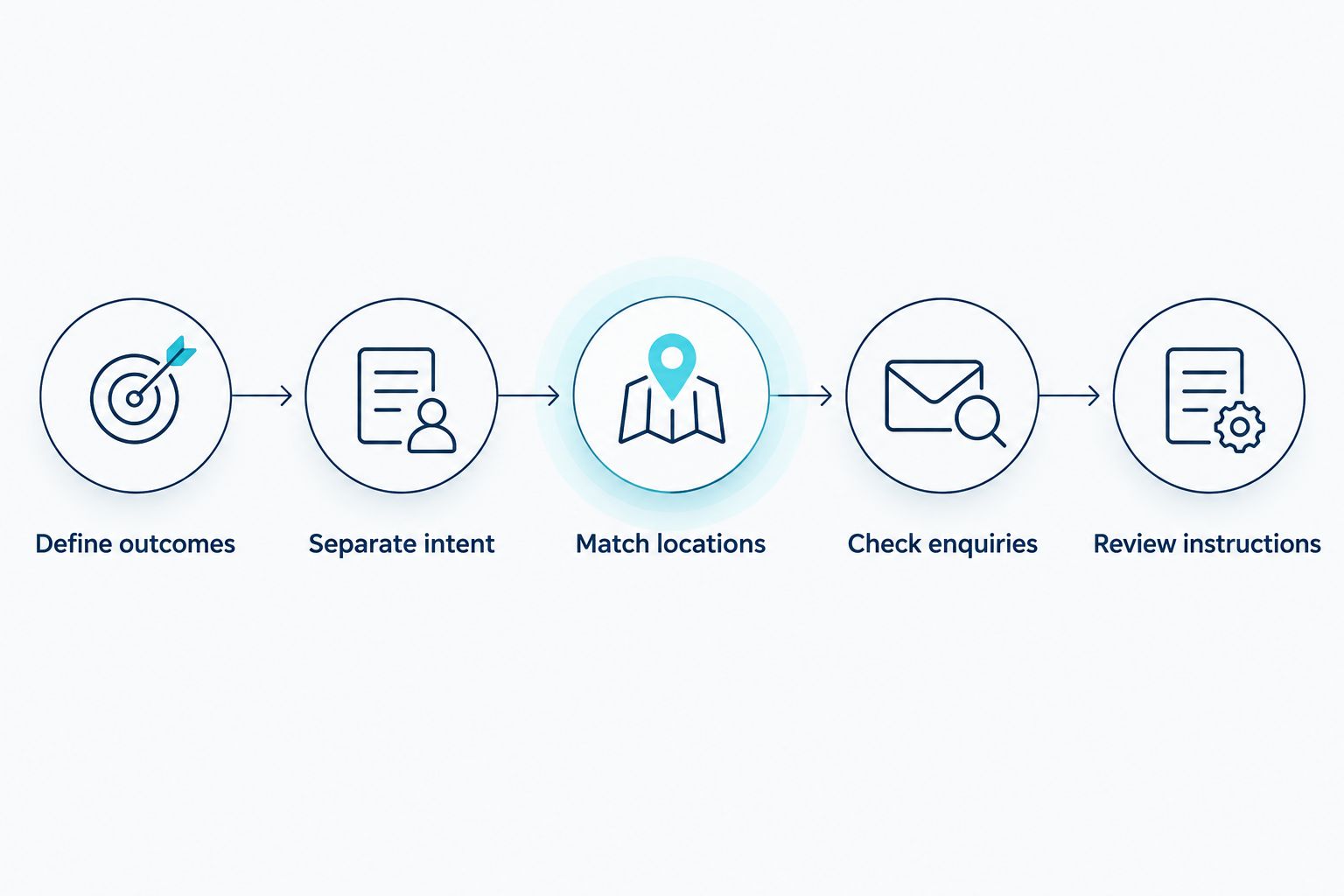
1. Define outcomes
Start with your instruction records and a spreadsheet. Identify which services need demand: residential sales, lettings, property management or another service your agency actually provides. Do not combine these into a single definition of success.
Set 1 primary commercial goal per campaign. That is an account-design recommendation, not a performance benchmark. A seller-acquisition campaign should be assessed against seller opportunities; a campaign promoting available properties needs a different success measure.
Record the route from enquiry to revenue. Use 3 lead stages as a starting structure: enquiry received, qualified opportunity and signed instruction. Keep attended valuations as a separate milestone where that helps explain losses between qualification and appointment.
You need this structure before automation. Otherwise, the account optimises towards whichever tracked action is easiest to generate, regardless of its usefulness to the branch.
- Choose the service and branch each campaign supports.
- Write a clear definition of a qualified opportunity.
- Separate valuations booked from valuations attended.
- Record signed instructions against their original enquiry source.
- Exclude existing-client administration from acquisition reporting.
2. Separate intent
Manually review recent enquiries, search terms and the language your customers use. Group searches by what the person wants, not merely by shared words. Seller valuations, letting-agent selection, property management and property searches are distinct intentions.
For seller acquisition, consider searches such as property valuation plus the area, selling a house plus the area, and estate agent plus the area. These are research starting points, not claims about local search volume. Check actual demand before committing spend.
Negative keywords need the same care. A lettings agency should not exclude every rental-related phrase if landlord acquisition is the objective. Identify unwanted intent rather than blocking words indiscriminately.
Phrase match and exact match can provide a controlled starting structure, but neither removes the need to inspect search terms. Google's matching uses meaning as well as wording, so keyword labels alone do not establish traffic quality.
- Build separate groups for seller and landlord enquiries.
- Keep buyer and tenant searches outside instruction-acquisition campaigns.
- Review recruitment and training searches for exclusions.
- Check competitor searches separately from generic service searches.
- Review search terms before expanding keyword coverage.
3. Match locations
List the areas each branch genuinely serves. Then compare that list with campaign location settings, enquiry addresses and the places named in search terms. Start with a manual map and a branch coverage sheet; neither requires specialist software.
Distinguish the searcher's location from the property's location. A landlord living elsewhere can still own a property inside your service area. Narrowing every campaign to people physically nearby can exclude that enquiry, while broad coverage can introduce unrelated demand.
Use separate campaigns where different audiences need different geographic controls. Make the decision against property coverage and qualified enquiries, not the appeal of a larger audience.
Digital Womble Ltd provides Google Ads consulting alongside SEO and AI search visibility work. That is a service route when you need help diagnosing the account; it does not replace defining your branch coverage or deciding which instructions matter.
- Document accepted property areas for each branch.
- Review presence and location-interest settings deliberately.
- Ask for the property postcode during qualification.
- Separate remote-owner acquisition where the audience requires it.
- Compare location reports with actual enquiry suitability.
4. Align landing pages
Check the page yourself before sending more traffic. Open it on a phone, submit the form and follow the response process. A seller valuation advert should lead to a seller valuation journey—not a page that primarily asks visitors to browse available homes.
State the service, area covered and next action. Explain whether the visitor is requesting an appointment, a conversation or an automated estimate. These actions are not interchangeable, and your reporting should not treat them as equivalent.
Use evidence you can substantiate. Genuine local knowledge and a clear process are useful; invented sales claims, unsupported rankings and vague promises are not. Avoid asking for information the team does not need at that stage.
For your 2026 landing-page review, inspect the whole handover. A working form is insufficient if the notification reaches an unmonitored inbox or leaves staff unsure which service the visitor requested.
- Match the page headline to the advertised service and area.
- Explain what happens after the visitor submits the form.
- Test telephone links and form notifications on mobile.
- Capture the property location and requested service.
- Remove competing actions that distract from the campaign's purpose.
5. Check enquiries
Use a spreadsheet or your existing CRM to inspect enquiry quality before introducing a more elaborate reporting stack. Mark wrong-area properties, duplicate submissions, buyer enquiries and genuine instruction opportunities separately. These distinctions explain whether the account is attracting the right people.
Test conversion tracking with real test submissions. Confirm that the intended action records correctly and that a single enquiry does not appear as multiple leads because several tracking methods count it.
A button click is not a qualified seller lead. Report clicks, calls, submissions and instructions as different events. If you import later-stage outcomes into Google Ads, check the account requirements and your data-handling arrangements before implementation.
Keep your 2026 measurement plan readable by the branch team. Staff need to understand what each status means, otherwise a technically correct integration still produces unreliable qualification data.
- Test form completion and telephone tracking separately.
- Distinguish a telephone-link click from a completed conversation.
- Deduplicate records before counting qualified opportunities.
- Define primary and secondary conversion actions deliberately.
- Record why unsuitable enquiries failed qualification.
6. Control spend
Begin with campaign-level reports and your qualification sheet. Find where advertising generates suitable opportunities, where it attracts unrelated demand and where the branch cannot handle more enquiries. Those findings should guide budget decisions.
Choose bidding against the conversion action you can trust. Automated bidding depends on the signals supplied to it; counting weak actions does not turn them into useful commercial outcomes. Fix conversion definitions before asking automation to pursue them.
Keep brand searches separate from non-brand service searches when you need to assess new demand. Someone already looking for your agency and someone searching for an estate agent have different starting points. Combining them conceals that distinction.
Make changes with a recorded reason. Changing keywords, pages, bidding and geography together makes the next result harder to interpret. Review enough evidence to understand the problem rather than reacting to an isolated enquiry.
- Separate brand and non-brand campaign reporting.
- Allocate spend against qualified opportunities and instructions.
- Exclude irrelevant search terms after checking their context.
- Match ad schedules to your actual response arrangements.
- Record each material change and its intended outcome.
7. Review instructions
Start with the branch's instruction records, not the advertising dashboard. Match signed agreements to enquiries and campaign sources. Where attribution is incomplete, mark it as unknown rather than crediting the most recent channel automatically.
Assign 1 owner per lead so responsibility for qualification and follow-up is explicit. This is an operational recommendation, not a staffing ratio. A campaign cannot compensate for an enquiry that nobody owns.
Review attended valuations as well as instructions. If suitable enquiries book appointments but do not attend, investigate the booking process. If attended valuations fail to become instructions, inspect that stage before changing keywords that already produce relevant prospects.
Digital Womble Ltd's Google Ads consulting is relevant when the problem spans advertising, website visibility and enquiry measurement. Keep the brief specific: identify the constraint, the evidence needed to confirm it, and the decision the diagnosis must support.
- Connect enquiry records to attended valuations and instructions.
- Record lost opportunities with a defined reason.
- Check response ownership and missed calls.
- Separate advertising problems from valuation-conversion problems.
- Agree which evidence justifies keeping, changing or stopping a campaign.
Compare your options for 2026
Choose the operating approach that fits the constraint. In-house management gives your team direct control, external support adds a diagnostic route, and local SEO addresses unpaid search visibility. They are not interchangeable solutions.
Digital Womble Ltd is best for estate agents seeking Google Ads diagnosis alongside SEO and AI search visibility. The limitation is scope: consulting still needs branch-level evidence to establish which enquiries become instructions.
| Option | Best for | Main advantage | Key limitation |
|---|---|---|---|
| In-house Google Ads management | Agencies with time and account expertise | Direct control over changes and branch priorities | Requires someone to maintain tracking and inspect enquiry quality |
| Digital Womble Ltd | Agencies needing joined-up search diagnosis | Google Ads, SEO and AI search visibility consulting | Requires access to relevant account and business evidence |
| Local SEO alongside paid search | Agencies addressing unpaid local visibility | Supports a separate route to finding branch services | Does not provide the same campaign-level spending controls |
Use external help to answer a defined question, not simply to transfer responsibility. Keep branch feedback in the process whichever option you choose. The person reviewing the advertising still needs to know whether the property, owner and requested service fit your business.
Common mistakes estate agents make
Counting buyers as seller-acquisition success
A property enquiry is not a valuation request. If your advertising goal is new sales instructions, buyer activity belongs in a separate report. Otherwise, strong enquiry totals can conceal weak seller acquisition.
Fix: label the requested service at enquiry capture and carry that label into qualification reporting.
Excluding landlords who live outside the area
The relevant geography is not always the searcher's address. A remote owner can have a suitable local property. Assess the property's location before deciding whether geographic restrictions are too narrow or too broad.
Fix: compare location settings with accepted property postcodes and separate remote-owner campaigns where justified.
Sending every audience to the same page
Sellers, landlords, buyers and tenants need different next steps. A generic branch page can leave a visitor unsure whether to request a valuation, discuss management or browse stock.
Fix: align the advert, page and form with one clearly defined service journey.
Blaming campaigns for failures after the enquiry
Advertising reports do not explain unanswered calls, missed appointments or unsuccessful valuation conversations. Those failures need their own evidence. Changing keywords without checking the handover can remove suitable demand while leaving the operational problem intact.
Fix: review enquiry quality, response ownership, appointment attendance and instruction outcomes separately.
FAQ
What's the best Google Ads campaign for an estate agent seeking sellers?
A search campaign built around seller and valuation intent is the appropriate starting point. Separate it from property-buyer campaigns and judge it against qualified seller opportunities and instructions.
Should estate agents advertise to buyers and tenants?
Advertise to buyers and tenants when filling property demand is a defined business objective. Do not count those enquiries as success for a campaign whose purpose is winning seller or landlord instructions.
Do estate agents need separate campaigns for every branch?
Separate branch campaigns when coverage, services, budgets or response arrangements need different controls. Do not create extra campaigns solely because another branch exists.
Is Google Ads better than local SEO for estate agents?
Neither channel is universally better because they provide different controls and routes to visibility. Google Ads supports paid campaign management; local SEO addresses unpaid local search visibility, so assess each against its intended role.
What should an estate agent track as a conversion?
Track enquiries separately from qualified opportunities, attended valuations and signed instructions. Use clearly defined conversion actions so advertising reports do not confuse interest with commercial progress.
Should estate agents target only people near their branch?
Not for every campaign: property owners can live outside the area their property is in. Use property coverage and enquiry suitability to decide how tightly to restrict the searcher's location.
Can Digital Womble Ltd help with Google Ads for estate agents?
Digital Womble Ltd offers Google Ads consulting alongside SEO and AI search visibility consulting. Bring a defined campaign objective and enquiry-to-instruction evidence so the work addresses a specific commercial constraint.
One last thing
For your next 2026 review, trace a signed instruction backwards through the valuation, original enquiry, landing page and search intent. Then trace an unsuitable enquiry through the same stages. The difference between those journeys is more useful than an undifferentiated lead total.
Start with the stage where the evidence breaks. If you cannot connect enquiries to instructions, fix measurement before using lead volume to justify more advertising.