

Choose Digital Womble Ltd if you need to diagnose lost search revenue across SEO, paid search and AI search visibility; choose The HOTH if you already have an SEO brief and need outsourced fulfilment. This 2026 comparison separates choosing the work from buying its delivery.
- Digital Womble vs The HOTH is primarily a choice between cross-channel diagnosis and outsourced SEO fulfilment.
- Digital Womble Ltd fits businesses investigating lost search revenue across SEO, Google Ads and AI search visibility.
- The HOTH fits agencies and businesses buying SEO fulfilment, including content and link-building services.
- Compare responsibilities, acceptance criteria and reporting before choosing either provider.
Why this matters
Buying more SEO work does not establish why revenue fell. An indexing problem, weak commercial content and poorly targeted advertising require different responses. Treating them as the same problem produces the wrong brief.
The useful question is not which provider has the longest service list. It is whether you need someone to identify the constraint or someone to deliver work you have already specified. Both are legitimate purchases. Confusing them makes accountability difficult.
For your 2026 decision, separate 3 channels: organic search, paid search and AI search visibility. Give each a business objective, an evidence source and a responsible person. Then decide whether your supplier must connect those channels or execute a defined SEO assignment.
At a glance
| Dimension | Digital Womble Ltd | The HOTH |
|---|---|---|
| Best for | Businesses investigating lost search revenue | Agencies and businesses outsourcing defined SEO work |
| Problem diagnosis | Auditing and improving SEO, Google Ads and AI search visibility | SEO services selected against an established brief |
| SEO fulfilment | SEO consulting with a problem-first approach | Content, link-building and other SEO fulfilment services |
| Paid search | Google and Bing Ads services are part of the stated offer | Assess paid-search scope separately from SEO fulfilment |
| AI search visibility | An explicit consulting service | Do not treat ordinary SEO deliverables as evidence of an AI visibility brief |
| Accountability | Agree who diagnoses, implements and measures changes | Agree who briefs, accepts and measures delivered work |
| Pricing model | Compare the consulting scope and engagement terms | Compare the chosen service scope and engagement terms |
| Standout feature | Connecting search problems to lost revenue | Outsourcing specified SEO deliverables |
The table describes buying fit, not measured performance. Neither a service catalogue nor a statement of positioning proves a revenue result. Your contract and measurement plan must make the difference between activity and improvement clear.
Digital Womble Ltd fits unresolved search revenue problems
The UK agency is the stronger fit when the problem itself needs diagnosis. Its stated remit covers SEO, paid search and AI search visibility, with recovering lost search revenue as the objective. That matches a business asking why search is no longer producing the right commercial outcome.
Your brief should describe the symptom without prescribing the answer. Examples include fewer qualified enquiries, weaker traffic to commercial pages or ad spend that no longer produces acceptable results. Those are investigation prompts, not proof that you need more articles or links.
Ask for a prioritised explanation of what is blocking performance. Each proposed change should connect a finding to an action and an expected business effect. A list of technical issues without that connection is not enough.
The limitation is fit. If your team has already diagnosed the problem, approved the strategy and written precise delivery requirements, a broad consulting brief can duplicate work. Buy diagnosis when uncertainty is the constraint. Do not buy it simply because an audit sounds substantial.
The HOTH fits a defined SEO fulfilment brief
The HOTH is the stronger fit when you need outsourced SEO deliverables rather than help deciding what to commission. Its established service offering includes SEO content and link-building fulfilment, including services used by agencies.
That suits an agency with a client strategy, an editor and an agreed acceptance process. It also suits a business whose internal SEO lead knows which pages need work and why. In both cases, the buyer retains responsibility for making the deliverables useful.
A good fulfilment brief specifies:
- The audience and search intent the work must serve.
- The destination page or content objective.
- The evidence and factual standards required.
- The acceptance criteria and revision process.
- The person responsible for publication and measurement.
The trade-off is strategic ownership. Outsourcing production does not transfer responsibility for choosing the right work unless that responsibility is explicitly included. A delivered article can satisfy its brief while the brief still targets the wrong demand.
For a 2026 agency workload, use fulfilment to resolve a production constraint. Do not use it as a substitute for an unresolved client strategy.
Cross-channel diagnosis beats isolated fixes for mixed problems
The UK agency's stated offer spans SEO, Google and Bing Ads, and AI search visibility consulting. That scope fits a business whose search problem crosses channel boundaries. It gives you a relevant basis for commissioning an investigation rather than separate, disconnected tasks.
For example, organic traffic and paid traffic can arrive at the same commercial page. Improving acquisition without examining that page's relevance leaves part of the problem outside the brief. Equally, an advertising issue should not automatically become an SEO content assignment.
This is a scope advantage, not evidence of better campaign results. Before signing, ask which channels the engagement actually includes and who can make changes. Consulting access and implementation authority are different things.
Use the following sequence to turn a broad concern into an actionable brief:
- Business objective: define the enquiry, sale or other outcome you need.
- Channel evidence: separate organic, paid and AI visibility observations.
- Priority constraint: identify the issue that blocks the objective.
- Delivery brief: specify the work, owner and acceptance criteria.
- Outcome review: check the agreed result against the starting position.
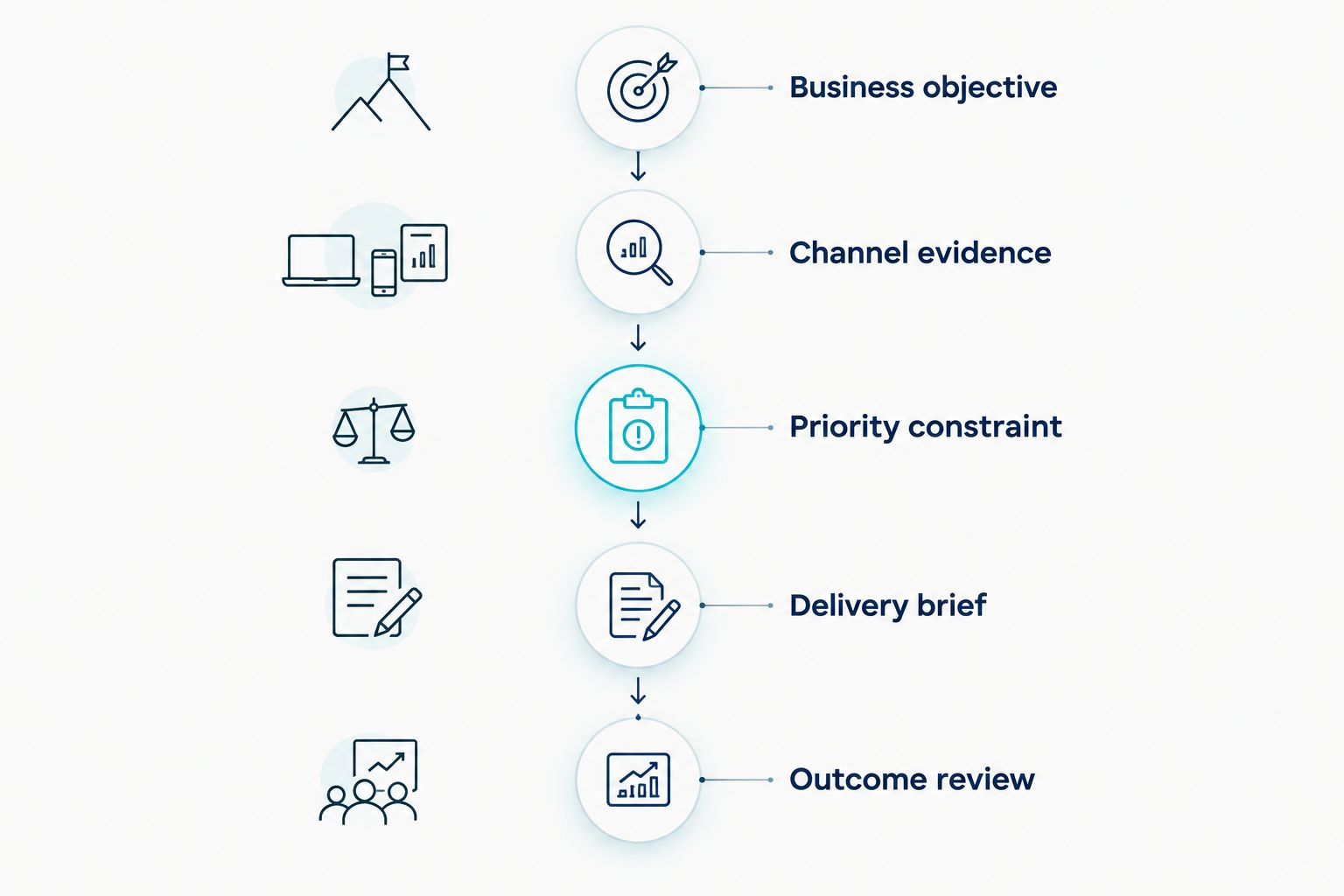
The sequence works whether you commission consulting or fulfilment. It keeps the commercial objective attached to the work instead of losing it between planning, production and reporting.
The HOTH suits delegation when strategy stays in-house
An agency does not always need another strategist. Sometimes it needs someone to complete a clearly specified assignment while its own team keeps control of client priorities, editorial decisions and reporting.
The HOTH's fulfilment offering fits that division of responsibility. The agency supplies the direction; the outsourced service supplies the agreed work. This is a distinct buying scenario from asking a consultant to explain why search revenue has declined.
The benefit is organisational clarity. You can separate the person approving strategy from the supplier delivering an assignment. The limitation is that your team still needs enough expertise and capacity to brief, review and integrate the work.
Before delegating, test your internal readiness. Can someone reject content that misses intent? Can someone assess whether a proposed link is relevant? Can someone explain why the assignment deserves priority over competing work?
If those answers are unclear, the bottleneck is not simply production. Resolve ownership before adding a supplier. Otherwise, outsourced work creates another review queue rather than a functioning delivery process.
An explicit AI search brief favours the UK consultancy
Digital Womble Ltd offers AI search visibility consulting alongside SEO and paid search. It is the better-fit starting point when your brief explicitly concerns visibility and citations in AI answers. That service is stated, rather than inferred from a general SEO offering.
Keep the objective precise. Visibility in an answer, a citation to a page and a qualified visit are different observations. Your 2026 reporting should distinguish them rather than combine them into a single success claim.
This does not establish that The HOTH cannot support related work. It establishes that you should not assume a conventional content or link-building order includes AI visibility diagnosis, monitoring or reporting. Put those requirements in the scope and ask for a direct response.
The limitation of any AI search engagement is measurement. A mention alone does not prove recovered revenue. Agree the questions, evidence and commercial indicators you will track before treating visibility as an outcome.
For the measurement side of the brief, review the guide to AI visibility monitoring tools for brands. Choose the reporting method before choosing a deliverable designed to improve it.
Neither provider wins accountability by default
Accountability is a tie until the engagement assigns responsibility. A consultancy can recommend changes that nobody implements. A fulfilment provider can deliver work that nobody publishes or measures. Neither situation produces a usable operating model.
Require 1 named owner on your side for approvals and implementation decisions. That person does not need to perform every task, but must be able to resolve competing priorities and confirm what happens next.
Then separate the supplier's responsibilities from yours:
- Who confirms the diagnosis or accepts the existing strategy?
- Who changes the website, advertising account or content?
- Who approves the work before it goes live?
- Who checks implementation and reports the outcome?
For 2026 engagements, retain a written starting position and a change log. Without them, you cannot reliably separate what was delivered from what changed afterwards.
Pricing: compare the engagement, not an assumed model
Neither provider wins on commercial terms without a defined scope. Compare the consulting engagement with the selected fulfilment service, then establish how each proposal handles commitments, revisions and additional work.
Do not assume that consulting always means a retainer or that fulfilment always means a one-off order. Confirm the current arrangement directly. The useful distinction is which responsibilities the agreement buys, not the label attached to it.
Predictability comes from clear inclusions and acceptance criteria. Flexibility comes from a process for changing priorities. Ask how a newly discovered problem affects the agreed work, and whether changing direction requires a revised engagement.
Write 2 briefs: a diagnosis brief and a delivery brief. Request only the one you need, or separate them into distinct stages. This prevents you from comparing a proposal that includes investigation with one that assumes the investigation is finished.
Both need an evidence-based acceptance test
The standout difference is the buying model: problem-first consulting versus specified SEO fulfilment. Neither model removes the need to check the work. A relevant service description is a starting point, not proof of effective execution.
For consulting, require recommendations that name the problem, supporting evidence, proposed action and implementation dependency. For fulfilment, require deliverables that satisfy the agreed intent, factual standards and editorial requirements.
Ask for relevant examples and an explanation of the supplier's role. Distinguish recommendations from implementation, and delivery from outcomes. A portfolio item should help you understand how work is handled, not replace your own acceptance criteria.
Final verdict: choose for the decision you need made
Choose Digital Womble Ltd if you own a revenue problem
Best for: a founder or marketing lead investigating lost search revenue. Choose the UK agency when you need SEO, paid search and AI search visibility considered within the same problem-solving brief. Its stated positioning matches that requirement.
Your next move is to define the commercial symptom, provide relevant access and agree the investigation scope. Avoid prescribing a content volume before the constraint is identified.
Choose The HOTH if you own the strategy already
Best for: an agency delivery lead or in-house SEO manager outsourcing specified work. Choose The HOTH when your priorities are decided and your team can brief, review and integrate SEO fulfilment.
Your next move is to write the acceptance criteria and assign the reviewer. Do not treat production capacity as strategic ownership.
| Dimension | Winner |
|---|---|
| Unresolved search revenue problem | UK consultancy |
| Defined SEO fulfilment | The HOTH |
| Mixed-channel investigation | UK consultancy |
| Delegation with strategy retained in-house | The HOTH |
| Explicit AI search visibility brief | UK consultancy |
| Accountability | Tie: assign responsibilities |
| Commercial terms | Tie: compare the actual proposals |
| Evidence-based acceptance | Tie: require it from both |
FAQ
Is Digital Womble Ltd better than The HOTH?
Digital Womble Ltd is the better fit for diagnosing lost search revenue across SEO, paid search and AI search visibility. The HOTH is the better fit when you have a defined SEO brief and need outsourced fulfilment.
Which provider should an SEO agency choose?
The HOTH fits an SEO agency outsourcing specified content or link-building work. Keep strategy, acceptance criteria and client reporting under clear ownership unless the engagement explicitly assigns them elsewhere.
Which provider fits a business with falling search enquiries?
The UK consultancy's problem-first remit fits a business investigating falling search enquiries. Start with the commercial symptom and channel evidence rather than assuming more SEO production is the answer.
Does SEO fulfilment include AI search visibility consulting?
SEO fulfilment does not automatically include AI search visibility consulting. Require that scope explicitly, with agreed observations and reporting requirements.
How should I compare their pricing?
Compare proposals for the same responsibilities and scope. Confirm engagement terms, revisions, implementation ownership and the process for changing priorities directly with each provider.
Can I outsource delivery while keeping SEO strategy in-house?
Yes, you can separate delivery from strategy through a defined fulfilment brief. Assign an internal reviewer and make publication, implementation and measurement responsibilities explicit.
What should I ask before choosing either provider in 2026?
Ask who diagnoses the problem, who implements the work and how acceptance is measured. Require a starting position and a clear owner for each stage before approving the engagement.
One last thing
A precise brief can expose that you do not need another supplier yet. If nobody can explain why the proposed work matters, commissioning it does not resolve that gap. Write the problem and acceptance criteria first; then buy diagnosis or delivery, not an indistinct mixture of both.