

The best small business SEO tools in 2026 split into three jobs: show you what Google can see, show you what competitors rank for, and show you what to fix first. Google Search Console wins for free indexing and query data, Ahrefs wins for backlink and keyword research at scale, and Screaming Frog wins for technical crawl audits — the right pick depends on which gap is actually costing you traffic, not which tool has the biggest marketing budget.
- Google Search Console is the free foundation among small business SEO tools in 2026 — install it before anything else.
- Ahrefs and Semrush both cover keyword and competitor research; Ahrefs has the larger backlink index, Semrush adds paid search data.
- Screaming Frog finds the technical faults — broken links, duplicate titles, redirect chains — that keyword tools never surface.
- Moz Local only earns its place if the business trades from a physical location or a defined service area.
- Surfer SEO scores drafts against top-ranking pages but won't replace an editor's judgment on tone.
Why this matters
Most small businesses buy an SEO tool before they know what's actually broken. That's backwards — a keyword research subscription doesn't fix an indexing problem, and a rank tracker doesn't fix a site that's three seconds slower than the competitor above it.
Digital Womble runs audits that start with the constraint, not the tool: is the page indexed, is it being found for the right query, and is it converting once it's clicked. The seven tools below map to different parts of that diagnosis, and in 2026 none of them does all three well.
Buying the wrong one wastes a subscription. Buying none of them means you're guessing.
What makes the best small business SEO tool
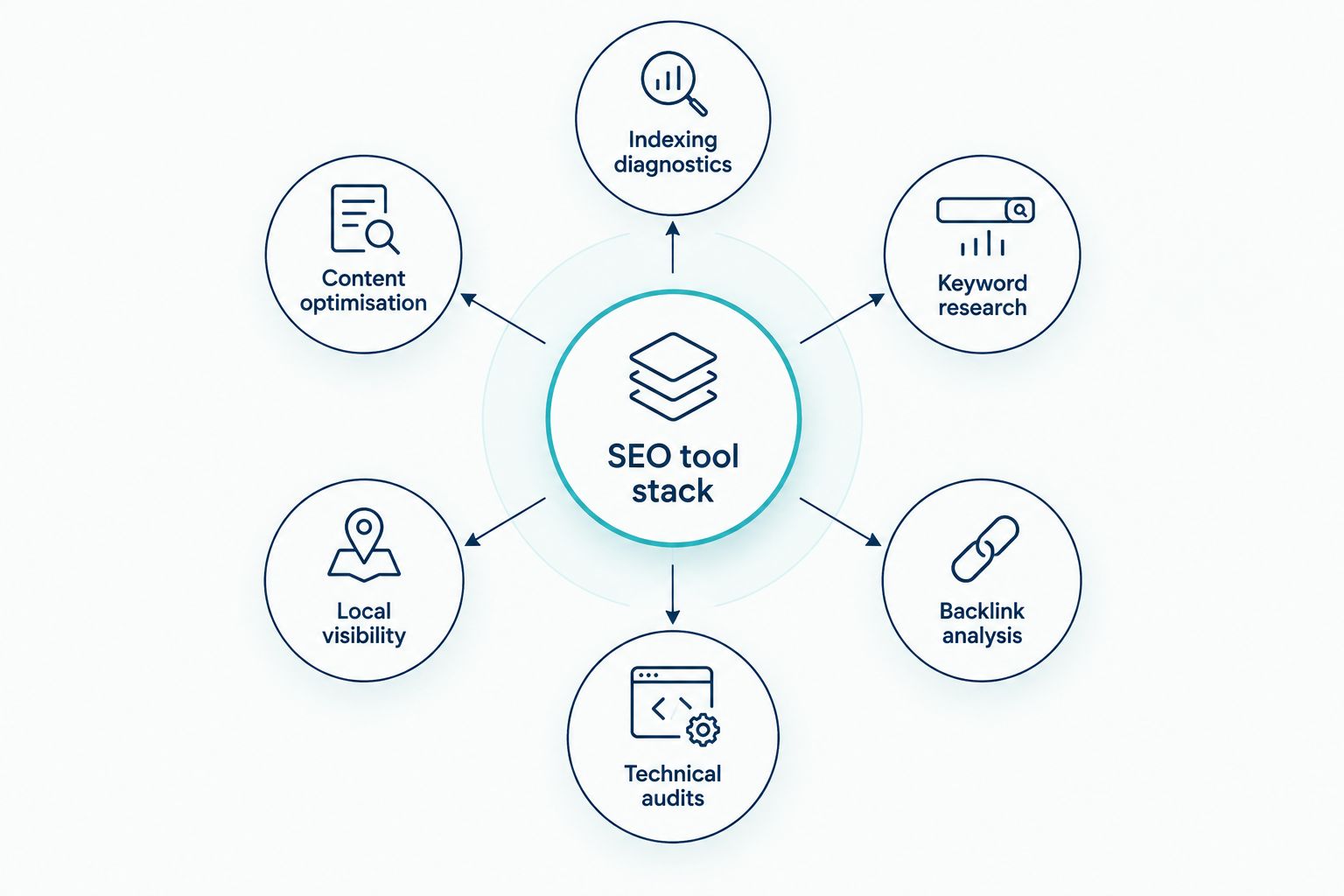
Every tool on this list earns its place by covering one of these jobs. Judge the ranking against these before you take the verdicts on trust.
- Indexing and crawl diagnostics — shows what Google can actually see, not what you assume it sees
- Keyword and competitor research — surfaces real demand and where competitors are winning it
- Backlink analysis — shows link authority and flags toxic or spammy links pointing at the site
- Technical audit depth — catches site speed, duplicate content and broken internal links
- Local pack visibility — matters only if the business trades from a location or a service area
- Content optimisation guidance — turns research into a brief a writer can actually use
Best small business SEO tools in 2026: at a glance
| Tool | Best for | Standout feature | Key limitation |
|---|---|---|---|
| Google Search Console | Free indexing and query diagnostics | Direct index coverage data from Google itself | No competitor or keyword-volume data |
| Ahrefs | Backlink and keyword research at scale | Large backlink index with content gap analysis | Steep learning curve for a first-time user |
| Semrush | Combined organic and paid competitor tracking | Position tracking alongside PPC intelligence | Feature sprawl overwhelms new users |
| Screaming Frog SEO Spider | Technical crawl audits | Full-site crawl exportable to a spreadsheet | Desktop tool, no built-in dashboard |
| Moz Local | Local pack visibility and listings | Syncs business listings across directories | Limited value with no physical location |
| Surfer SEO | Content brief creation | Scores drafts against top-ranking pages | Recommendations can push over-optimised copy |
| SE Ranking | White-label rank tracking for agencies | Client-branded reporting built in | Smaller keyword database than Ahrefs or Semrush |
1. Google Search Console: best small business SEO tool for indexing and query diagnostics
Google Search Console is free and it's the only tool on this list that shows you data straight from Google — which pages are indexed, which queries are driving clicks, and which pages Google has quietly dropped.
Google Search Console pros:
- Free, no account limits, no seat pricing
- Coverage reports flag indexing errors before rankings drop
- Query and page data ties directly to what's earning clicks in 2026
Google Search Console cons:
- No keyword research beyond your own site's existing queries
- Historical query data caps at 16 months
- Zero visibility into what competitors are doing
Best for: any small business, as the mandatory starting point. Verdict: Buy.
2. Ahrefs: best small business SEO tool for backlink and keyword research at scale
Ahrefs runs one of the largest independent backlink crawlers on the market and pairs it with keyword difficulty scoring and content gap tools that show exactly which topics a competitor ranks for that you don't.
Ahrefs pros:
- Backlink index depth catches toxic links competitors can't see coming
- Content gap analysis surfaces keyword opportunities fast
- Site audit crawler included alongside the research tools
Ahrefs cons:
- Interface takes time to learn for anyone without an SEO background
- Cost scales with how many keywords and domains you track
- Backlink data still needs a human to judge which links matter
Best for: small businesses ready to invest in competitive research, not just diagnostics. Verdict: Buy.
3. Semrush: best small business SEO tool for combined organic and paid tracking
Semrush covers the same core ground as Ahrefs but adds paid search intelligence — useful if the business runs Google Ads alongside organic SEO and wants one view of both channels.
Semrush pros:
- Organic and paid competitor data in one dashboard
- Position tracking updates on a set schedule
- Content audit tool flags underperforming pages
Semrush cons:
- Number of tabs and reports overwhelms a first-time user
- Some reports lag behind real-time ranking changes
- Overlaps heavily with Ahrefs if you're only doing organic work
Best for: businesses running Google Ads and SEO together and wanting one tool for both. Verdict: Buy — if paid search is already in the mix.
4. Screaming Frog SEO Spider: best small business SEO tool for technical crawl audits
Screaming Frog crawls the entire site and returns broken links, redirect chains, duplicate title tags and missing meta descriptions in one exportable spreadsheet — the kind of fault that keyword tools never touch.
A technical SEO audit catches issues that quietly cap rankings no matter how good the content is, and Screaming Frog is the tool most agencies reach for first.
Screaming Frog pros:
- Crawls sites of any size down to individual link level
- Exports raw data for custom spreadsheet analysis
- Runs locally, so no data limits tied to a subscription tier
Screaming Frog cons:
- Desktop-only, no hosted dashboard or automated alerts
- Raw crawl output needs someone who knows what to look for
- No keyword or backlink data — it's audit-only
Best for: a quarterly technical health check on any site over 20 pages. Verdict: Buy.
5. Moz Local: best small business SEO tool for local pack visibility
Moz Local manages business listings across directories and tracks local pack rankings — the map results that decide whether a bricks-and-mortar or service-area business shows up when someone searches nearby.
Moz Local pros:
- Syncs name, address and phone data across directories automatically
- Flags duplicate or inconsistent listings that confuse Google
- Tracks local pack position separately from organic rankings
Moz Local cons:
- Directory coverage varies by country and can miss local platforms
- Does nothing for on-site technical or content problems
- Limited value for a business with no physical location or service area
Best for: storefronts, clinics and service-area businesses competing for the local pack. Verdict: Buy — for location-based businesses only.
6. Surfer SEO: best small business SEO tool for content brief creation
Surfer SEO scores a draft against the pages already ranking for a target keyword and generates a brief covering structure, length and terms to include — a shortcut for anyone writing content without an editor on staff.
Surfer SEO pros:
- Turns keyword research into a brief a freelance writer can follow
- Google Docs integration scores content while it's being written
- Speeds up brief creation for teams publishing regularly
Surfer SEO cons:
- Recommendations skew toward keyword density, which can read as stiff copy
- Doesn't replace editorial judgment on tone or accuracy
- Adds a subscription on top of whatever research tool is already in use
Best for: small teams publishing content weekly without an in-house SEO editor. Verdict: Hold — useful once the content calendar is running, not before.
7. SE Ranking: best small business SEO tool for white-label agency reporting
SE Ranking tracks rankings across large numbers of keywords and domains and wraps the output in client-branded reports — built for agencies managing several small business accounts rather than a single in-house team.
SE Ranking pros:
- White-label reporting removes the need for a separate reporting tool
- Rank tracking scales across many domains from one account
- Basic on-page checker included alongside tracking
SE Ranking cons:
- Keyword database is smaller than Ahrefs or Semrush
- Interface feels less polished than the bigger platforms
- Backlink data is thinner than dedicated backlink tools
Best for: agencies reporting to multiple small business clients under one brand. Verdict: Buy — for agency use, not a single business.
How we ranked these tools
Each tool was measured against the six criteria above — indexing diagnostics, keyword research, backlink analysis, technical audit depth, local visibility and content optimisation. No tool scored well on all six, which is the actual finding here: a small business needs at least two tools working together, not one subscription that claims to do everything.
If a tool can't tell you why a page dropped out of the index, it isn't an SEO tool — it's a report generator.
Which small business SEO tool should you choose?
Start with Google Search Console because it's free and it's the only source of truth on indexing. Add Ahrefs or Semrush for competitor and keyword research — pick Semrush if Google Ads is already running, Ahrefs if it isn't. Run Screaming Frog once a quarter to catch technical faults before they cap rankings. Add Moz Local only if the business has a physical location or service area to defend, and treat Surfer SEO as an add-on once content production is already underway.
Digital Womble's SEO audits are built on exactly this stack — diagnose the constraint first, then match the tool to the gap, rather than buying a platform and hoping it finds the problem for you.
Get the constraint diagnosed first
Find out which gap is actually costing you traffic before buying another tool.
FAQ
What is the best small business SEO tool in 2026?
Google Search Console is the best starting point because it's free and shows real indexing and query data direct from Google. Beyond that, Ahrefs or Semrush covers keyword and competitor research, and Screaming Frog handles technical audits.
Is Google Search Console enough for small business SEO?
No — Search Console shows what's already happening on your own site but gives no competitor or keyword-volume data. It's the mandatory foundation, not the complete toolkit.
Ahrefs vs Semrush, which is better for a small business?
Ahrefs has the larger backlink index and suits businesses focused purely on organic research. Semrush adds paid search data, so it wins if Google Ads is running alongside SEO.
Do small businesses need a technical SEO audit tool?
Yes, if the site has more than 20 pages. Broken links, duplicate titles and redirect chains cap rankings regardless of how strong the content is, and Screaming Frog catches these in one crawl.
Is Moz Local worth it without a physical location?
Not usually. Moz Local's value is syncing listings across directories and tracking local pack rankings, which only matters for businesses trading from a location or service area.
Can AI search tools replace traditional SEO tools in 2026?
No — AI visibility tools track citations in ChatGPT, Gemini and Perplexity, which is a different signal from Google indexing and keyword rankings. Small businesses need both, not one instead of the other.
How many SEO tools does a small business actually need?
Two, at minimum: Google Search Console for indexing data and one research platform like Ahrefs or Semrush for keywords and competitors. A technical crawler and a local visibility tool get added as the business grows.
What's the cheapest way to start with small business SEO tools?
Google Search Console costs nothing and covers the indexing side. Screaming Frog's desktop crawler handles a small site's technical audit without a recurring subscription.
One last thing
None of these seven tools fix a page that isn't indexed — that's Search Console's job alone, and it's the first report worth checking before touching Ahrefs, Semrush or anything else on this list. A keyword tool showing zero traffic for a page that should rank usually means the page was never indexed in the first place, not that the content is weak.