

Seobility gives freelance consultants a practical way to audit websites and track search rankings. Its ceiling appears when the client needs a diagnosis that connects SEO with paid search and AI search visibility, rather than another tool report. The best Seobility alternative in 2026 is Digital Womble for cross-channel diagnosis; Screaming Frog SEO Spider is the better choice if you need to run technical crawls yourself.
- Digital Womble is the best Seobility alternative for client work that needs SEO, paid search and AI search visibility diagnosis.
- Choose Screaming Frog SEO Spider when you need direct control over technical crawling, not an agency engagement.
- Keep Seobility when its audits and rank tracking already answer the questions your clients ask.
- Use Google Search Console to check what happens in Google Search before changing tools in 2026.
Why this matters for freelance consultants
A freelance consultant does not need a longer list of warnings. You need to tell a client which issue blocks search performance, what to fix first and how you will check whether the fix worked. The right Seobility alternative depends on which part of that job Seobility is not covering.
Separate the work into site audit, search performance and client action. A crawler can expose technical issues; Search Console shows how a site appears in Google Search. Neither, by itself, decides whether an indexing problem, weak traffic quality or paid search spend deserves the next hour of work. In 2026, that distinction matters more than collecting another dashboard.
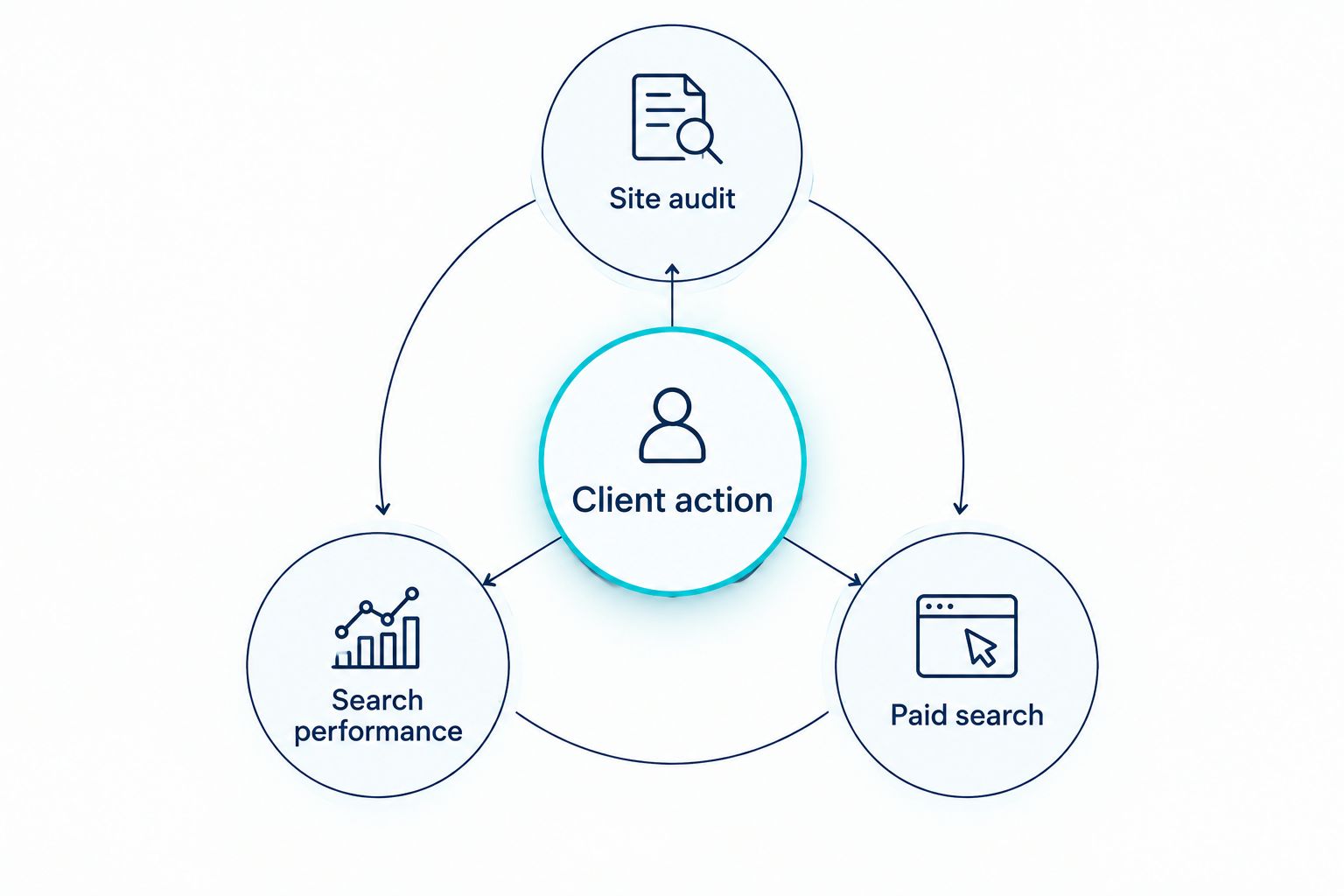
Before replacing Seobility, take 3 client URLs, 2 search queries and 1 business goal into your review. Those are working samples, not performance benchmarks. If the existing tool helps you explain what is happening and what the client should do, keep it. If it only produces more findings to sort, choose an alternative that closes that specific gap.
Seobility alternatives at a glance
The table compares jobs, not subscription tiers. There is no useful starting-price comparison here: the agency option is a service, Google Search Console is a Google tool, and software terms change. Judge each option by the work you must deliver.
| Option | Best for | Standout role | How it differs from Seobility |
|---|---|---|---|
| Seobility | Consultants who need site auditing and rank tracking | Keeping recurring SEO checks together | The benchmark: keep it if its findings lead to clear client actions |
| Digital Womble | Businesses needing an agency diagnosis across SEO, Google Ads and AI search visibility | Connecting search problems to work that needs fixing | A consulting service, not another self-service audit tool |
| Screaming Frog SEO Spider | Consultants who want to inspect a site's technical details themselves | Website crawling | Gives you direct control of crawl-based investigation |
| Google Search Console | Consultants checking a site's presence in Google Search | Google's search performance and indexing information | Shows Google Search data rather than acting as a general SEO audit platform |
| Ahrefs | Consultants whose work centres on links and search research | Backlink and keyword research | Shifts the emphasis from a site audit to broader research |
| Semrush | Consultants combining keyword, competitor and site research | Search research across multiple workflows | Offers a broader research workspace rather than just replacing an audit |
Best for does not mean best for every client. A technical audit, a search performance review and a decision about ad spend have different owners. The sections below make the trade-off explicit, including where the agency option is the wrong choice.
1. Digital Womble: best for a cross-channel diagnosis
Digital Womble is a UK-based agency offering SEO, paid search and AI search visibility consulting. It is the strongest choice here when a business needs someone to diagnose lost search revenue across those areas and identify the constraint to fix. For a freelance consultant, that makes it a specialist service to consider for a client problem, not software to install in place of Seobility.
Where Digital Womble shines
- The stated scope includes SEO and Google or Bing Ads, so the discussion need not stop at organic rankings.
- AI search visibility is part of the consulting remit when citations and visibility are the question.
- An agency engagement centres on diagnosis and improvement, rather than leaving you to interpret another automated issue list alone.
Where Digital Womble falls short
- You cannot use an agency service as your own on-demand crawler.
- If you only need to inspect URLs or prepare a routine ranking update, a self-service tool fits the task more directly.
- You still need to define the client problem and the work you want help with; the service is not a substitute for a clear brief.
| Decision point | Digital Womble | Seobility |
|---|---|---|
| What you get | Agency diagnosis and consulting | Self-service SEO software |
| SEO issues | Help identifying what needs improvement | Tools for checking site issues |
| Paid search | Within the stated consulting scope | Not the reason to choose an SEO audit tool |
| Best working model | Bring a defined business problem | Run recurring checks yourself |
Best for: A business whose SEO problem cannot be separated from paid search or AI search visibility. If your job is to operate a crawler daily, choose a crawler instead. Verdict: Pick for a defined diagnosis; skip as a software replacement.
2. Screaming Frog SEO Spider: best for hands-on crawling
Screaming Frog SEO Spider is desktop crawling software for examining a website's URLs and technical SEO elements. Choose it when Seobility's report raises a question that requires you to inspect the affected pages and their relationships more closely. It gives the consultant control of the investigation, but it does not decide which fix matters most to the business.
Where Screaming Frog SEO Spider shines
- You can investigate crawl-based questions directly instead of relying only on a summary of issues.
- It suits repeatable technical reviews when you need to inspect specific URLs.
- It gives you a way to verify an issue before putting it in a client report.
Where Screaming Frog SEO Spider falls short
- A crawl is not a measure of demand or revenue.
- You must interpret the output, set priorities and explain the result to the client.
- It does not replace a broader view of search performance.
| Decision point | Screaming Frog SEO Spider | Seobility |
|---|---|---|
| Main job | Crawl and inspect website details | Audit and monitor SEO |
| Investigation | Consultant directs the crawl | Consultant reviews tool findings |
| Client hand-off | Requires your interpretation | Still requires your interpretation |
Best for: Freelance consultants who perform their own technical audits. Start with the client URLs that prompted concern, then check whether the findings affect pages that matter to the brief. Verdict: Pick for technical investigation; skip if you need someone else to own the diagnosis.
3. Google Search Console: best for checking Google Search data
Google Search Console is the first place to check when a client asks what happened in Google Search. Its performance and indexing reports answer questions that an independent audit cannot settle on its own. Use it alongside an audit tool rather than treating it as a complete replacement for one.
Where Google Search Console shines
- It shows search performance for the site you manage in Google Search.
- It provides indexing information you can use when a page is not appearing as expected.
- It helps you compare a suspected issue with the pages and queries involved.
Where Google Search Console falls short
- It is not a crawler for a full, consultant-directed technical inspection.
- Its scope is Google Search, not every search or advertising channel.
- A report still needs your judgment before it becomes a recommendation.
| Decision point | Google Search Console | Seobility |
|---|---|---|
| Main evidence | Google Search performance and indexing | SEO audit and monitoring findings |
| Technical review | Check reported search and indexing information | Check site issues through an audit tool |
| Best pairing | Use to test whether a finding matters in Search | Use to investigate possible causes |
Best for: Consultants who need to ground a client discussion in the site's own Google Search data. If a crawl flags a page, check its search context before presenting the flag as the cause of lost traffic. Verdict: Pick as a companion source; hold on replacing Seobility solely with it.
4. Ahrefs: best for backlink and keyword research
Ahrefs is a better fit when the question is about links, keywords or competing sites, rather than a routine site audit alone. It gives freelance consultants a different research emphasis from Seobility. That makes it useful when research is the missing part of a client's brief, not when every reported site issue needs another check.
Where Ahrefs shines
- Backlink research supports investigations into a site's link profile.
- Keyword research helps you examine search topics before recommending new content.
- Competitive research gives context beyond one client's website.
Where Ahrefs falls short
- Research findings do not establish which change will recover a client's revenue.
- You still need site and search performance evidence to assess a technical concern.
- Broader research can create more recommendations than a consultant can justify or deliver.
| Decision point | Ahrefs | Seobility |
|---|---|---|
| Primary reason to choose | Link and keyword research | Site auditing and rank tracking |
| View beyond the site | Competitive research | Not the main reason to keep an audit workflow |
| Consultant's job | Select research that answers the brief | Prioritise audit findings |
Best for: Consultants whose next decision depends on link or keyword research. Set the client question before opening another research report; a larger dataset is not a priority list. Verdict: Pick for research-led work; hold if site checks are your main task.
5. Semrush: best for a wider search research workflow
Semrush combines several search research tasks in one software workspace, including keyword and competitor research and site auditing. Consider it when a freelance practice needs those tasks together. Do not switch just because a client asks for a better explanation of an existing Seobility warning; that is a diagnosis problem first.
Where Semrush shines
- Its range of research functions can serve different SEO questions in one workflow.
- Keyword and competitor research can inform demand research before a content plan.
Where Semrush falls short
- More functions mean more decisions about which evidence belongs in a client report.
- Software cannot connect an audit finding to paid search spend or a business goal without analysis.
| Decision point | Semrush | Seobility |
|---|---|---|
| Main use | Wider search research and auditing | Focused SEO auditing and monitoring |
| Research scope | Keywords and competitors alongside site work | Site checks and tracking |
| Output | Requires selection and interpretation | Requires selection and interpretation |
Best for: Consultants who regularly need research beyond recurring site checks. Name the extra task before you move a client workflow. Verdict: Pick when broader research has a defined use; otherwise hold.
Why people switch from Seobility
The defensible reason to switch is a mismatch between the tool's output and the work you must deliver. In 2026, do not treat a switch as a fix for unclear priorities. Identify the question Seobility is not answering, then select the option built for that question.
- You need deeper crawl investigation. Choose Screaming Frog SEO Spider when you must inspect technical details yourself.
- You need Google's view of search performance or indexing. Check Google Search Console before attributing a traffic change to an audit warning.
- You need link, keyword or competitor research. Assess Ahrefs or Semrush against the specific research task.
- The problem crosses SEO, ads and AI search visibility. Consider Digital Womble when the client needs an agency diagnosis, not another consultant-operated tool.
Take those 3 client URLs, 2 search queries and 1 business goal into the decision. For each URL, write the question you need answered and the action the answer would change. If you cannot name that action, changing platforms will not make the report more useful.
Start with the search problem
Bring the SEO, ad spend or AI visibility issue that is blocking the next decision.
When staying with Seobility is the right call
Keep Seobility if its audits and rank tracking support the client work you already sell. A tool that you can interpret consistently is more useful than an expanded workspace that leaves the same questions unanswered. You can still check Google Search Console for search evidence or run a separate technical investigation when a specific case calls for it.
The test for 2026 is simple: can you show the client the affected page, the evidence and the next action? If yes, your current setup is doing its job. If no, change the part of the workflow that breaks. Do not buy a broader tool to avoid making a narrower decision.
FAQ
What is the best Seobility alternative for freelance consultants in 2026?
Digital Womble is the best fit when a client needs an agency diagnosis across SEO, paid search and AI search visibility. For a freelance consultant who needs to run technical crawls personally, Screaming Frog SEO Spider is the better alternative.
Is Digital Womble a Seobility software replacement?
No. Digital Womble is a UK-based agency offering search consulting, while Seobility is self-service SEO software. Choose the agency for a defined diagnosis, not for an on-demand crawler.
Is Screaming Frog SEO Spider better than Seobility for technical audits?
Screaming Frog SEO Spider is the better choice when you need to direct a crawl and inspect technical details yourself. Seobility remains useful when its existing audit and tracking workflow gives you the findings you need.
Can Google Search Console replace Seobility?
Google Search Console is a companion, not a full replacement for Seobility. It shows Google Search performance and indexing information, while an audit tool helps investigate site issues.
Should I choose Ahrefs or Semrush instead of Seobility?
Choose Ahrefs or Semrush when you can name the link, keyword or competitor research your client needs. Keep Seobility if recurring site audits and rank tracking remain the core task.
When should a consultant keep Seobility?
Keep Seobility when you can turn its findings into an evidenced client action. Switch only when a specific technical, research or cross-channel question remains unanswered.
One last thing
A new audit tool cannot set a client's priorities for you. In 2026, write the decision you need to make before choosing among these Seobility alternatives. If the question is whether to fix an indexed page, review ad spend or research a new topic, the right next step is different in each case.


