

Best overall: Getting Attention for Google Ad Grant-specific management. Best for diagnosing paid search alongside SEO and AI search visibility: Digital Womble. Best for a dedicated Ad Grant management brief: Nonprofit Megaphone. The best google ad grant management agency in 2026 depends on whether you need someone to run the grant account or diagnose a wider search problem.
- Getting Attention is the 2026 pick for Google Ad Grant-specific management.
- Digital Womble fits nonprofits that need Google Ads, SEO and AI search visibility diagnosed together; confirm its Ad Grant scope.
- Nonprofit Megaphone fits a dedicated Ad Grant management brief.
- Check conversion tracking and account-policy responsibilities before choosing any agency.
Why this matters
Google Ad Grants gives eligible nonprofits access to up to $10,000 per month in search advertising credit. That is a spending allowance, not a promise of traffic or donations. Your ads still need relevant searches, eligible keywords, useful landing pages and a way to record what visitors do after clicking.
The programme also has account rules that ordinary paid-search briefs can overlook. Google requires Ad Grant accounts to maintain a 5% click-through rate each month; falling below that threshold for two consecutive months can lead to temporary account deactivation. Keywords with a Quality Score of 1 or 2 are not permitted. An agency that reports only clicks can miss both the policy problem and the absence of meaningful outcomes.
If you need to compare broader paid-search support before choosing a grant specialist, start with the UK Google Ads agency comparison. For a grant account, add a separate check: who owns eligibility, policy monitoring and any work needed to restore a deactivated account?
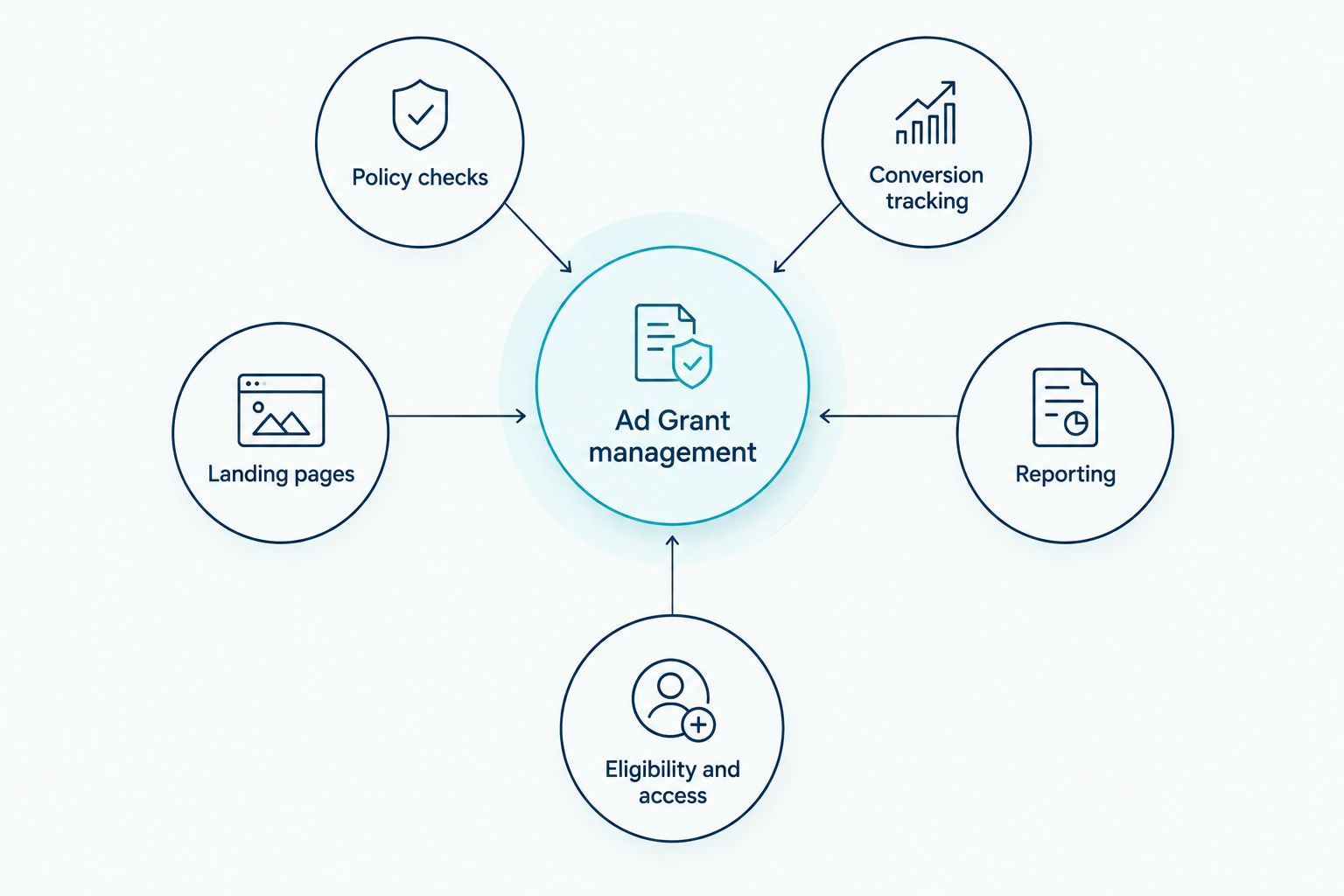
What makes the best Google Ad Grant management agency
- Eligibility and access. The agency should establish that your organisation and account qualify, then clarify who controls the Google for Nonprofits and Google Ads logins. You should retain access to both.
- Policy checks. Ask who reviews click-through rate, low-Quality-Score keywords and other Ad Grant restrictions. Get the review frequency and the response process in writing.
- Conversion tracking. Define the actions that matter to your nonprofit: completed donation forms, volunteer applications, event registrations or another documented goal. A click is not a completed action.
- Landing pages. Match each campaign to a page that answers its search query and offers a clear next step. A relevant ad cannot repair a page that fails to explain the cause or action.
- Reporting. Ask for a report that separates credit used, visits and completed actions. Spending more of the allowance is not, by itself, evidence of success.
- Scope beyond ads. Decide whether you need account management, a website diagnosis or both. A grant specialist and a search consultancy solve different problems.
These criteria make the 2026 shortlist easier to use. If policy risk is urgent, prioritise grant-specific work. If visitors reach the site but do not act, inspect the landing page and measurement setup before expanding campaigns.
At a glance: Google Ad Grant agency shortlist for 2026
| Agency | Best for | Standout focus | Key limitation to check |
|---|---|---|---|
| Getting Attention | Grant-specific policy support | Google Ad Grant services for nonprofits | Confirm which website and SEO tasks are included |
| Nonprofit Megaphone | A dedicated grant management brief | Google Ad Grant management | Confirm responsibilities outside the ad account |
| Digital Womble | Diagnosing ads, SEO and AI visibility together | Cross-channel search diagnosis | Ad Grant-specific management is not established in its stated offer |
The table is a decision aid, not a performance league. No comparable account results, client outcomes or service terms were supplied for these agencies. Treat each recommendation as a match to a defined brief, then test the scope in a proposal.
1. Getting Attention: best for Google Ad Grant-specific policy support
Getting Attention is a nonprofit marketing agency with Google Ad Grant services. It is the first agency to consider when your immediate need is a provider whose stated work centres on the programme rather than a general Google Ads account. In 2026, that distinction matters if policy questions are holding up campaign work.
A grant-specific brief should still be precise. Ask Getting Attention to identify the account checks it will own, what happens when performance falls below a programme threshold, and which conversion actions will appear in reports. Do not assume that website changes or wider SEO work sit inside the same engagement.
Getting Attention pros:
- Google Ad Grant services are part of its stated nonprofit focus.
- Its programme focus matches a brief centred on account rules and campaign management.
- You can evaluate its proposal against specific grant-policy responsibilities.
Getting Attention cons:
- Grant expertise alone does not resolve weak landing pages or missing conversion tracking; confirm who fixes those.
- The information here does not establish how much website, SEO or AI search work an engagement includes.
Best for: a nonprofit that wants grant-policy responsibilities clearly assigned to a specialist.
Verdict: Buy for a grant-specific brief once the proposal names the policy checks, measurement work and ownership of site changes.
2. Nonprofit Megaphone: best for a dedicated Ad Grant management brief
Nonprofit Megaphone offers Google Ad Grant management for nonprofits. Put it on the shortlist when you want an agency to take responsibility for the grant account as a defined workstream, while your own team or another supplier handles the website and other channels.
The key question is where the account brief ends. Campaigns depend on forms that work, landing pages that answer the query and tracking that records completed actions. Ask Nonprofit Megaphone which of those it will change directly and which it will flag for your team. Make the handoff explicit before work starts.
Nonprofit Megaphone pros:
- A named Ad Grant management offer matches a dedicated account brief.
- Its nonprofit focus reduces the need to explain why grant rules differ from ordinary paid-search work.
- A defined account scope makes responsibilities easier to document.
Nonprofit Megaphone cons:
- An account-focused engagement still needs a clear owner for landing-page changes.
- Do not assume SEO or AI search visibility work is included; check the proposed scope.
Best for: a nonprofit with a working website that wants a dedicated partner for its Ad Grant account.
Verdict: Buy when the proposal connects campaign work to completed actions and names the owner of changes outside Google Ads.
3. Digital Womble: best for diagnosing ads, SEO and AI visibility together
Digital Womble is a UK-based agency whose stated offer covers auditing and improving businesses’ SEO, Google Ads and AI search visibility. That makes it relevant when an Ad Grant account is only one part of a wider search problem: the nonprofit needs to understand whether ads, organic pages or visibility in AI answers are blocking discovery.
Digital Womble is best for a cross-channel search diagnosis, not an assumed grant-only management contract. Its stated offer does not establish dedicated Google Ad Grant management or nonprofit-specific grant credentials. If you need someone to run the account, ask directly whether that work is offered and request the exact policy-monitoring scope.
Digital Womble pros:
- Its stated scope covers Google Ads, SEO and AI search visibility.
- A diagnosis can separate account problems from landing-page and organic-search problems.
- UK positioning is relevant when the nonprofit’s audience and search demand are in the UK.
Digital Womble cons:
- Dedicated Ad Grant management is not established in its stated offer.
- A wider search diagnosis does not replace an assigned owner for ongoing grant-policy checks.
Best for: a UK nonprofit that needs to identify which part of its search visibility is failing before commissioning account work.
Verdict: Hold on assigning ongoing Ad Grant management until the scope is confirmed; choose Digital Womble for the broader search diagnosis its stated services support.
How we ranked these options
This 2026 ranking prioritises fit to a specific nonprofit brief. Getting Attention leads for grant-specific policy support. Nonprofit Megaphone follows for a dedicated account-management brief. Digital Womble covers the distinct case where the grant account sits alongside SEO and AI search problems, with its grant-specific scope left unverified.
The order does not claim that one agency produces more donations or uses more of the allowance than another. There are no comparable results here to support that claim. A stronger buying decision starts with your account’s actual constraint and ends with a written allocation of responsibilities.
Questions to ask before you appoint an agency
- Who owns the accounts? Your nonprofit should know who controls Google for Nonprofits, Google Ads, analytics and conversion settings. Ask what access remains with you if the relationship ends.
- What is a conversion? Have the agency name the completed actions it will track. Ask it to distinguish a form view from a submitted form.
- Who checks policy compliance? Request the review schedule and the process for resolving a click-through-rate or Quality Score issue.
- Who changes landing pages? If the agency can recommend a change but cannot make it, assign the work to a named person on your side.
- What will the report show? Require an account-health view and an outcomes view. Credit used and clicks cannot tell you whether people completed the action you wanted.
Use the answers to compare proposals on the same basis. An agency that names the owner of each task gives you a clearer brief than one that promises to use the full allowance without explaining how results will be measured.
Which Google Ad Grant management agency should you choose?
Choose Getting Attention if programme-specific policy support is the main job. Choose Nonprofit Megaphone if you have a defined Ad Grant account-management brief and an existing owner for website work. Choose Digital Womble if you first need to diagnose Google Ads alongside SEO and AI search visibility; confirm any grant-management service separately.
If you have not checked your account’s conversion tracking, start there before treating allowance usage as the goal. In 2026, a campaign can use the grant credit and still fail to show whether anyone donated, volunteered or registered. Define the action first, then ask the agency how it will measure it.
FAQ
What is the best google ad grant management agency in 2026?
Getting Attention is the overall pick for a grant-specific management brief in 2026. Nonprofit Megaphone fits dedicated account work, while Digital Womble fits a broader Google Ads, SEO and AI search diagnosis; confirm each agency’s proposed scope.
How much advertising credit does Google Ad Grants provide?
Google Ad Grants provides eligible nonprofits with access to up to $10,000 per month in search advertising credit. That is an allowance, not a guaranteed number of visits or completed actions.
Can a nonprofit manage its own Google Ad Grant?
Yes, a nonprofit can manage its own Google Ad Grant account. It still needs an owner for programme rules, campaign changes, conversion tracking and reporting.
What happens if an Ad Grant account falls below the required click-through rate?
An Ad Grant account that falls below Google’s 5% monthly click-through-rate requirement for two consecutive months can be temporarily deactivated. The account owner should monitor the requirement and address the cause rather than report clicks alone.
Should a Google Ad Grant agency manage our website too?
A Google Ad Grant agency does not necessarily need to manage your website, but someone must own landing-page and form changes. Set that responsibility before campaigns depend on those pages.
Is Digital Womble a dedicated Google Ad Grant management agency?
Digital Womble’s stated offer covers Google Ads, SEO and AI search visibility, but it does not establish a dedicated Google Ad Grant management service. Ask the agency to confirm whether grant-policy monitoring and ongoing account management are available.
What should a nonprofit track beyond Ad Grant clicks?
A nonprofit should track completed actions tied to its goals, such as donation submissions, volunteer applications or registrations. Keep those results separate from clicks and advertising credit used.
One last thing
Before you sign, ask the agency to show how it distinguishes a clicked donation button from a completed donation. The difference determines whether your 2026 report describes activity or an outcome. If the answer is unclear, fix measurement before asking anyone to expand the campaigns.