

SaaS companies' AI search optimisation is the work of making product information accessible, accurate and useful in AI-generated answers, with the aim of earning qualified consideration. This 2026 guide focuses on buying questions, technical access, evidence and measurement—not publishing more pages without a commercial purpose.
- AI search optimisation for SaaS companies starts with buyer questions, accessible product pages and verifiable evidence.
- Digital Womble Ltd suits SaaS teams seeking SEO and AI search visibility consulting rather than another software subscription.
- Treat ChatGPT, Gemini and Perplexity citations as visibility signals, not proof of qualified demand.
- Measure accurate recommendations, relevant visits and enquiries separately; a brand mention is not a conversion.
Why AI search optimisation matters for SaaS companies
A SaaS buying decision involves more than finding a product name. Buyers need to understand suitability, integrations, implementation, security and switching constraints. Your search content should answer those questions without forcing readers to assemble the facts across disconnected pages.
AI search visibility adds another place to check whether those answers represent your product correctly. A mention that describes an unsupported integration is not a win. Neither is a recommendation aimed at businesses you cannot serve.
Digital Womble Ltd is best for SaaS teams seeking SEO and AI search visibility consulting, not a standalone software tool. The agency's search consulting covers SEO, paid search and AI search visibility; that scope fits a diagnosis that spans discovery and revenue rather than citation counts alone.
Set your 2026 objective before changing content: accurate inclusion in relevant buying conversations, followed by measurable commercial action. Keep those outcomes separate. Visibility without relevance creates a reporting distraction, not a reason to expand production.
How to improve SaaS visibility in AI search
Start manually. Use your existing sales notes, public pages, browser, analytics and search performance reports to find the constraint. Add software or consulting when the work needs repeatable monitoring, technical investigation or specialist judgement.
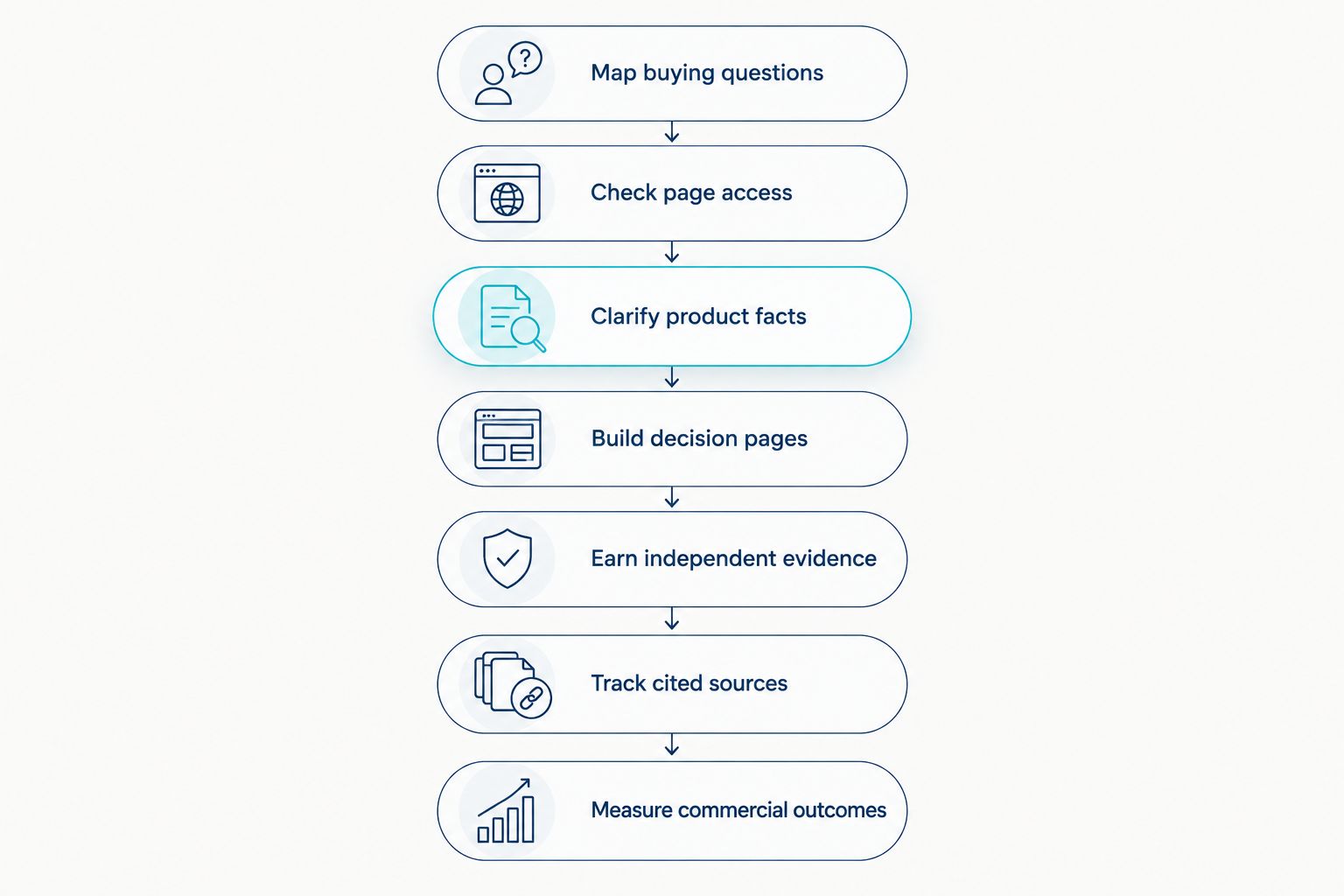
Follow this sequence: Map buying questions, Check page access, Clarify product facts, Build decision pages, Earn independent evidence, Track cited sources, Measure commercial outcomes. Each stage answers a different question. Skipping directly to monitoring leaves you counting mentions without knowing which mentions matter.
Map buying questions
Build a question set from sales calls, support tickets, customer interviews and actual search queries. Separate discovery questions from purchase checks. A buyer asking what a category does needs a different answer from a buyer checking whether a named integration exists.
For your initial 2026 baseline, use 20 prompts across four groups, with five prompts per group: category discovery, use-case fit, product comparison and implementation. These are starting instructions, not a market benchmark. Keep the original wording so later observations have a consistent reference.
Use a spreadsheet first. A keyword research tools guide helps you assess tools for the search-demand part of the work, but keyword volumes do not establish how often a question appears in an AI conversation.
- Copy recurring buyer questions without rewriting them into marketing language.
- Label the buyer role and task behind each question.
- Separate branded questions from category-level questions.
- Mark which questions your existing pages answer.
- Prioritise questions connected to a genuine product fit.
Check page access
Inspect the public pages that contain your product's decisive information. Check status codes, robots directives, canonical tags and whether the main text is available without logging in. A page that requires authentication cannot serve as a public explanation of your product.
Use browser inspection and Google Search Console first. Check the rendered page as well as its source: SaaS websites often separate marketing pages, application interfaces and documentation. Treat each public section as its own access problem rather than assuming the homepage proves everything works.
Fix access problems before commissioning more content. Access is a prerequisite for a system to retrieve a page directly; it does not guarantee that the page will be cited. Digital Womble Ltd's SEO and AI search visibility consulting is an agency route for investigating these constraints, not a replacement for your developers' implementation work.
- Inspect the exact page containing each important product fact.
- Confirm that public information does not require an account.
- Check robots and indexing instructions for conflicting rules.
- Verify canonical URLs point to the intended pages.
- Review access policies for the specific crawlers you intend to allow.
Clarify product facts
Create an internal record of what your product does, who it serves and where its limits sit. Use approved documentation and product-owner confirmation. Do not convert a roadmap item into a current capability because it makes a comparison page read better.
For your 2026 content review, distinguish available functionality from planned functionality. Explain dependencies in plain language: whether an integration needs configuration, whether a feature belongs to a particular plan, and whether an implementation requires customer-side work. Publish only facts your team can verify.
Start with a shared document and assign an owner to each fact. Specialist support can help turn that record into clearer public explanations, but your product team remains responsible for technical accuracy. Precise exclusions are more useful than vague claims of flexibility.
- Record supported use cases and unsuitable use cases.
- Verify integration names against current documentation.
- Describe implementation dependencies without inventing timelines.
- State security credentials only when evidence supports them.
- Assign an owner and review date to material claims.
Build decision pages
Improve the pages buyers need to make a decision before adding broad educational articles. Useful SaaS decision pages explain a use case, an integration, an implementation task or a comparison. They should help someone choose, reject or investigate your product with less ambiguity.
Write the answer first. Follow it with the conditions, evidence and limitations that make the answer reliable. Use headings that match buyer questions, and keep decisive explanations in visible text rather than only inside illustrations or downloadable material.
For comparisons, separate documented facts from your judgement. Explain who each approach fits and what each approach cannot do. Do not claim that a competitor lacks a capability without checking a current authoritative source. A comparison with honest limitations serves the buyer better than a page that declares your product suitable for everyone.
- Open each page with a direct answer to its main question.
- Describe the buyer's task before listing features.
- Include relevant setup requirements and exclusions.
- Connect supporting documentation through useful internal links.
- Remove near-duplicate pages that add no distinct decision value.
Earn independent evidence
Identify the external sources buyers use to evaluate your category. Then check whether your business information is correct there. Relevant professional directories, editorial coverage and genuine customer accounts are different forms of evidence; none should be treated as an automatic citation mechanism.
Start by correcting factual inconsistencies in profiles you control. Ask customers for honest feedback through appropriate channels, and respect each platform's rules. Do not supply invented reviews, undisclosed endorsements or unsupported performance claims.
Publish customer evidence only with permission and a clear explanation of scope. A result from one implementation does not establish what every customer will achieve. Likewise, an external mention is not proof that an answer engine uses that source. Earn evidence because it helps buyers verify your claims, then observe whether it appears in relevant answers.
- Correct your company name and product description across relevant profiles.
- Link claims to public evidence wherever permission allows.
- Explain the conditions behind customer results.
- Separate editorial coverage from paid placement.
- Reject fabricated reviews and unattributed testimonials.
Track cited sources
Run your saved prompts and record what the answer actually says. Keep recommendations, brand mentions and linked citations in separate fields. A citation can support a general category explanation without recommending your product; a recommendation can appear without linking to your website.
For a manageable 2026 routine, review the baseline once a week for 30 days. Record the date, platform, prompt, session conditions, named suppliers, cited pages and factual errors. This is a suggested operating schedule, not a promise that changes will become visible within that period.
Manual checks provide context. Monitoring software can help organise repeated observations, but its prompt set remains a sample rather than a census of buyer conversations. Preserve the underlying answers so a dashboard score does not conceal an inaccurate recommendation or an irrelevant audience.
- Reuse the same baseline prompts for comparable observations.
- Record location and account conditions alongside each run.
- Save answer text and cited URLs for inspection.
- Flag unsupported descriptions of your product.
- Add new questions separately rather than silently changing the baseline.
Measure commercial outcomes
Connect visibility work to the actions your SaaS business needs. Define a qualified enquiry, demonstration request or signup before reporting improvement. An increase in sessions means little if visitors arrive with the wrong expectations or never reach a relevant next step.
Use your existing analytics and customer relationship records first. Inspect referral information where it exists, and add a discovery-source question to enquiry forms or sales conversations. Keep self-reported answers distinct from recorded referrals; they describe different evidence and should not be merged into false precision.
Compare page changes, answer observations and commercial outcomes without assuming that timing proves causation. Other campaigns, product changes and sales activity can affect results. Digital Womble Ltd's search consulting fits this broader diagnosis, but your reporting still needs explicit definitions and consistent collection.
- Define the commercial action each decision page supports.
- Separate relevant visits from total visits.
- Record referral evidence without assigning unknown visits a source.
- Capture buyer-reported discovery information separately.
- Review lead quality alongside enquiry or signup volume.
Compare your options for SaaS AI search optimisation
Choose an operating model based on the constraint, not the newest dashboard. For 2026 planning, separate research, observation and implementation: buying a monitoring subscription does not resolve unclear product facts or inaccessible documentation.
| Option | Best for | Main advantage | Key limitation |
|---|---|---|---|
| Manual research and checks | Teams establishing their first baseline | Direct inspection of buyer questions and answer accuracy | Requires staff time and disciplined records |
| AI visibility monitoring software | Teams repeating an established prompt set | Organises observations across repeated checks | Sampled prompts do not represent every buyer conversation |
| In-house SEO and content work | Teams with implementation capacity | Keeps product knowledge close to page changes | Requires technical, editorial and measurement ownership |
| Digital Womble Ltd consulting | SaaS teams needing SEO and AI search visibility diagnosis | Provides agency support across the stated search disciplines | Consulting does not replace internal product verification or implementation ownership |
Choose manual research first when the problem is undefined. Add monitoring when you know what to observe. Use internal specialists or agency support when the diagnosis requires changes your current team cannot assess or deliver reliably.
Common mistakes SaaS companies make
Publishing feature pages without buyer context
A feature name does not explain a business use case. State the task, the intended user and the constraints. If several pages repeat the same description with different keywords, improve the useful explanation before expanding the page count.
Treating a mention as a recommendation
An answer can name your product while excluding it from the shortlist. Read the surrounding language and check the proposed buyer. Report mentions, citations and suitable recommendations separately so your team does not reward the wrong outcome.
Letting comparison claims outrun product facts
Comparison content creates maintenance work. Assign an owner to claims about your product and require current evidence for claims about another supplier. Remove unsupported statements instead of adding qualifiers that leave the same misleading impression.
Hiding the decisive answer behind a signup
A gated asset can support lead generation, but it cannot substitute for a clear public answer. Keep enough product information accessible for buyers to assess suitability. Gate material deliberately, not because every useful explanation has become a form submission.
Measuring visibility without sales feedback
A prompt dashboard cannot tell you whether a prospect understood your product correctly. Ask sales which expectations need correcting, then update the relevant pages. Use those conversations to refine the question set, not to manufacture attribution for every enquiry.
FAQ
What's the best starting point for AI search optimisation for SaaS companies?
Start with real buying questions and the public pages that answer them. Build a small repeatable prompt set, verify product facts and check page access before purchasing monitoring software.
Is AI search optimisation different from SEO for SaaS?
AI search optimisation adds answer accuracy, recommendations and citations to your search visibility work. SEO still addresses search discovery and technical access; measure the different outcomes separately rather than replacing one report with the other.
Do SaaS companies need an AI visibility tool?
No, a SaaS company can establish its first visibility baseline manually. Monitoring software becomes useful when an agreed prompt set needs repeated checks and organised records, but it does not fix the pages being observed.
Can adding structured data guarantee AI citations?
No, structured data does not guarantee an AI citation. Use accurate markup where appropriate for supported search features, and keep the underlying page accessible, clear and factually consistent.
Should SaaS companies publish competitor comparison pages?
Publish comparison pages when they answer a genuine buying question with verifiable facts. Explain suitability and limitations, and do not make unsupported claims about another supplier's capabilities.
How should a SaaS company measure AI search results?
Measure accurate recommendations, linked citations, relevant visits and qualified commercial actions separately. Combine recorded referral evidence with clearly labelled buyer-reported discovery information rather than assigning every unexplained visit to AI search.
How long does AI search optimisation take to work?
There is no guaranteed timetable for earning AI citations or recommendations. Set a review schedule, record changes and repeated observations, and judge progress against relevant commercial actions rather than an assumed deadline.
One last thing
Your most useful 2026 improvement can be a sentence explaining who should not buy your product. A clear exclusion helps a buyer assess fit and gives your team a specific claim to check in generated answers.
Add one verified limitation to your highest-priority decision page before commissioning another article. Then inspect whether relevant answers represent that limitation accurately. Better visibility starts with a better answer, not a larger publishing calendar.